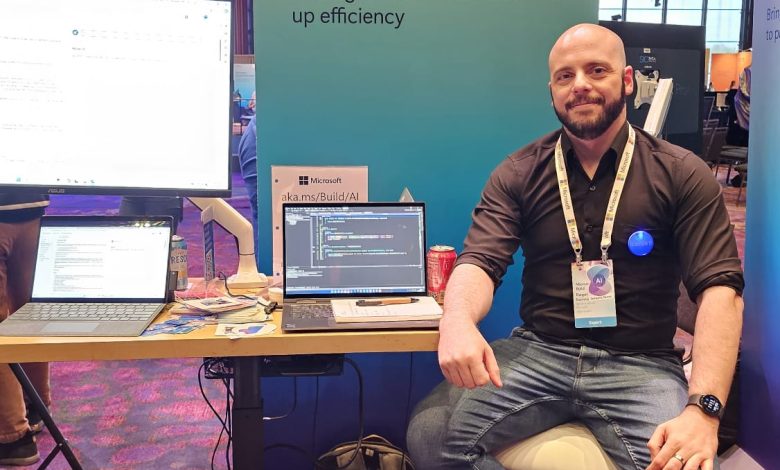
He helps teams use agents in production by making framework behavior stable even as model vendors change their rules.
A modern agent can write code, call tools, and stream answers in real time. The part that breaks is expectation. An SDK update lands. A provider tweaks a payload. A carefully tuned integration starts failing in small, expensive ways. Roger Barreto works on the layer that prevents that drift. He works as a Principal Software Architect with roughly twenty-five years of experience and a track record in platform work where reliability matters. At Microsoft, he has helped shape open source AI frameworks that developers use to orchestrate models and build agents at scale.
“I spend a lot of time making behavior clearly boring,” Barreto says. “Predictable boring is what lets people trust a platform.”
Building frameworks from the first commit
Barreto joined Microsoft’s Semantic Kernel effort early and worked on its .NET as the project took shape. Later, in 2025, he was part of the initial engineering group behind the Microsoft Agent Framework, a toolkit aimed at making agent development more structured for real applications.
These roles forced decisions about streaming, hooks, plugins, and safe extension points, the kinds of choices that become defaults for the wider ecosystem.
“A framework is a set of promises,” he says. “If the promises are unclear, every team rebuilds the same glue.”
He contributed to primitives that support streaming output and plugin extensibility. He also wrote architectural decision records so the reasoning behind key choices stays visible as the community grows.
Writing down the why so the project can grow
Barreto treats decision records as part of the product.
“Open source grows fast,” he says. “If you do not capture tradeoffs, you end up in circular arguments.”
His approach is to document constraints and intent, then let the code evolve inside those boundaries. AI frameworks change quickly. Without a written rationale, projects lose coherence.
Making many providers feel usable
AI orchestration has no single rulebook. Teams move between vendors for cost, governance, features, and performance, and every move creates friction.
Barreto has worked on integrations that let developers switch providers without rewriting their application, including OpenAI, Anthropic, Gemini, Bedrock, and Azure AI Inference, plus other community options.
He led an eight-step transition to the V2 OpenAI SDK, designed to reduce breaking changes for downstream users.
“When the foundation shifts, you stage the change and watch what happens,” he says.
During the Agent Framework launch, he wrote the integration package that enables Anthropic models to run within the framework via Azure Foundry, and then produced a library of tool examples that show how agents can interact with external capabilities such as search, file retrieval, and enterprise sources.
Before Microsoft, he learned to build for real constraints
Barreto’s platform mindset was shaped in Brazil, long before AI became a daily topic. Early in his career he shipped production code in an early stage startup, then joined Accenture’s Rio team and built platforms for oil and telecom customers.
He later worked at Cast IT Group, where he reengineered a statewide education system for Rio de Janeiro built to handle scoring at scale and heavy classroom workflows under extreme concurrency. He also built a phonetic search engine tailored to Brazilian Portuguese, where speed and accuracy had to coexist without a usable ready made option.
At Go2web, he designed a public school enrollment system that could function offline, capturing student information in schools with unreliable internet and synchronizing safely when connectivity returned.
“When the network is unreliable, the software has to protect truth,” he says.
He also created an internal automation framework at Wooza that later became the default across the company. Later, he contributed early specification work for Microsoft Syntex eSignature, which shipped as a Microsoft 365 feature for SharePoint and Word.
Founding changed how he thinks about tradeoffs
Barreto worked as founding engineer at Hostintown and owned product direction as well as architecture.
“Founding forces you to feel every compromise,” he says. “You learn what debt really costs.”
A Dublin base and an open source footprint
Barreto moved to Ireland in 2019 after being hired by Verizon Connect under a Critical Skills visa. He worked as a Senior Software Engineer responsible for the gateway platform that abstracts communications for a fleet management product. By the end of his second year there, he was recognized as a Solution Architect responsible for microservices integrations with the Mobile Gateway. He also holds dual citizenship, Brazilian and Portuguese.
He joined Microsoft in 2021. He is based in Dublin and works in English, with Portuguese as his first language. He has also spoken about Semantic Kernel in conference settings, including Update Conference 2024 and MI TechCon 2025.
Mentorship is part of the architecture
Barreto often takes on mentorship and team formation.
“Code quality is habits,” he says. “Teams need shared discipline.”
He focuses on review culture, naming consistency, and patterns that reduce surprises for maintainers who inherit the code.
Building at the Speed of Thought
Barreto also points to a shift he calls “Building at the Speed of Thought,” where agent-driven tooling changes what software engineers can do and how quickly they can do it. He wants to be positioned as someone who is prepared for that change and who builds the infrastructure that keeps fast progress dependable.
Barreto describes his goals in terms of impact and learning. He wants work on the frontier of new knowledge, products he believes in, and platforms that scale.
“I want to build the layer that lets other people build,” he says. “That is the work that lasts.”