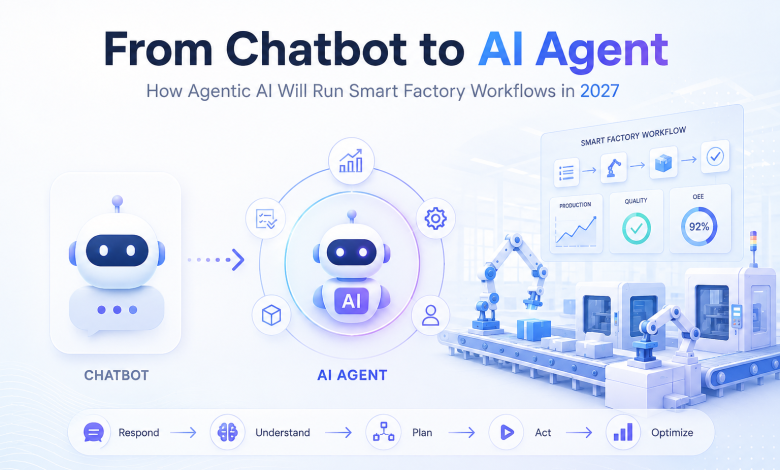
For the past few years, manufacturers have experimented with AI, largely through conversational AI in manufacturing that answers questions, surfaces reports and helps operators query data without writing SQL. Useful, certainly. But not transformative. What is beginning to take hold in 2027 is something structurally different. Agentic AI in manufacturing does not wait to be asked. It monitors, decides and acts continuously and across interconnected systems. For manufacturers, this is not an incremental upgrade. It is a change in who, or what, is running the operational loop.
Why Chatbots Were Always a Stopgap for Manufacturing
A factory operations chatbot is fundamentally reactive. It processes a question, retrieves relevant information and returns an answer. In a manufacturing context, that means an operator asks about a temperature anomaly and gets a report. Valuable in a low-stakes, information-retrieval sense. But on a production line where conditions change in seconds, waiting for a human to notice something, formulate a query and act on the result is a structural bottleneck.
The real challenge in factory operations is execution speed. The ability to close the loop between sensing a condition and responding to it before it cascades into downtime or quality loss.
AI factory assistants in their chatbot form cannot close that loop. Agents can.
What Agentic AI Actually Does Differently
The distinction between an AI agent and a conversational assistant is not just about automation. It is about the scope of what the system can reason about and act upon.
Multi-Step Reasoning Across Systems
Unlike earlier generative AI agents for factory operations that were confined to single-turn responses, today’s agents evaluate a situation across multiple variables current production schedule, maintenance history, inventory levels, supplier lead times and plan a sequence of actions accordingly. When a bearing temperature exceeds a threshold, the agent does not simply flag it. It checks whether the relevant machine can be paused without disrupting downstream operations, adjusts the schedule if it can, generates a maintenance work order and notifies the right technician. That entire sequence happens autonomously, without a human initiating any single step.
Live Telemetry as a Trigger, Not Just a Dashboard
Traditional monitoring systems display data. Agentic systems consume it as operational input. Sensors tracking vibration, cycle time, temperature and pressure feed directly into the agent’s reasoning layer. Anomalies become triggers for action, not just alerts for human review. The practical implication is a system that responds to emerging problems in near real time, before they become failures, which is precisely what separates AI-driven production workflows from traditional monitoring dashboards.
Integration Across Disconnected Platforms
One of the persistent friction points in industrial AI has been data fragmentation. MES, ERP, CMMS and QMS systems often operate in silos and connecting them has historically required expensive, time-consuming custom integrations. The emergence of the Model Context Protocol addresses this directly. Acting as a universal connector, it allows agents to interface with existing manufacturing and enterprise systems without bespoke development work, making it practical for any AI operations platform for manufacturing teams are already running to support agent deployment without rebuilding infrastructure from scratch.
The Smart Factory Floor in 2027: What Autonomous Operations Look Like
Understanding how conversational AI in manufacturing will automate smart factories in 2027 is best approached through three operational areas where deployment is already most advanced. Each one reflects a distinct shift from reactive monitoring to autonomous execution.
Autonomous Production Scheduling
- Agents ingest live MES and supply chain signals to detect variability before it disrupts output
- Production plans are continuously rebalanced within predefined constraints, without planner intervention
- The system accounts for supplier delays, machine downtime and demand shifts simultaneously
- The outcome is manufacturing workflow with automation AI that operates on current data, not yesterday’s schedule
Predictive and Reactive Maintenance in One Loop
- Failure likelihood is identified using machine learning factory automation techniques refined over the past decade
- Agents go beyond prediction by initiating the response automatically
- Work orders are generated, parts availability is confirmed and technician schedules are updated without manual input
- The human role shifts from reactive firefighting to approving actions the agent has already staged
Supply Chain Orchestration Under Pressure
- Agents monitor contract terms and flag renegotiation triggers based on live market signals
- Logistics routes are adjusted in real time when disruptions or tariff changes occur
- Supplier instability is tracked continuously, not reviewed quarterly
- Procurement teams are freed to focus on strategic relationships rather than transactional coordination
How Manufacturers Are Measuring the Value of Agentic AI
The pace of adoption in manufacturing reflects genuine operational urgency. These are not projections built on optimism. They are signals of a structural shift already underway.
On market growth:
- $8.5B to $45B projected expansion of the global agentic AI market between 2026 and 2030
- 24% of manufacturers will have implemented agentic AI by 2027, up from just 6% in 2025
- 82% of manufacturing sector leaders now classify AI as a primary driver of growth
On returns:
- 74% of organisations deploying AI agents report positive ROI within the first twelve months
- 39% report doubled throughput in targeted workflows where agents have been given clear scope
- 44% of manufacturers are already reporting measurable returns from current AI adoption efforts
The gains are concentrated in operations where agents have been assigned well-defined problems. That pattern explains why enterprise AI automation tool procurement has accelerated so sharply. Manufacturing leadership now is deciding where to deploy it first.
How Manufacturers Can Successfully Deploy Agentic AI
What Separates Early Wins From Stalled Projects
Deployments that scale share three consistent traits.
Defined scope: Agents perform best against a specific bottleneck. Choosing the right factory automation AI platform matters less than being precise about what problem it is solving first.
Data readiness: Agent output quality is a direct function of input data quality. Operations investing in proper DataOps architecture before deployment consistently report fewer erroneous recommendations.
Governance by design: The move toward industrial intelligence platforms, where agents, data and execution systems coexist, is what makes it possible to set autonomy boundaries before something unexpected forces a revision.
This is why many organisations start with focused AI agent deployments before expanding into more autonomous workflows. Platforms such as GetMyAI enable teams to build AI agents around specific business processes, knowledge bases and operational workflows without extensive development effort.
How the Human Role Is Changing
The displacement concern misframes the shift. Agents are replacing reactive, procedural tasks: alert triaging, schedule updates, maintenance logging. What remains is more consequential. Operators and planners are increasingly in the business of supervising decisions, calibrating guardrails and managing outcomes rather than executing routine steps. The role is not shrinking. It is moving upstream.
Conclusion
The shift from reactive tools to autonomous agents is already underway in manufacturing and the stakes are real. Agents that reason across systems and act on live data represent a genuine change in AI-powered factory operations. Projects without clear governance, strong data foundations and defined scope are failing at a notable rate. The manufacturers who will look back on 2027 as a turning point are those treating agentic AI as an operational discipline, not a technology investment.