Artificial intelligence is changing almost every industry it touches. But there is one area where the consequences of handing greater decision-making power to machines are potentially far more profound: warfare.
AI can process enormous amounts of information, identify patterns, track objects and support decisions at speeds humans cannot match. Applied to military systems, these capabilities raise a difficult question: how much control should we be prepared to hand over to machines?
I explored that question through fiction while writing my geopolitical techno-thriller, An Unlikely War. The novel imagines a world in which a new generation of extraordinarily advanced AI-enabled weapons changes the balance of military power almost overnight.
The technology in the novel is fictional. The questions behind it increasingly are not.
From Automated Weapons to Autonomous Decisions
Military technology has incorporated automation for decades. What makes today’s discussion different is the increasing ability of systems to use sensors, software and artificial intelligence to perform tasks that previously required human judgement.
Autonomy is not simply an on/off switch. There is an important difference between a weapon that follows predetermined instructions, one that automatically responds to certain threats, and a system capable of selecting and engaging targets after activation.
The International Committee of the Red Cross (ICRC) describes autonomous weapon systems as systems that, once activated, can select and engage one or more targets without further human intervention. SIPRI similarly notes that the international policy conversation commonly characterizes autonomous weapon systems in terms of selecting and engaging targets without human intervention after activation.
That distinction matters because the further decision-making moves from the human operator toward the machine, the more difficult the legal, ethical and operational questions become.
The Advantage of Machine Speed
One of AI’s greatest military advantages could also become one of its greatest risks: speed.
A human operator must receive information, interpret it, determine whether it is reliable, consider possible consequences and decide how to respond. AI-enabled systems can compress parts of that process by processing sensor and intelligence data rapidly and supporting targeting and planning decisions.
SIPRI’s 2026 Yearbook notes that artificial intelligence-assisted targeting, autonomous weapon systems and swarms of uncrewed aerial vehicles are now being routinely used in armed conflicts, while also highlighting ethical and legal questions concerning human oversight.
The danger is not necessarily that artificial intelligence suddenly becomes conscious or decides to start a war. A more immediate concern is that increasingly automated systems may compress decision time and increase the difficulty of meaningful human assessment and intervention.
Does AI Need to Think Like Us?
When people hear the term “AI weapon”, science fiction can create a misleading image of a machine that thinks and reasons exactly like a human being. That is not necessarily required.
A military AI does not need consciousness to be extraordinarily capable. It may only need to perform a sequence of specialised tasks extremely well: detect, analyse, classify, track, predict and respond.
Combine those abilities with advanced sensors, high-speed communications and sophisticated weapons, and the result could be systems operating at a pace that would have been unimaginable to previous generations.
The real question therefore may not be whether machines will one day “think” like soldiers. It may be how much authority humans are prepared to give machines that do not.
The Human-Control Problem
Human control sits at the centre of the current debate. The ICRC argues that loss of human control and judgement in the use of force raises humanitarian, legal and ethical concerns, and recommends requirements for human-machine interaction, including effective human supervision and timely intervention and deactivation.
The issue is not viewed identically by every institution or government. The United States Department of Defense, for example, requires autonomous and semi-autonomous weapon systems to be designed so commanders and operators can exercise appropriate levels of human judgment over the use of force, alongside testing, reliability and legal requirements.
That leads to one of the most difficult questions surrounding military AI: who should make the final decision to use lethal force, and how should responsibility be allocated when AI-enabled systems contribute to that decision?
Increasing autonomy does not make questions of human responsibility disappear. In many ways, it makes determining responsibility more complicated.
Imagining the Next Generation of Warfare
These questions became central to the technological world I created in An Unlikely War.
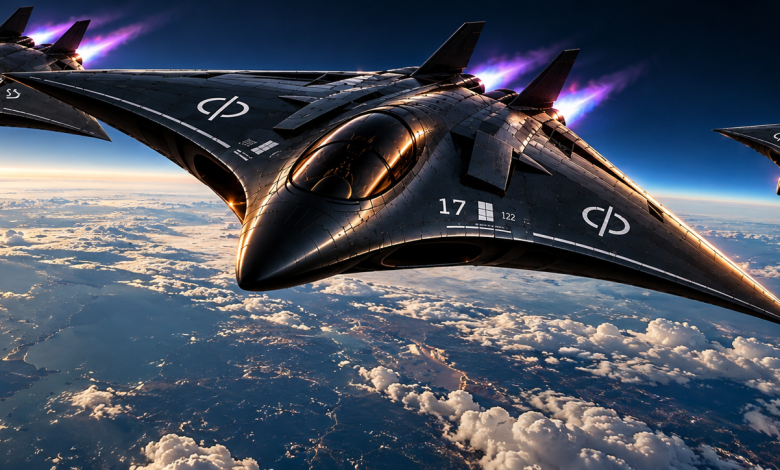
The novel introduces the Omega Manta, an advanced fictional combat aircraft designed around extraordinary speed, stealth and AI-enabled warfare. Its companion weapon is the AISJ, an advanced intelligent missile capable of operating at extreme speed and pursuing targets using sophisticated autonomous technology.
Neither system exists. They are deliberately speculative. But when developing them for the novel, I wanted to explore a serious question: what happens when a weapon becomes so fast, intelligent and capable that conventional military systems can no longer effectively respond to it?
The Omega Manta represents more than a futuristic aircraft within the story. It represents technological imbalance.
When Technology Changes the Balance of Power
Military history repeatedly demonstrates that technological advantages can alter strategy. Artificial intelligence adds another dimension because improvements may not depend solely upon building a faster aircraft or a more powerful missile.
The advantage may come from information. AI-enabled decision-support systems are already part of military-targeting discussions; SIPRI’s 2025 analysis examines how these systems can shape human roles in decisions about the use of force and create risks of unintended harm.
That raises another question explored in An Unlikely War: what happens when opponents cannot counter a new technology using existing weapons? They adapt, and that can create pressure to develop competing systems.
International discussions have been underway for more than a decade. SIPRI notes that autonomous weapons have been discussed under the Convention on Certain Conventional Weapons framework since 2014, with continuing debate over definitions, regulation and the role of human control.
Could Humans Become the Slowest Part of the System?
There is an uncomfortable paradox at the centre of autonomous warfare. We want humans to remain involved in critical decisions, but humans are also slower than machines.
As military systems become faster and increasingly interconnected, planners may face tension between preserving meaningful human judgement and responding quickly enough to an adversary’s systems.
This is not a settled technological or policy outcome. It is precisely why questions of predictability, explainability, traceability, supervision and human judgement feature prominently in current military-AI governance discussions.
Fiction as a Testing Ground for Real Questions
Science fiction and techno-thrillers allow us to take emerging technologies and ask what might happen if they develop far beyond their present capabilities. That was one of the reasons I wrote An Unlikely War.
The novel is entertainment first — a geopolitical thriller involving international conflict, political decisions and advanced weapons technology. But beneath the fictional conflict are questions that increasingly belong to the real world.
What happens when artificial intelligence changes the balance of military power? Can humans remain meaningfully in control of weapons operating at extreme speed? What happens when an autonomous system makes the wrong decision? And just because technology allows us to automate a decision, does that mean we should?
The Future Is Still a Human Decision
The most important question surrounding autonomous weapons may ultimately have little to do with computing power. It is about responsibility.
Artificial intelligence will continue becoming more capable, while military institutions and international bodies continue debating how autonomy should be governed. In 2026, those discussions remain active in forums dealing with autonomous weapons and military AI.
The fictional world of An Unlikely War takes today’s technological trajectory and pushes it considerably further. The Omega Manta and AISJ belong to fiction. The questions they represent do not.
As AI becomes more deeply integrated into military systems, the challenge may not simply be determining what machines are capable of doing. It may be deciding what humans should allow them to do.
References and Further Reading
International Committee of the Red Cross, “ICRC Position on Autonomous Weapon Systems.”
SIPRI (2026), “Artificial intelligence and international peace and security,” SIPRI Yearbook 2026.
SIPRI (2026), “Global trends in armed conflict,” SIPRI Yearbook 2026.
SIPRI, “Autonomy in weapon systems.”
U.S. Department of Defense (2023), DoD Directive 3000.09, “Autonomy in Weapon Systems.”
About the Author
Tony Rebeiro is the author of An Unlikely War, a geopolitical techno-thriller exploring artificial intelligence, advanced weapons technology, international conflict and the consequences of a sudden shift in military power.
An Unlikely War is available in eBook, paperback, hardcover and audiobook formats through international book platforms.
Official website: anunlikelywar.com