For most of the past decade, conversational AI has lived inside a text box. The model writes, the user reads, and the experience moves at the speed of typing. That is changing quickly, and the shift from reading a reply to watching someone answer you has consequences that go well beyond a nicer interface.
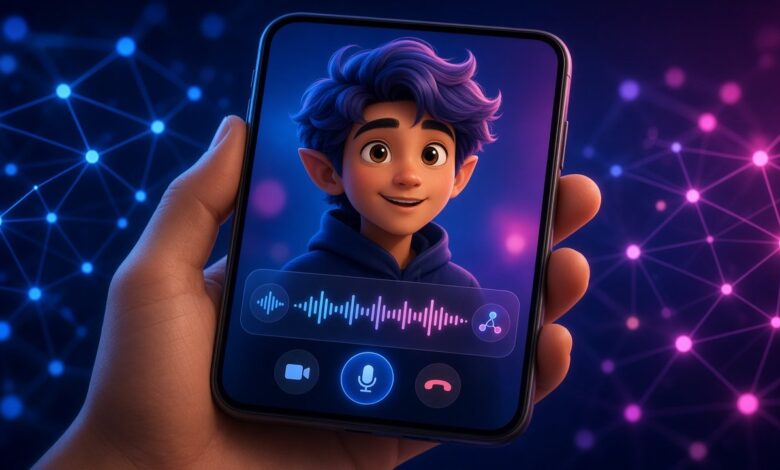
The newest consumer AI products let people talk face to face with a character in real time. Instead of a chat log, the user sees a face, hears a voice, and can interrupt mid-sentence the way they would on any other call. For product teams, this turns a familiar chatbot problem into something closer to live broadcasting, with all the technical, commercial, and ethical weight that implies.
From Messages to Moments: Why Video Is the Next Interface
Text chat is forgiving because it is asynchronous. A model can take two or three seconds to respond and users barely notice, because they are used to waiting for a message bubble. A call works differently: silence reads as hesitation, and a delayed reaction breaks the sense that someone is actually there.
This is why search behaviour around the category is shifting from “chat” to “call”. People now ask whether they can have an AI FaceTime conversation, meaning a face-to-face exchange with a character rather than a voice assistant reading out answers. The expectation is not a talking chatbot, but a presence that looks back at you and responds to what you just said.
That expectation reshapes the product brief. A text companion is judged on what it says, while a video companion is also judged on when it says it, how its face moves, and whether it lets you cut in. Those are three new failure modes that most chatbot teams have never had to design for.
The Latency Budget Is the Product
In live video, every stage of the pipeline competes for the same few hundred milliseconds. Speech has to be recognised, the language model has to start generating, a voice has to be synthesised, and a face has to be animated in sync with that voice. Each step can be fast on its own, but a conversation only feels natural if the whole chain is.
The practical answer is streaming everywhere. Teams start speaking the first words of a reply before the full response exists, and they render the face from the audio as it arrives rather than waiting for a finished clip. Browser standards such as WebRTC make low-latency media delivery possible without plugins, which is why so many of these experiences now run in an ordinary browser tab.
The hardest part is turn-taking, not raw speed. A good real-time AI avatar has to detect when the user starts talking, stop its own sentence gracefully, and carry the interruption into its next reply. Getting this wrong makes even a fast system feel robotic, because people interrupt each other constantly and expect to be heard when they do.
Memory Turns a Demo Into a Relationship With a Story
A single impressive call is a demo; a character that remembers last week’s conversation is a product. Video raises the stakes here, because forgetting a name on camera feels far more jarring than forgetting it in text. Users treat a face as a continuous identity in a way they rarely treat a chat window.
The most effective pattern pairs automatic memory with memory the user controls directly. Letting people pin key facts, such as the setting of an ongoing story or how they want to be addressed, reduces the guesswork for the model and gives users a sense of ownership. It also makes behaviour easier to debug, because the team can see what the character was told to keep.
Memory is also what connects calls to storytelling. When a character can step out of an interactive video story and phone the user in the middle of a scene, the narrative becomes something the audience participates in rather than watches. That blend of episode and conversation is a new format, and it depends entirely on continuity.
Companionship Is the Use Case, and It Deserves Care
It would be dishonest to discuss this category without naming its strongest demand signal: companionship. Searches for an AI boyfriend call or AI girlfriend video chat have grown alongside the technology, and many users describe these characters as a low-pressure way to unwind, practise conversation, or enjoy an ongoing romance story. That demand is real, and product teams should design for it rather than pretend it is incidental.
Research suggests that design choices matter less than usage patterns. A four-week randomised study from the MIT Media Lab with nearly 1,000 participants found that text and voice modes did not, on their own, change outcomes such as loneliness. Participants who chose to use the chatbot more heavily, however, showed consistently worse outcomes, including greater emotional dependence.
For builders, the lesson is to treat engagement as something to manage rather than maximise. Sensible defaults include clear labelling that the character is fictional, keeping the user’s camera off unless they choose to share it, and transparent pricing for call time. Age gates and firm content boundaries are not optional extras in a format this immersive.
Original Characters Are a Strategic Choice, Not Just a Legal One
Many early character platforms leaned on fan fiction and recognisable faces. In live video, that approach becomes risky very quickly, because a moving, speaking likeness of a real person or a licensed character raises likeness, copyright, and deepfake concerns at the same time. The safer and more durable path is building original characters with their own look, voice, and backstory.
Original characters also give companies something they can actually own. A cast of characters with consistent personalities can carry across text, voice, video calls, and short-form story episodes, building recognition the way a television series does. That turns a model wrapper into an entertainment property, which is a far more defensible position as underlying models commoditise.
This is the approach we have taken at Prelulu, where every character is original and users can create their own. The broader point applies to any team in this space: the character is the brand, so it should not be borrowed.
The Economics of Every Minute
Text generation is cheap enough that many products offer it free. Real-time video is different, because each minute involves speech recognition, language generation, voice synthesis, and face rendering running continuously. Unit economics therefore look more like a streaming or telecoms business than a typical software subscription.
That cost structure is why many products separate free text chat from metered calls. It aligns price with compute, lets curious users try the format before paying, and avoids a flat plan that heavy users would make unprofitable. The trade-off is that pricing needs to be explained clearly, or users will feel nickel-and-dimed at exactly the moment they are most engaged.
Over time, inference costs will fall and on-device processing will take on more of the pipeline. Until then, the winners are likely to be teams that treat latency, cost, and experience as a single optimisation problem rather than three separate ones.
What This Means for Enterprise Teams
Although companionship is driving consumer adoption, the same stack is relevant to businesses. Customer service, onboarding, language practice, sales training, and patient intake all benefit from a face that can listen and respond in real time. The lessons consumer platforms are learning now about latency, memory, and trust will transfer directly.
Enterprise buyers should watch three signals in particular. First, how well a system handles interruptions, since that is the clearest test of real-time quality. Second, whether memory is inspectable and controllable, and third, whether the provider has a credible policy on likeness, consent, and data retention.
The move from text to live video is not simply a new output format for language models. It changes what users expect from AI, how products are priced, and where the ethical lines need to be drawn. Teams that design for presence, continuity, and restraint will define what this next interface looks like.
Frequently Asked Questions
What is a real-time AI avatar?
A real-time AI avatar is a digital character that listens and responds during a live conversation, with a face and voice generated as it speaks. Unlike a pre-recorded video, it reacts to what the user says and can be interrupted mid-sentence. Most current systems combine speech recognition, a language model, voice synthesis, and facial animation.
Can you FaceTime an AI?
Not inside Apple’s FaceTime app itself, but several AI products offer a FaceTime-style experience. The user opens a video call within the product and talks face to face with an AI character in a browser or mobile app. In most cases the user’s own camera is optional.
How is an AI video call different from a voice assistant?
A voice assistant is designed to answer questions and complete tasks, usually without a visual presence. An AI video call is built around conversation with a specific character, with facial expressions, memory of earlier exchanges, and a consistent personality. The goal is presence and continuity rather than task completion.
Why does latency matter so much for live AI characters?
Humans are highly sensitive to delays in face-to-face conversation, so a pause that is acceptable in text feels awkward on a call. Each stage of the pipeline adds delay, so systems stream audio and animation rather than waiting for complete responses. Handling interruptions smoothly is just as important as raw speed.
Are AI companion apps safe to use?
Safety depends on the product’s design and on how people use it. Good practice includes clear labelling that characters are fictional, age verification, camera privacy by default, and transparent pricing. Research suggests heavy usage is linked to greater emotional dependence, so moderation in use is sensible.
Why do some AI platforms use only original characters?
Original characters avoid the likeness, copyright, and deepfake risks that come with imitating real people or licensed characters on video. They also let a company build its own recognisable cast that can appear across chat, calls, and story episodes. Over time, that cast becomes a long-term asset in its own right.
About the author: Tony Tong is with Prelulu, a platform where people text, call, and video call original AI characters and step into interactive AI video stories.