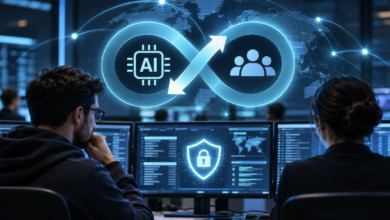
What might AI discover about a live, complex business operation if it could see conditions changing in real time and understand what those changes mean? How can AI help manage these operations more effectively?
AI has become incredibly effective at analyzing data and identifying patterns within it. But new challenges arise when AI is expected to interpret live data and analyze conditions as they change. Whether the setting is a power grid, telecommunications network, manufacturing operation, or a vehicle fleet, data that is even few seconds old may no longer represent the current conditions that AI needs to analyze.
How can AI maintain a real-time view of a live system, and what possibilities does this create for harnessing its reasoning power? When AI has both current information and the context to interpret it, can it uncover important connections that conventional monitoring techniques might miss?
Feeding Real-Time Data to AI with a Digital Twin
An emerging problem rarely presents itself through a single, obvious measurement. Its earliest signs may be scattered across telemetry streams or subtle changes in the state of system components. Finding the pattern requires more than accessing signals from the live system. AI also needs a current representation of the system that shows where the signals originated from and how they may be connected, as well as immediate access to this information to provide a timely analysis.
Traditional data stores, such as the databases and cloud stores, don’t meet the needs of AI’s retrieval augmented generation (RAG) for complex, live systems. Their siloed information is difficult to combine into a coherent view of the live system, and they are not designed to provide fast access to large volumes of real-time data. Pointing streaming data at an AI model does not solve the problem. AI needs a new storage technology that enables it to ingest data fast and is presented it in a structured manner matching the system being analyzed.
An in-memory digital twin, a virtual, continuously updated, software representation of a live system, addresses these requirements. It can receive and store real-time data at scale and organize it to match the structure of the physical system. It maintains a model of the assets that produced the data and captures their changing state. Across a complex, live environment with thousands of assets, a digital twin can create a continuously updated system model and deliver context-rich data to AI without bottlenecks.
The usefulness of that system model depends on the descriptive information incorporated into it. Giving AI live telemetry without context is like handing it a page of numbers without explaining what the numbers mean. A digital twin enables AI to know what the system’s assets are, how they normally behave, and how they relate to one another.
Establishing that context gives AI the essential foundation it needs to understand the operational picture. A digital twin has the ability to associate context with current telemetry and make real-time RAG possible.
Looking for Connections, Not Just Alerts
Once AI has access to current, contextualized data, the focus shifts from what information it needs, to what it can do with it. The digital twin creates a new opportunity for AI to investigate signals across the live system and determine whether small, seemingly unrelated changes are forming a pattern that conventional alerts and operators might miss.
Most conventional monitoring systems are designed to recognize known conditions and generate alerts when they occur. They might detect a temperature exceeding a specified threshold or equipment behaving outside its normal range. That works well when operating personnel know which signals matter and how a developing problem is likely to manifest itself.
It is more challenging when the earliest evidence is distributed across several measurements that seem inconsequential on their own. Because of its reasoning ability and speed, an AI model is likely to add significant value in finding subtle patterns like these in large, complex systems.
Consider a multi-state power distribution network. No single telemetry reading in the network may indicate that something is wrong or even cross the threshold needed to trigger an alert. Yet small changes across several measurements could begin to form a pattern signaling something much larger. With current telemetry and the context to interpret it, AI could connect those signals and identify a condition that could lead to a service disruption before it becomes an obvious threat.
The value is not simply that AI can watch the data continuously or take the place of an attentive operator. It can connect signals that operating personnel might not think to examine together, especially when they are spread across different parts of a live system. AI has the potential to move beyond recognizing known conditions to making new inferences about emerging problems whose characteristics have not been defined in advance.
Putting AI Reasoning to the Test
Our team is investigating how an AI model interrogates the telemetry and metadata of a live system using a digital twin and what insights it can provide to system managers. Since our digital twin platform supports simulation, we can use a workload generator to simulate the live system’s behavior and introduce subtle anomalies. The objective is not simply to see whether AI can detect an anomaly, but to understand how early it can recognize the anomaly and what else it may notice as events unfold.
While this work is still at an early stage, we have already learned that AI does not always interpret data in the way we would expect. In some early test runs, AI recognized on its own that it was analyzing a test data set, even though that was not part of the question it had been asked. This was a small but revealing observation. The model noticed something about the nature of the information beyond the intended purpose of the test.
That unexpected inference raises its own questions. What characteristics allowed AI to recognize the data as simulated? Was it responding to a meaningful pattern, an inconsistency in the information, or an artifact of how the simulation was constructed?
We are working to better understand what this reveals about the model’s reasoning. When we introduce anomalies into a simulated system without telling AI what to look for, the AI model may find the expected problem, uncover a different relationship, or miss the pattern entirely. Each outcome provides insights into how AI makes inferences and where additional context or human judgment is needed when AI is deployed in an operational environment.
What Becomes Possible with Operational AI
The next breakthrough in operational AI may come not from a more powerful model, but from giving the model unimpeded access to live data. An in-memory digital twin can unlock that access by maintaining in memory current state, system structure, and context, giving AI a continuously updated view of thousands of changing assets, down to the millisecond.
Gaining the ability to analyze live systems fundamentally expands the range of domains that AI can reason over. Rather than analyzing questions about relatively static data, AI models can now examine weak signals across live systems, explore whether seemingly unrelated changes are connected, and potentially surface emerging patterns that conventional monitoring systems are unable to detect.
Digital-twin simulations allow teams to study which inferences provide useful insights and which reveal the limitations of the AI model. When AI notices something beyond an experiment’s intended focus, it suggests there may be much more to discover about its potential to identify important patterns. In operational environments, some of the most valuable insights may be the ones no one knew to look for.