Sentiment analysis means something different to everyone using it. To a marketing lead it is a dashboard with a red or green arrow; to a data engineer, a scoring function; to finance, a line item. All three describe parts of one system, which is why buying decisions here go wrong: teams compare a dashboard against a model against an API as if those were alternatives.
What is sentiment analysis in AI?
AI sentiment analysis is the automated scoring of text as positive, negative or neutral using a language model rather than a keyword list. In practice it is never one product. It is three layers stacked together, and most tools on the market sell one or two of them rather than all three.
| Layer | What it does | Typical pricing model |
| Data | Supplies the posts, reviews or tickets to analyze | Per call or per record |
| Model | Scores each piece of text | Per unit of text, or self-hosted |
| Action | Turns scores into dashboards, alerts or triggers | Per seat or workspace |
Where does the sentiment data come from?
For social sentiment it comes from X, formerly Twitter, and collection is now the hard part rather than the modelling. Official platform access needs an approved developer account and bills reads per resource returned, so most technical teams use a third-party data API to pull public posts from X over an ordinary HTTP request with a bearer token.
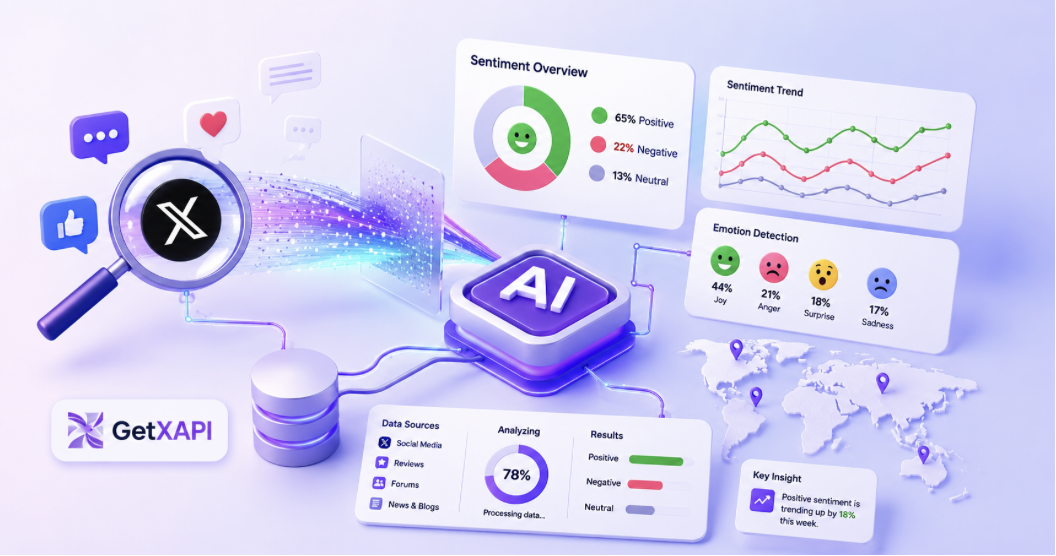
GetXAPI is one provider in that category, billing from $0.001 per call where a standard call returns about 20 posts. Before comparing providers on headline price, check what each counts as a call. A service returning one post per call and one returning twenty can quote an identical figure and differ twentyfold on the same workload, which is the most common costing mistake at this layer.
Settle early whether you need live posts, historical ones, or both. Real-time monitoring needs only a rolling window, so a modest polling cadence covers it. Training or benchmarking a model needs a backfill, a one-off cost that can dwarf a year of monitoring if you size it carelessly. The two optimise for different things, so decide before comparing providers.
Can ChatGPT do sentiment analysis?
Yes, and for small volumes it is often the fastest thing to reach for. A general-purpose model handles tone and context well without any training work. The catch is cost shape: you pay per token on every classification forever, which is fine for a few thousand records and expensive for a few million.
At sustained volume, teams move to a purpose-built option. Hugging Face hosts open-source sentiment models fine-tuned on social text that you run yourself with no per-seat licensing, and managed services such as AWS Comprehend return scores over an API without training. The choice is mostly whether you would rather own infrastructure or own a bill.
How accurate is AI sentiment analysis?
Reliable on clearly positive or negative text, and noticeably weaker on sarcasm and on posts carrying mixed sentiment. Older keyword approaches scored “this update is sick” as negative; current models read that correctly. Treat scores as a directional signal rather than ground truth, review outliers by hand, and never let a single post trigger an irreversible action.
The number worth having is accuracy on your own text, not the benchmark in a vendor deck. Hand-label two or three hundred representative posts, run them through each model you are evaluating, and compare. It is an afternoon of work and it routinely changes the shortlist, because models trained on product reviews often read social posts poorly and the gap shows only on your data.
What do you actually do with the scores?
A score nobody sees is wasted compute. This layer is a dashboard, an alert when negative mentions spike, or a write into a CRM record. It is also where the easiest wins are, because a threshold alert into a channel your team already reads costs almost nothing and captures most of the value an expensive dashboard promises. The common failure is building a dashboard nobody opens when the team needed a message that arrives when something changes. Route by theme rather than by volume where you can, since ten posts about a billing bug matter more than a hundred about a logo refresh.
What does a sentiment stack cost to run?
Cost each layer separately, because they scale on different axes. Data is volume-driven: at pay-per-call pricing of roughly $0.05 per 1,000 posts, monitoring 100,000 posts a month is a few dollars. Model inference is near zero self-hosted, or per-character on a managed API. The action layer is where per-seat pricing lives, and it scales with headcount rather than usage.
Model the cost at the volume you expect in a year, not the volume you have now. A stack that looks balanced at ten thousand posts a month rarely still does at a million, because the data line grows with posts while the dashboard line grows with the team.
Which AI tool is best for sentiment analysis?
There is no single best tool, only the layer you are missing. Enterprise suites such as Brandwatch and Talkwalker sell all three layers bundled at seat pricing, which is why they dominate large brand teams and also why you pay seat rates for data you may not have needed. Sprout Social suits marketing teams wanting one platform. Technical teams almost always end up with a data source plus a model they control, because that is the combination that does not scale with headcount.
Work out whether your gap is data, modelling or action before shortlisting anything. Teams frequently find the bundled product is priced against the layer they were least short of, and that the layer they genuinely lacked was the cheapest of the three to solve on its own. A useful test: if you already have somewhere to put the output, you are buying data and a model, not a platform.