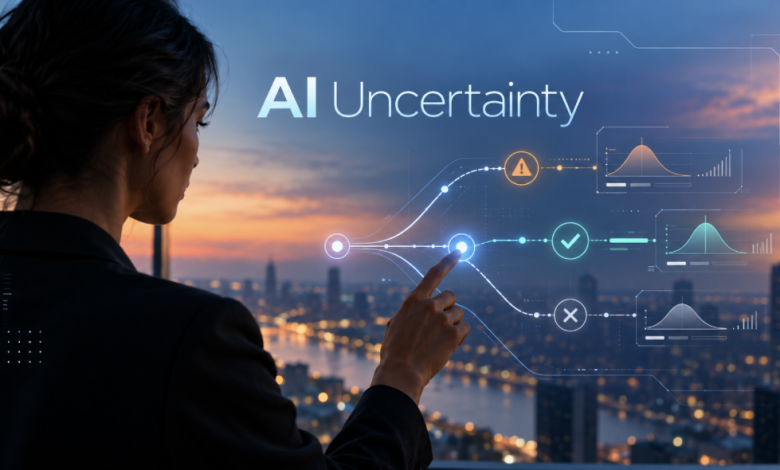
Software is built to produce answers, but high-stakes systems have a harder responsibility: knowing when an answer is too uncertain to trust. A medical model can rank diagnoses, a fraud engine can score a transaction, and a driver-assistance system can classify an object in milliseconds, yet each output is still shaped by incomplete data, model assumptions, and real-world conditions.
The real risk begins when software presents an estimate as a fact. In healthcare, finance, transportation, security, and other consequential fields, uncertainty is part of the result. Reliable systems must therefore do more than predict accurately. They must recognize weak evidence, expose meaningful doubt, and know when automation should give way to review.
Confidence Is Not Certainty
Machine-learning systems often produce probabilities that look more precise than they are. A classifier may assign 93% confidence to one category, but that number does not mean the answer has a universal 93% chance of being correct. It reflects confidence within the model, based on its training data, assumptions, and interpretation of the input.
That distinction matters when deployment conditions differ from training conditions. A vision model trained mainly on clear daytime road images may perform well in testing yet become less reliable in heavy rain, glare, temporary roadworks, or unusual camera angles. The system may still produce a confident result even when the situation falls outside the data it understands well.
High-stakes software therefore needs to distinguish between several types of uncertainty:
- Data uncertainty appears when inputs are incomplete, noisy, damaged, or outdated, such as blurred scans, missing laboratory values, or degraded sensor readings.
- Model uncertainty appears when the system has limited experience with a situation, especially rare combinations that were poorly represented during training.
- Decision uncertainty appears when several interpretations remain plausible, even though the system has enough information to narrow the possibilities.
Uncertainty itself is not a failure. The bigger failure is designing software that conceals it.
The Interface Hides Doubt
Most users never see the probability distribution, competing hypotheses, or data-quality limitations behind an automated decision. They see a label such as “approved,” “high risk,” “fraud detected,” or “object identified.”
That translation can remove important context. A model may be only moderately confident, or several outcomes may be nearly tied, yet the interface presents one definitive answer because simple outputs are easier to understand and faster to act on.
| What the system may actually know | What the interface may show |
| One outcome has a 62% probability | Approved |
| Evidence is incomplete but concerning | High risk |
| Several diagnoses remain plausible | Most likely condition |
| Sensor quality is degraded | Object detected |
| Fraud signals conflict | Transaction blocked |
This simplification is relatively harmless in low-risk software. A music app does not need to explain its confidence before suggesting a song. High-stakes systems are different because users may interpret the interface as a statement of fact rather than a compressed estimate.
A confidence range, missing-data warning, or “requires review” status can change how a person responds without changing the model itself. Uncertainty is therefore not only a machine-learning problem. It is also a product and interface design problem.
Edge Cases Become Real Cases
Engineers often describe unusual situations as edge cases, but large-scale deployment changes what “rare” means. An event that appears in only 0.1% of cases can still occur around 1,000 times in a system processing one million decisions.
That is why overall accuracy can hide important weaknesses. A model may perform well on ordinary cases while failing more often on unusual road layouts, uncommon medical histories, damaged documents, regional language patterns, or user behavior that differs from its training data.
The problem becomes more serious when rare conditions appear together. A driver-assistance system may handle rain reasonably well and road construction reasonably well, yet struggle when heavy rain, glare, temporary lane markings, and a partly obscured sign occur simultaneously. Each condition may have appeared during testing, while the combination remains poorly represented.
High-stakes testing should therefore focus not only on average performance but also on where the system becomes brittle. Teams need to understand which environments, users, and combinations of conditions produce unreliable behavior.
Automation Changes Human Judgment
Human oversight is often treated as a simple safety layer: software makes a recommendation, and a person checks it. In practice, automated outputs can influence the person doing the checking.
Once a system displays a risk score or ranked recommendation, that result can become an anchor. A reviewer may search for evidence that supports the machine rather than examining the case independently, particularly when the software is usually accurate or when decisions must be made quickly.
The opposite problem can also occur. A system that produces too many weak alerts trains users to ignore them. Security teams become desensitized to warnings, drivers respond more slowly to repeated assistance alerts, and staff may stop treating system notifications as meaningful.
Effective oversight therefore requires more than placing a human at the end of an automated process. Reviewers need access to the original evidence, information about model confidence, and a practical way to disagree with the system without treating every override as an exceptional failure.
Systems Need an “I Don’t Know”
Consumer software is generally rewarded for producing something. Search engines return results, writing tools generate text, and recommendation systems always offer another option. High-stakes systems sometimes need the opposite behavior.
A system that recognizes weak evidence can be safer than one that always forces a prediction. In machine learning, this idea appears in selective prediction and abstention, where the system only acts when its confidence and operating conditions meet defined thresholds.
Useful fallback behavior can include:
- Requesting additional information when important inputs are missing instead of estimating those values from weak correlations.
- Escalating unusual cases to a trained reviewer when the input differs significantly from normal operating conditions.
- Showing several plausible outcomes when the evidence does not support one definitive result rather than hiding ambiguity.
- Switching to a safer operating mode when sensors or dependent systems degrade instead of continuing as though nothing changed.
This changes what successful automation means. In some situations, the best automated decision is recognizing that the system should not make the final decision itself.
Uncertainty After an Accident
The limits of digital certainty become clear when software meets a complicated physical event. After a vehicle collision, investigators and insurers may have access to dashcam footage, vehicle telemetry, phone location records, traffic-camera data, photographs, and witness statements. More information can help reconstruct events, but it does not automatically create one unquestionable account.
A timestamp may be wrong, a camera may miss critical seconds, and location data can show where a device was without proving exactly what the person carrying it was doing. Someone reviewing evidence with a West Palm Beach Car Accident Attorney could therefore encounter several digital records that appear precise but still require interpretation alongside physical evidence and human testimony.
The same principle applies to high-stakes software more broadly. Systems should preserve the distinction between what was directly observed, what was inferred from data, and what remains unknown. Once those categories are merged into one confident output, later users may mistake an automated interpretation for primary evidence.
More Data Can Create False Confidence
Technology teams often treat additional data as the cure for uncertainty, but quantity and evidence quality are not the same thing. More measurements can help only when they add genuinely independent information.
Suppose three databases report the same identity detail. If all three copied the information from one original record, they are not three independent confirmations. A system that counts them separately can become more confident without learning anything new.
The same problem can appear across AI models. Several systems may agree because they were trained on overlapping datasets or inherited the same assumptions. Their agreement may look convincing while providing much less independent confirmation than users assume, as a fraudulent site can pass every automated scan and still fail a closer human review.
Sensor-heavy environments create a similar risk. A device can collect thousands of readings every second, but incorrect calibration can make a large volume of data consistently wrong. More readings from the same faulty source do not reduce uncertainty.
High-stakes systems therefore need to track provenance as carefully as volume. They must know where information came from, whether sources are genuinely independent, how recently they were updated, and which assumptions connect raw data to the final conclusion.
The Cost of the Wrong Error
Accuracy alone cannot explain whether a high-stakes system is safe. Two systems can both be 96% accurate while creating very different consequences when they fail.
| System | False positive | False negative |
| Fraud detection | Legitimate payment is blocked | Fraudulent payment is approved |
| Medical screening | Healthy patient receives more testing | Serious condition is missed |
| Safety monitoring | Unnecessary alarm is triggered | Genuine hazard is overlooked |
| Content moderation | Legitimate material is removed | Harmful material remains visible |
The correct decision threshold depends on the cost of each error. A medical screening system may tolerate more false positives because additional testing can be preferable to missing a dangerous condition. Another system may need stricter control of false positives because unnecessary intervention creates its own harm.
These costs can also change through repeated use. A security system that produces too many alerts may appear cautious, but persistent false alarms can eventually reduce trust until users ignore a genuine warning.
High-stakes evaluation therefore needs more than headline accuracy. Teams must understand which mistakes happen, how often they occur, and what consequences follow when the system is wrong.
Reliability Is a System Property
AI discussions often focus on model performance, but real software depends on far more than a model. Databases, sensors, APIs, timestamps, preprocessing systems, network connections, and user interfaces all influence the final output.
A highly accurate model can still sit inside an unreliable product if one of those surrounding components fails. Even small failure rates can compound across a chain of dependent services.
Consider five stages that each work correctly 98% of the time. If all five must succeed for the final result to be correct, combined reliability falls to roughly 90.4%. No individual component is catastrophically unreliable, but the system as a whole becomes noticeably weaker.
Production failures often follow this pattern. A model receives stale information because an upstream database stopped updating, a sensor stays online while drifting out of calibration, or a software update changes a field format without causing an obvious crash.
High-stakes teams therefore need end-to-end monitoring. They must track not only model accuracy, but also whether inputs are current, dependencies are healthy, data distributions have shifted, and the information shown to users matches what the system actually knows.
Design for Reversible Decisions
One practical way to manage uncertainty is to make uncertain decisions easier to reverse. Some systems turn an automated output directly into a permanent action, which makes every model error expensive.
A better design connects confidence to consequence. The less certain the system is, the easier the resulting action should be to review, correct, or undo.
Useful patterns include:
- Temporary restrictions instead of permanent actions when evidence justifies caution but not a final decision.
- Review queues before irreversible enforcement for cases close to decision thresholds.
- Original evidence shown beside machine-generated summaries so reviewers can check the source rather than trusting the interpretation.
- Decision logs that record the model version, data source, confidence level, and missing inputs available at the time.
- Appeal and correction mechanisms that feed confirmed mistakes back into monitoring systems so recurring problems can be detected.
Reversibility does not prevent errors, but it reduces their cost. A temporary incorrect decision that receives review is very different from an irreversible action generated by the same mistaken prediction.
Better Software Shows Its Limits
High-stakes software should not be judged only by how confidently it produces answers. It should also be judged by how well it represents what it does not know.
The strongest systems separate observations from inferences, expose important gaps in evidence, recognize unfamiliar conditions, and escalate cases where automation becomes unreliable. They also give human reviewers enough context to challenge a recommendation rather than simply confirming it.
This does not mean filling every screen with statistical details. The goal is to surface the uncertainty that changes a decision. A 52% prediction and a 99% prediction should not always trigger the same workflow merely because both cross the same threshold.
Bottom Line
High-stakes software does not become trustworthy simply by becoming more accurate. Trust also depends on how the system behaves when data is missing, components fail, evidence conflicts, or conditions differ from those seen during development.
A system that makes fewer mistakes can still be dangerous if it presents every output with identical confidence. Reliable software should know the boundaries of its knowledge and make those boundaries visible when they matter. In consequential settings, uncertainty is not something to hide behind a cleaner interface. It is information that should shape the decision itself.