After nearly two decades of interpreting emerging technologies for mainstream audiences, TV journalist Spencer Kelly has an ability to cut through the noise around artificial intelligence. He studied computer science at university in the ’90s, where his third-year dissertation centred on trying to break the world record for travelling through the London Underground network in the fastest time using genetic algorithms, a search and optimisation process based on Darwin’s theory of evolution, designed to solve complex problems by mimicking the process of natural selection.
My point in giving that detail is to underline Spencer’s opening remarks during a recent discussion I hosted with him for Pearl: many people still do not realise AI is not new, or even ‘recent’. It is actually decades old, with the original concept developed in the 1950s.
That misunderstanding is easy to see in everyday conversations, whether in the workplace, on professional platforms such as LinkedIn, or in dental forums. The bulk of public conversation is focused on large language models, such as ChatGPT or Claude, and yet AI has already informed so many things we take for granted, from smartphones recognising faces to predictive text messages.
For those of us working in dental AI, this matters. If the profession only sees AI through the lens of hype, fear or consumer-facing tools, it becomes harder to have a sensible conversation about where the technology can genuinely support clinical practice.
So, in an age where everybody has their own perception of what AI is or will be, ranging from doomsday headlines to everyday convenience, how do we separate the real, positive signals from pure hype?
Spencer’s approach is to give people a baseline understanding of how AI works, because once they have that understanding, they can start to discern fact from fiction. He uses the analogy of distinguishing between images of real cats and Fugglers, wide-mouth toys that bear a passing resemblance to our feline friends.
During our discussion, he showed our audience just six different images of cats and Fugglers to highlight how quickly the human brain can process information from a small amount of detail. However, for a computer to be trained to make the same distinction, it needs to be trained on many thousands, possibly millions, of examples of images of cats and non-cats until it can reliably distinguish a cat from a Fuggler, or anything else for that matter.
The same principle is important for dentistry. AI does not ‘know’ what it is looking at in the human sense. It is trained to recognise patterns by analysing very large numbers of images and learning which features are associated with particular findings.
In dental radiology, that means AI can be trained to review radiographic images in a highly structured way, assessing visual patterns, changes in density, morphology and anatomical structure. The important point is that this is not guesswork, nor is it magic. It is pattern recognition, applied at scale.
At Pearl, we believe this distinction is critical. Dental AI should not be positioned as a replacement for clinical judgement, but as a way of supporting the clinician’s existing expertise. The dentist still brings the clinical context, patient history, experience, judgement and responsibility. AI can help make certain radiographic findings easier to identify, review and explain, but it does not remove the need for the dental professional at the centre of the decision.
This is where the conversation around AI in dentistry needs to become more nuanced. The value is not that technology replaces the clinician. It is that it can help draw attention to areas that may warrant closer examination, particularly in busy practices where multiple radiographs are being reviewed every day.
For dentistry in particular, perhaps even more important than AI’s ability to support diagnosis is its role in enhancing patient communication and understanding.
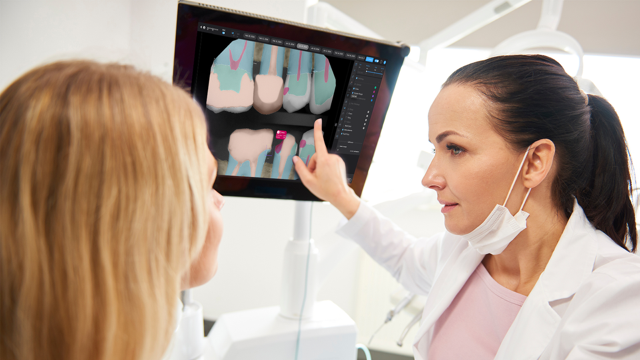
Radiographs are familiar to clinicians, but they can be difficult for patients to interpret. A patient may be shown an x-ray in the surgery and still struggle to understand what they are looking at, why it matters, or why a particular treatment option is being discussed. If technology can help make findings more visible, or help a clinician explain what they are seeing more clearly, it has the potential to improve the quality of the conversation.
That matters because dentistry is not only about diagnosis. It is also about trust, consent and shared decision-making. When a patient sees and understands a finding on their own x-rays, they are better placed to make a genuine decision, with their practitioner, about what to do next; whether that means proceeding with treatment, monitoring a situation, or changing their oral hygiene routine.
The conversation moves from dentist-patient instruction to collaboration. A patient who understands why something is being recommended is more likely to feel involved in the decision, rather than simply being told what needs to happen.
There is also a wider professional question about consistency. Two clinicians may look at the same radiograph and bring different experience, focus and clinical judgement to what they see. AI will not remove the need for that judgement, but it may support a more standardised way of reviewing and discussing radiographic findings.
For Pearl, this is one of the most important roles AI can play in dentistry: supporting clearer clinical conversations. Not by taking over the decision, but by helping make information easier to see, explain and discuss. Used well, AI can support the relationship between dentist and patient, rather than getting in the way of it.
This is why education around AI is now so important. Dental teams need to understand not only what the technology can do, but also what it cannot do. Patients need reassurance that AI is there to support their clinician, not replace them. The wider profession needs an informed conversation that moves beyond both fear and hype.
Ultimately, the integration of artificial intelligence into dental surgeries represents an evolution in how clinicians interact with both diagnostic data and their patients. Its value lies not in replacing clinical judgement, but in enhancing clarity: making subtle findings more visible, explanations more tangible, and decision-making more collaborative.
For companies like Pearl, the responsibility is therefore bigger than technology alone. It is about helping the profession understand AI properly, so it can be adopted with confidence, transparency and trust.