While much of America baked in record heat on July 4th, a group of friends huddled to stay warm high in the Alaska mountains. Surrounded by wet snow and ice, one of the group had lost their shoes as the dusk started to arrive. Out of options they turned like so many other Americans on the 4th to 911.
Like nearly all emergencies, this one was complicated. No cell reception, remote area, high elevation. Using new satellite SOS capabilities built into most new smartphones, they were able to reach first responders. Alaska Mountain Rescue Group jumped into action, getting them to safety.
America Sees Its Busiest Single Day in 911 History
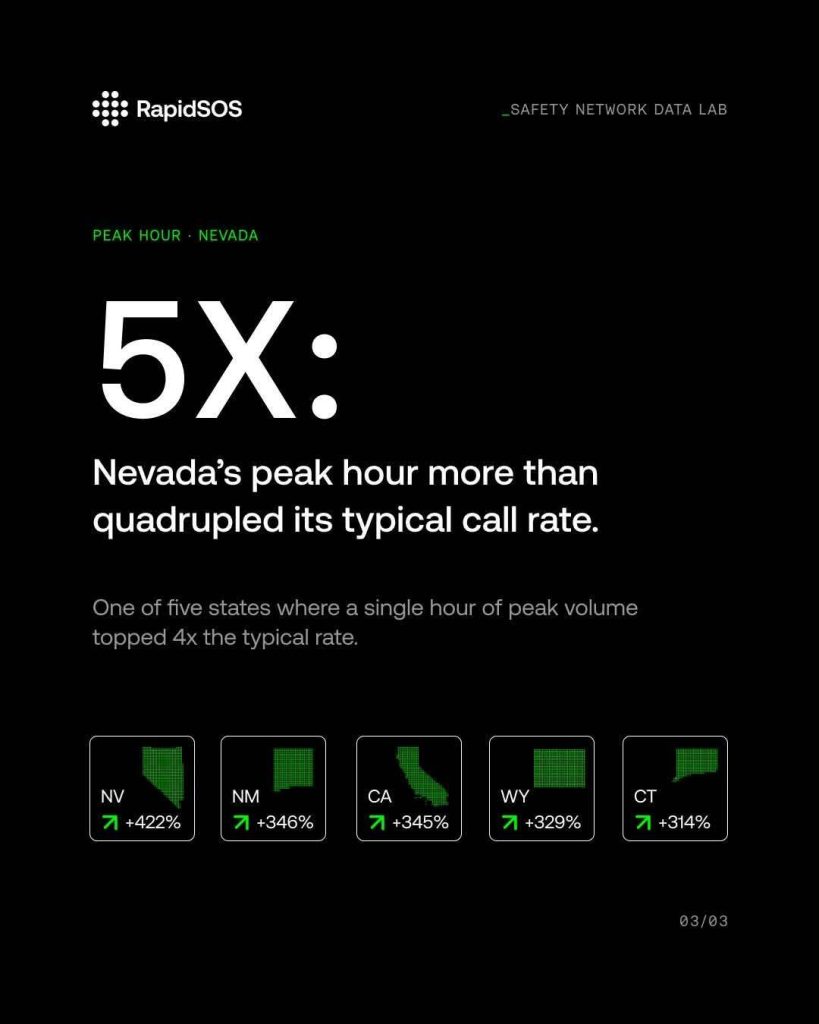
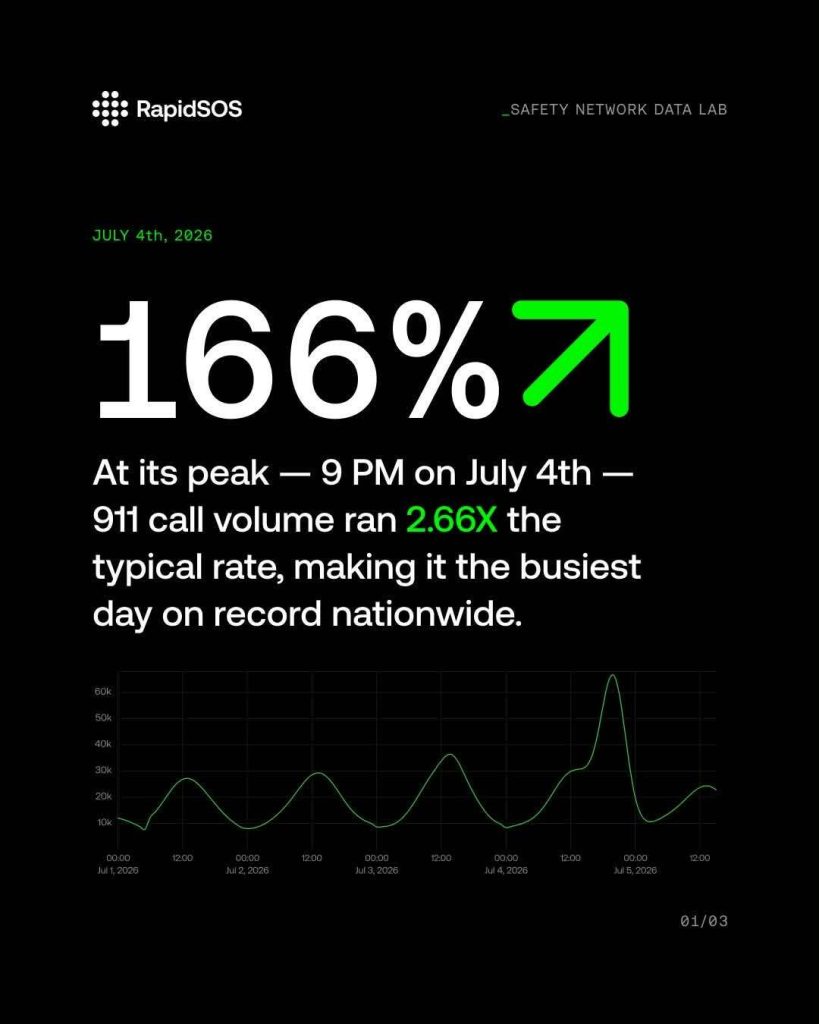
On July 4th, our nation’s 911 systems processed over 700,000 calls—a 38.5% increase over baseline. At the peak, 9 p.m. ET, we hit 2.66 times normal volume in a single hour: 65,738 calls.
Every year, July 4th ushers in one of the busiest days for first responders. This year a combination of America’s 250th celebrations, World Cup festivities, and extreme weather magnified the surge.
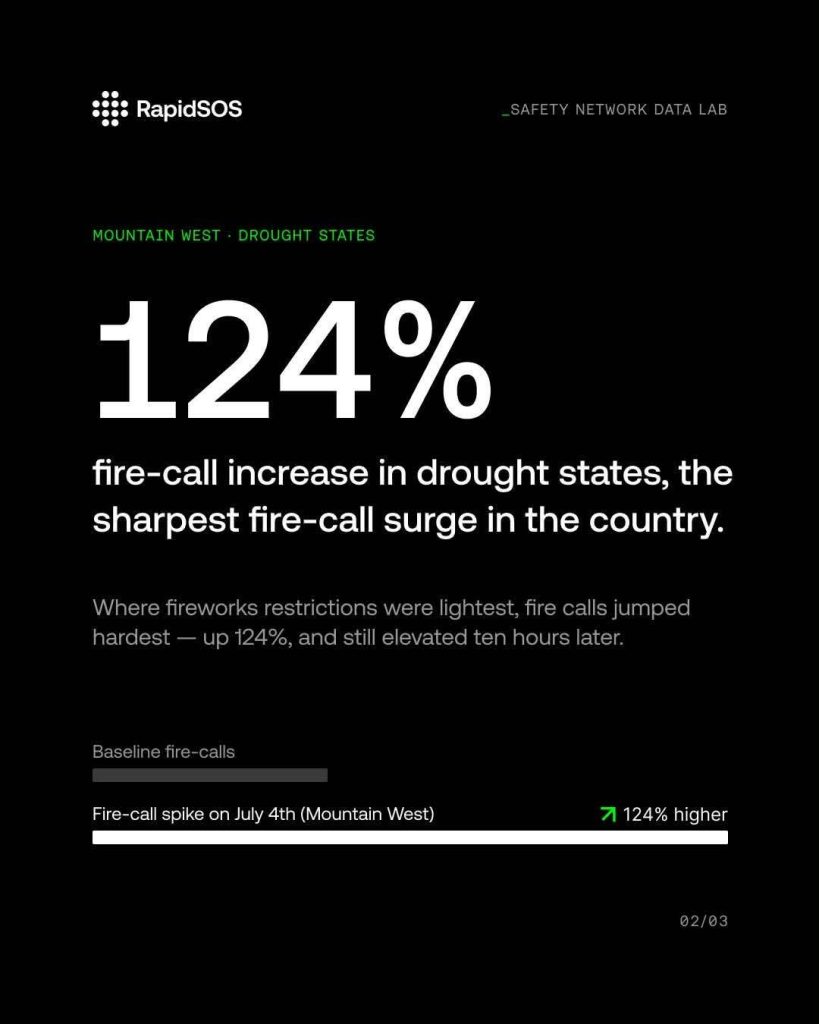
Nationally, fire calls jumped 124% and remained elevated for over 10 hours. Stories of wildfires and severe weather played out across Oklahoma, Montana, Idaho, Wyoming, Nevada, and beyond. In the intermountain west, record heat collided with dry brush and fireworks – wildfire reports nearly doubled. In San Francisco, autonomous vehicles caught fire. In Coney Island, gunshot calls spiked to over 1,500% as first responders flooded into a family gathering where eight people, including four children, were shot.
Gunshot calls also spiked, almost perfectly correlated (0.98 R-squared value) with fireworks calls until they weren’t (later in the evening – as fireworks calls returned to near baseline but gunshot calls remained elevated).
Among it all across America, thousands of lives were saved this July 4th. As we reflect on America’s 250th birthday, we are reminded of the spirit of service that makes this country great.
Technology in Emergency Response
The role of calming a panicked 911 caller or navigating someone safely out of their enflamed home is a uniquely human task. Humans save lives, not technology.
On July 4th we witnessed how the incredible first responders in our communities are increasingly on the cutting edge of how to fuse technology with mission critical work that only humans can perform.
Over the past decade, a fundamental shift has occurred in how emergency services operate. Facing a growing global safety threat, consumers and enterprises have installed hundreds of millions of alarms, sensors, and health monitors to help protect their businesses, families, and communities. Collectively and in partnership with local public safety agencies, these interconnected systems now work together as a unified network: tens of thousands of public safety agencies operating alongside hundreds of millions of connected devices that feed real-time data into emergency response systems.
This integration represents a new frontier in emergency operations: the convergence of disparate data sources into actionable intelligence that first responders can use in real time.
Mission Critical AI Supporting Heroes
Public safety and the technology community have spent the past decade building the infrastructure and artificial intelligence systems to operationalize this connected ecosystem. Modern AI platforms purpose-built for mission-critical operations represent a fundamental advancement in emergency response.
These systems converge large language models, traditional machine learning, and physical AI models with real-time context from millions of sensors, thousands of operational protocols and procedures, and the life-saving decision-making expertise of first responders themselves. The result is a new class of technology: systems designed to detect emergencies earlier, understand complex situations from multiple convergent data streams—sensor feeds, health information, video, location data—and integrate seamlessly into existing emergency agency workflows and standard operating procedures.
In parallel, these systems provide capabilities like real-time language translation, automated transcription, and detection of mass incident patterns as they emerge.
On July 4th, that meant first responders could detect a fast-moving house fire and respond with precision. Over 20,000 vehicle crashes were automatically detected across the nation’s roads. And across America, over 700,000 individual moments unfolded where a dedicated team of first responders, armed with better information and connected systems, protected a fellow American in need.
The technology did not save these lives—the first responders did. But the convergence of connected devices, intelligent systems, and human expertise created the conditions for faster response, better decisions, and ultimately, more lives saved.
In Reflection & Gratitude for the Public Safety Professionals Keeping Us Safe
It was 250 years ago that a group of Americans stood up to injustice and had the courage to found this great country. Today we are encouraged to see that spirit still lives on in our community, our technologists, and the brave first responders who climb mountains in extreme cold to bring our loved ones safely home.
Michael Martin is Founder and CEO of RapidSOS, the leading public safety AI company that unlocks mission-critical intelligence for first responders and security teams – enabling faster, smarter and more accurate emergency response.