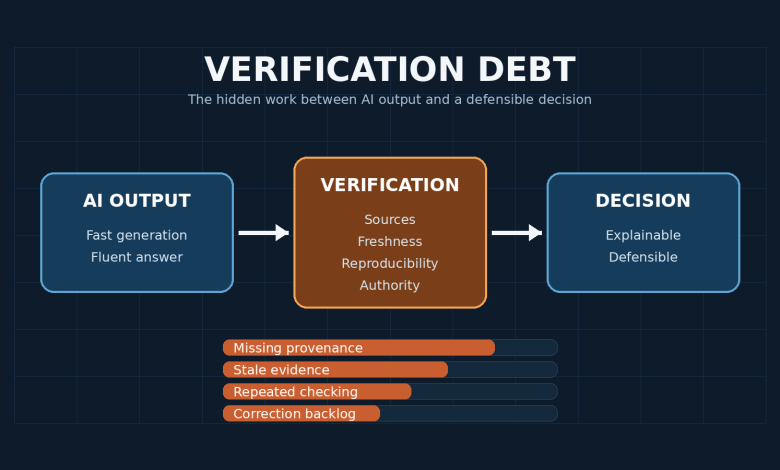
Generation time is visible. The work required to prove that an AI output is correct, current, traceable and reproducible is often scattered across teams. That hidden burden should be measured before productivity claims are trusted.
The invisible ledger
When a team reports that generative AI saved 20 hours, the figure usually describes production. It rarely includes the time spent checking sources, rebuilding missing context, comparing versions, correcting unsupported claims and deciding who is accountable for the final decision.
That omitted work creates verification debt: the accumulated obligation to establish that an AI output is correct, current, traceable, authorised and reproducible before the organisation can safely rely on it. Like financial debt, it can be useful when taken deliberately. It becomes dangerous when no one records who must repay it, by when, or with what evidence.
Verification debt is not the same as technical debt. Technical debt sits in code, architecture and maintenance choices. Verification debt sits in the evidentiary burden attached to outputs and decisions. A system can be technically stable while producing conclusions that are expensive to justify.
How verification debt accumulates
The first source is missing provenance. An answer may contain a plausible number without preserving the document, passage, date and transformation that produced it. A reviewer then has to reconstruct the path after the fact. Even a correct answer becomes costly when its evidence trail has disappeared.
The second source is stale evidence. Retrieval systems can continue serving a policy, price, regulation or scientific result after the underlying source has changed. The output still looks fluent, but the organisation has inherited an obligation to determine whether the evidence remains valid.
The third source is repeated checking. If five employees independently verify the same type of output because no reusable evidence bundle exists, the organisation is paying the same debt multiple times. The apparent saving at the generation stage is consumed by duplicated review.
The fourth source is non-reproducibility. A decision cannot be reconstructed when the model version, prompt, tools, source snapshot and human edits are missing. That matters most when a customer, regulator or executive asks why a recommendation was made weeks later.
The fifth source is correction asymmetry. A model can generate a confident paragraph in seconds; a specialist may need an hour to identify what is wrong and document the correction. Scaling generation without scaling verification therefore increases the backlog of unresolved claims.
A simple example
Consider a hypothetical procurement team using AI to compare 100 supplier contracts. The system reduces the first-pass reading time from several days to a few hours. That is a genuine gain.
But legal staff then discover that some clause references are paraphrased, two summaries use an earlier contract version and the ranking cannot be reproduced because the model and retrieval snapshot were not recorded. The work has not vanished. It has moved from reading to reconstruction, and it arrives later, when deadlines are tighter.
The right productivity measure is therefore not gross generation saved. It is net decision time after verification, correction and documentation.
Five metrics leaders can use
- Verification minutes per accepted output. Measure the human time required before an AI-produced result is approved for use. Track it by task and risk level rather than averaging everything together.
- Evidence coverage rate. Record the share of material claims that have a source, a retrievable passage and a date. A hyperlink alone is not evidence coverage if the cited document does not support the conclusion.
- Evidence age at decision. Measure how old the decisive sources are when the output is used. Different domains need different revalidation intervals, but every high-stakes workflow should have one.
- Reproducibility rate. Sample past decisions and test whether another reviewer can reconstruct the output from the recorded model version, instructions, tools and source snapshot.
- Correction cost. Track the time between detecting a material error and repairing every downstream use of it. A single wrong summary copied into several systems can create a much larger liability than the original mistake.
Pay the debt during design
Verification should not be added as a final human checkpoint after deployment. It should be designed into the workflow. Systems should produce an evidence bundle with each consequential output: source passages, timestamps, model and prompt versions, uncertainty markers and a record of human edits.
Review intensity should follow risk. A low-impact internal draft may need a light sample. A decision affecting employment, credit, safety, compliance or public services needs deterministic checks, named reviewers and a clear stop rule when evidence is incomplete.
Organisations should also create reusable verification assets. A validated source library, shared test cases and documented correction patterns reduce the need for every employee to begin from zero. The goal is not to eliminate human judgement, but to spend it where it changes the decision.
Ownership matters. Each deployed workflow should have a named owner for verification debt, a budget for review and a trigger for stopping use when the backlog exceeds safe capacity. Procurement teams should ask vendors whether sources can be preserved, model versions pinned and past outputs reconstructed. If those capabilities are absent, the purchase price understates the real operating cost.
The NIST Generative AI Profile treats provenance, testing, monitoring and incident response as lifecycle responsibilities rather than optional extras. Human-computer interaction research on the ‘ironies of generative AI’ likewise shows that users can become evaluators and workflow repairers when automation shifts rather than removes work. These are not edge cases; they are signals that verification belongs in the cost model from the start.
From gross output to net trust
Enterprise AI dashboards usually show adoption, tokens, latency, task completion and estimated hours saved. Add verification debt and the picture becomes more honest. A system that produces twice as much but triples the review burden is not necessarily more productive.
The best AI programme is not the one that generates the most material. It is the one that produces decisions the organisation can explain, reproduce and correct at a sustainable cost.
Generation is cheap because the machine performs it immediately. Trust remains expensive because people and institutions must stand behind the result. Verification debt makes that expense visible before it becomes a crisis.
Author biography
Roney Lima do Nascimento is a mathematics educator, AI specialist, AI systems developer and doctoral candidate in Pure Mathematics at the University of São Paulo. He writes about model evaluation, enterprise AI, education and institutional capacity. His recent work has appeared in Folha de S.Paulo, GovInsider, EUobserver, HEPI, Nexo Políticas Públicas and Congresso em Foco.