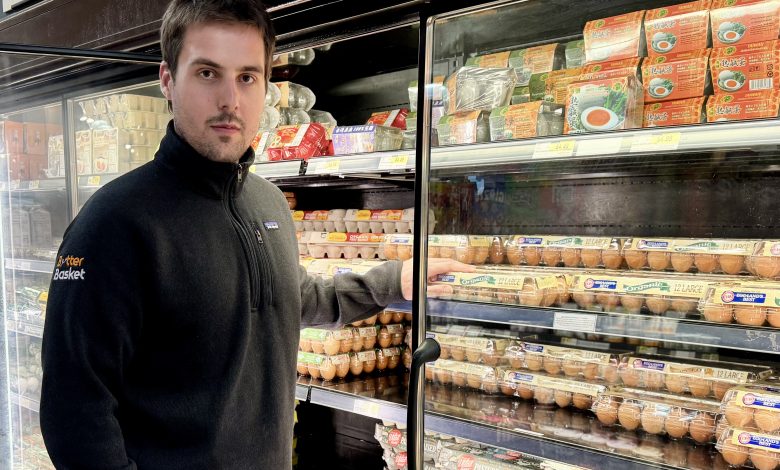
Vagelis Viskadouros grew up inside his family’s fresh-produce business in Greece, where pricing changed with supply, customer demand, and the condition of the product itself. Years before he worked with machine learning, he saw how quickly a grocery decision could affect what sold and what remained unsold.
“Pricing was part of the daily work,” Viskadouros said. “You watched what was available, what buyers wanted, and how the market was moving. There was no distance between the decision and the result.”
That early exposure shaped the way he later approached technology. Viskadouros trained in electrical and computer engineering with a major in computer science, then began his career as a data scientist at Uber Eats.
The company was building grocery operations through dark stores, which are warehouses that fulfill app-based orders. Viskadouros expected the larger organization and stronger technical resources to make grocery planning more predictable. Instead, he found many of the same uncertainties he had known in Greece.
“At Uber Eats, I saw that more data did not remove the commercial judgment from grocery,” he said. “The operation was larger, but people still had to understand demand and make decisions under changing conditions.”
That recognition helped lead him to co-found BetterBasket in 2023. The company develops software that supports grocery pricing and category management. Viskadouros serves as chief technology officer and personally built the product’s data infrastructure, pricing models, assortment systems, and AI assistant, Athena.
BetterBasket was accepted into Y Combinator’s Winter 2024 batch and raised $1.3 million in seed funding. The platform now serves seven grocery chains.
Viskadouros believes his background gave him an advantage when building for an industry that is often misunderstood by outside technology teams.
“A model can look strong in a controlled test and still fail inside a grocery business,” he said. “The real environment includes incomplete information, local differences, and products that do not fit neatly into one format.”
Product matching became a clear example of where his operating experience influenced the design.
Retailers need accurate competitive information before they can decide whether a price is too high, too low, or properly positioned. Creating that view requires the system to recognize when two stores are selling the same item, even when the listings do not look alike.
Viskadouros found that generic tools often struggled with the exceptions commonly seen in grocery. His experience around produce helped him recognize that those exceptions were part of the normal business.
“Fresh food does not behave like a clean catalog,” he said. “You need a system that understands the disorder instead of treating it as bad data that can be ignored.”
He rebuilt BetterBasket’s matching process using computer vision and machine learning. The system reports 99.6 percent matching accuracy.
That precision helped the company address a larger obstacle. BetterBasket was entering a conservative industry where retailers had strong reasons to be skeptical of a young software company.
Grocers operate on narrow margins and make decisions that customers can see immediately. A poor recommendation can affect a shelf price or create an inventory problem. Many buyers had already encountered systems that promised impressive results but failed to reflect the way their stores worked.
“We were asking established retailers to trust a company they did not know with decisions tied directly to profitability,” Viskadouros said. “We could not rely on a long reputation. We had to earn confidence through the quality of our product.”
That meant understanding how grocery teams evaluate new technology. A system could be advanced and still create more work than it removed. It could generate useful information without helping anyone decide what to do next.
Viskadouros wanted BetterBasket to fit the responsibilities of the people using it.
“Retail teams do not need a technical exercise,” he said. “They need a tool that respects how they work and helps them reach a decision they are willing to defend.”
The platform has produced an average 6 percent margin uplift on optimized categories for its customers.. Viskadouros sees those results as evidence that technical accuracy and industry understanding can reinforce each other.
His work on Athena (chat-based AI assistant) extends the same philosophy. The assistant is designed to answer questions about pricing and assortment while supporting actions within real store operations. Building it required more than adding a conversational layer to existing data.
The system needed enough context to understand the retailer’s products and operating priorities. It also had to perform reliably across a large volume of daily decisions.
“Grocery has a high threshold for trust,” Viskadouros said. “A retailer will not hand over an important process because the technology looks modern. It has to prove that it understands the business.”
That lesson now informs his advice to other founders building specialized AI products. He believes industry knowledge should influence the product from its earliest design decisions rather than being added later through customer interviews.
Viskadouros also argues that adoption requires a meaningful improvement over the tools a company already uses. Grocery teams may complain about spreadsheets, but they understand them and know how to recover when something goes wrong.
“A new system has to be dramatically better than the familiar process,” he said. “Otherwise, the disruption of changing tools will outweigh the benefit.”
BetterBasket is helping with not only price recommendations but also broader category-management decisions. The company is building technology to help grocers evaluate their assortments and promotions with less manual analysis.
For Viskadouros, that direction follows the same pattern that first drew him to the problem. Grocery decisions have always involved imperfect information and changing conditions. He can now build systems capable of examining those conditions at scale.
His role draws equally from his experience inside grocery operations and his ability to build the technology behind the product.
“Growing up around produce taught me where the pressure comes from,” Viskadouros said. “Engineering gave me a way to respond to it. BetterBasket came from bringing those two parts of my life together.”