

LONDON, 18 November 2026 – Sapiens International Corporation N.V. (“Sapiens”) today announced the UK findings from the Sapiens Insurance AI Maturity Index study conducted by Research in Finance, revealing that less than one in three (29%) of UK insurers have a fully operational AI governance strategy in place. The challenge is particularly acute among UK specialist and mid-size insurers where the figure falls to just 9%. The study identifies key competencies required for insurers to successfully adopt AI and finds that 80% of those leading AI transformation, classified in the Index as Autonomous Leaders, have fully operational policies. Given that governance is a key part of successful AI adoption and building trust and confidence among customers, regulators, and investors, UK insurers must move quickly to remain competitive and unlock the full business value of AI.
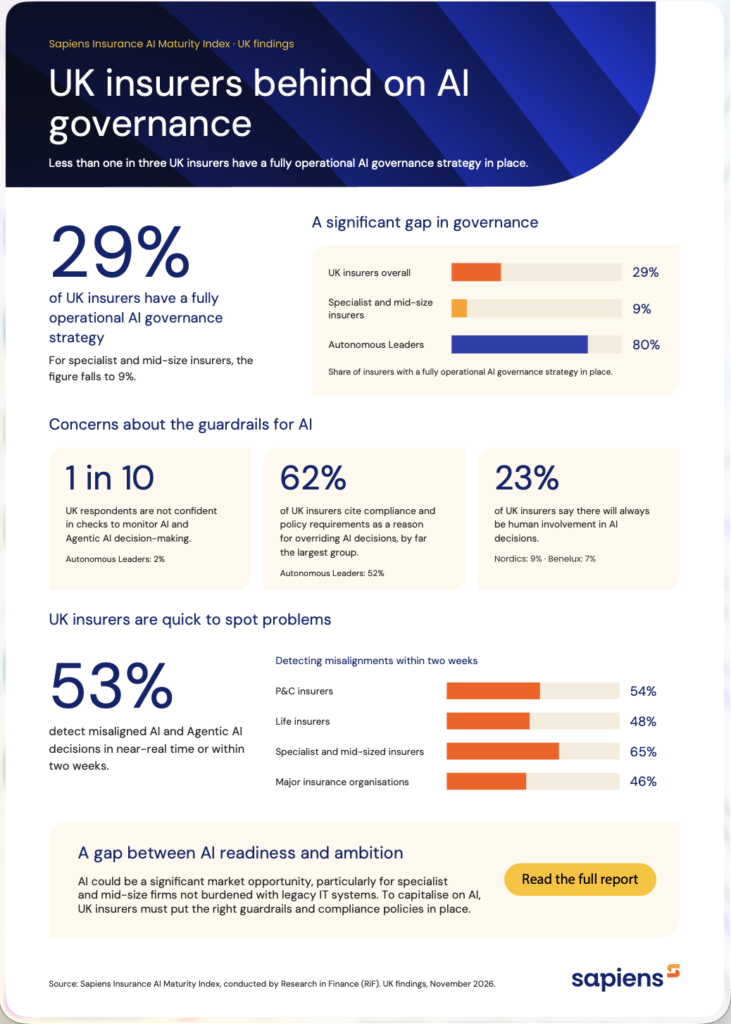
The findings cite the establishment of governance as a critical measure of AI maturity and with 58% of UK respondents anticipating AI could be fully autonomous in insurance within the next two to three years, they highlight a significant gap between the industry’s AI readiness and ambition. AI presents a significant market opportunity for specialist and mid-size firms, as its speed and scalability to automate tasks can dramatically enhance productivity for such companies in ways that are harder for larger global institutions that are burdened by legacy, complex IT infrastructures. However, if specialist and mid-size companies are to capitalise on AI adoption, robust governance will be a key success factor.
“Strong governance must be a priority not an afterthought, and our research highlights a significant opportunity particularly for UK specialist and mid-size firms who are behind on this,” commented Paul Wheeler, CEO, Sapiens. “These firms can be more agile than their larger counterparts and they should invest in doing vital governance groundwork now, so they are better positioned to take advantage of the technology and drive long-term business value over the next couple of years.”
Encouragingly for the UK, the study found that 81% of insurers using AI are confident in the decisions that AI and Agentic AI are making, which is not far behind 86% of international respondents, but the figure is understandably higher for Autonomous Leaders (95%). Elsewhere, UK respondents raise concerns about the guardrails for AI not being effective and the perennial shadow of compliance red tape also lurks. One in ten UK respondents say they are not confident in checks to monitor AI and Agentic AI decision-making compared to only 2% of Autonomous Leaders. When asked about the top reasons for overriding AI decisions, UK insurers had by far the biggest group citing compliance and policy requirements (62%) compared with 52% of Autonomous Leaders. This focus on oversight may be contributing to stronger monitoring capabilities in the UK, with 53% saying they detect misaligned AI and Agentic AI decisioning either in near-real time or in less than two weeks, but it is also important this supervision does not hamper teams using AI to drive business value and competitive advantage.
There are notable differences across the UK insurance market, with P&C insurers (54%) slightly ahead of Life counterparts (48%) when it comes to spotting misalignments within two weeks. Interestingly, specialist and mid-sized insurers (65%) are most effective at this, in contrast to 46% of major insurance organisations. As most UK insurers are still working out their governance strategies, they could be erring on the side of caution when it comes to vigilance. This may be why 23% in the UK argue there will always be human involvement unlike the Nordics (9%) and Benelux (7%), suggesting human-in-the-loop is an important part of UK insurers’ AI governance strategies.
As the UK insurance industry moves towards autonomous insurance operations, the imperative for UK firms is clear; governance must evolve alongside AI ambition and it needs to do so quickly to follow the example of the Autonomous Leaders as identified in the Sapiens Insurance AI Maturity Index. This means moving beyond planning and early-stage frameworks to establish clear accountability, effective monitoring, robust controls and appropriate human oversight. These foundations will be critical to scaling AI effectively and building the trust and confidence needed to realise its full potential, but they should also be adopted in a measured way to ensure UK insurers have the agility to compete effectively on the global stage.
Research in Finance (RiF) Methodology
The purpose of the research is to create an annual maturity index that benchmarks how advanced insurers are in adopting AI and autonomous decisioning. RiF surveyed 475 senior insurance professionals across the UK & Ireland, Nordics, Benelux, South African, and North America, who work for insurance providers and operated within life and/or P&C. 95 senior insurance professionals are surveyed across each geographical region. These are split by 45 Transformation Leaders and 50 Business Users. The size of the organisations surveyed covered:
- Specialist & Mid-Sized Insurers (Under 1,000 employees)
- Large Insurers (1,000 – 4,999 employees)
- Major Insurance Groups (5,000 – 19,999 employees)
- Global Insurance Leaders (20,000+ employees)
Maturity Index Scoring
Results to the maturity index scoring assumed a normal distribution of data (fewer low or high scoring cases with a larger population of results around the mean). Due to this, the maturity index has been defined by the four quartiles of results (0-24%, 25-49%, 50-74% and 75%+). The categories are defined as such:
- Reactive
- Enabled
- Operational
- Autonomous Leaders
Explanation of automation, AI and agentic AI
Automation: rules set by humans. Does exactly what it is told, every time. No thinking involved
AI: Learns from data and makes judgements. Responds to questions. Spots patterns, advises.
Agentic AI: acts independently across multiple steps. Plans, decides, and completes tasks alone.
About Sapiens
Sapiens is a global leader of AI-centric, SaaS-based insurance software, delivering hyper-relevant experiences that are efficient, compliant, and innovative. With agile intelligence, Sapiens’ solutions turn real-time data and human insight into precise action at every moment, across every risk. The Sapiens platform includes agentic workflows accelerating every capability across policy, underwriting, claims, reinsurance, decisioning, finance and compliance. With more than 600 insurers in over 30 countries running on Sapiens, our deep industry expertise is the foundation of our long-term relationships, from initial implementation through to modernisation and market transformation. Sapiens is headquartered in London, serving customers in property and casualty, life, reinsurance, specialty, and workers’ compensation from offices across North America, Europe, Asia Pacific and the Middle East including Israel where the company was founded. For more information, please visit Sapiens.com, or follow us on LinkedIn.
About Research in Finance
Research in Finance is a full-service global market research and intelligence provider, specialising in asset management, banking and insurance. Research in Finance delivers data and insights on a wide range of markets and bespoke projects.
Media Contact
Charlotte Otter
Chief Communications Officer, Sapiens
Mobile: +0049-175-7072411
Email: [email protected]