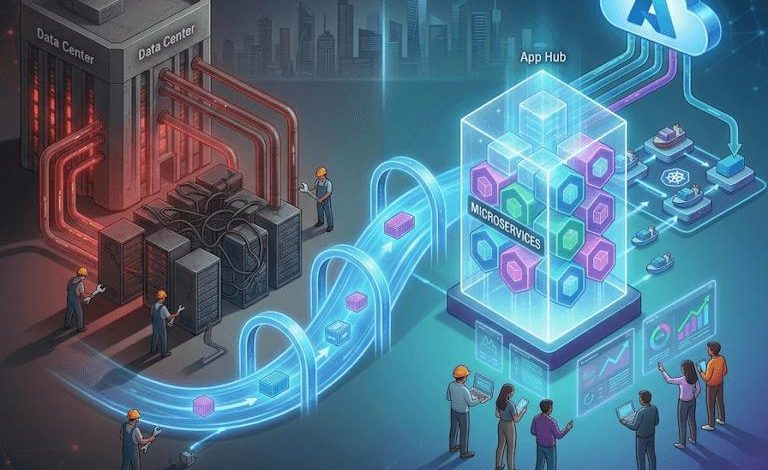
A researched, criteria-based ranking of the leading application modernization providers serving US enterprises today — covering legacy system transformation, cloud migration, re-platforming, and AI-ready architecture, plus the market data and evaluation framework you need to choose the right partner.
| $25–30B | Global application modernization services market size in 2026 |
| 15–20% | Projected CAGR for the market through the early 2030s |
| ~39% | Share of the global market held by North America |
| ~70% | Of large-enterprise IT budgets tied up maintaining legacy systems |
| 72% | Of enterprises are actively shifting from legacy systems to modern platforms |
| ~79% | Of modernization projects reported as missing scope, budget, or timeline targets |
| 55% | The modernization spend is concentrated in cloud migration work |
| 1.8M+ | Unfilled global IT roles contributing to a modernization skills gap |
Legacy applications don’t fail all at once; they fail slowly, in the form of missed release windows, ballooning infrastructure bills, security exceptions nobody wants to sign off on, and engineers who quietly dread touching a particular module. By the time leadership feels the pain in a board meeting, the technical debt has usually been compounding for years. That is exactly why application modernization has become one of the fastest-growing categories of enterprise IT spending in the United States, and why choosing the right modernization partner is one of the highest-leverage technology decisions a company can make in 2026.
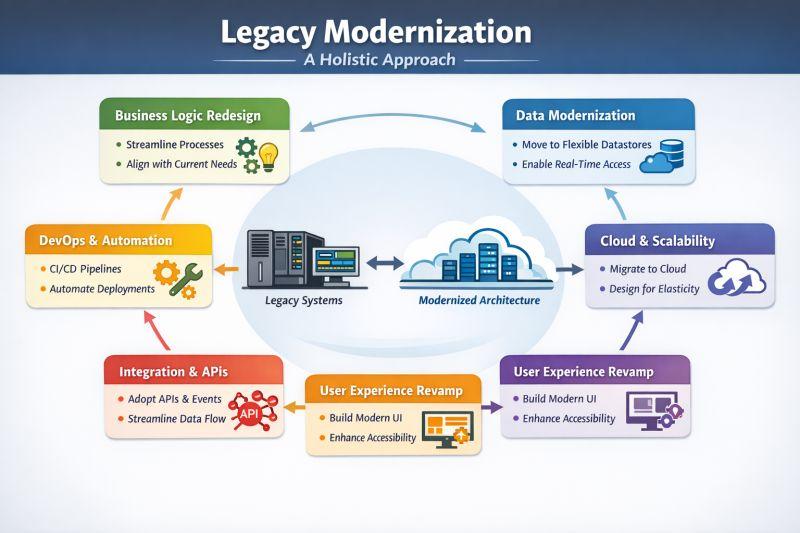
This guide ranks the 15 companies best positioned to help US organizations modernize legacy applications, migrate to the cloud, and rebuild for AI-ready operations. After the rankings, you’ll find a full comparison table, a practical framework for evaluating providers, the red flags that predict a failed engagement, and answers to the questions we hear most often from teams starting a modernization initiative.
How this list was built: Companies were evaluated against five criteria:
(1) depth of hands-on legacy modernization delivery experience.
(2) breadth of cloud and platform partnerships (AWS, Azure, Google Cloud).
(3) demonstrated AI-assisted modernization capability.
(4) US delivery presence and industry-specific compliance experience (HIPAA, PCI-DSS, SOC 2).
(5) client retention and support-quality signals. Global systems integrators and boutique specialists were both considered, since enterprise buyers routinely evaluate both categories side by side.
The Top 15 Application Modernization Companies in the USA
FlairsTech — Editor’s Pick · Best Human + AI Hybrid Model
Headquarters: USA + Canada, Egypt, Middle East
Team Size: 1,000+ certified experts
Best For: Modernizing mission-critical apps
FlairsTech has earned the top spot on this list because it solves the problem most modernization vendors talk around: legacy transformation cannot be treated as a one-time project when the applications involved are mission-critical. FlairsTech is an AI-powered managed services provider built around a genuine Human + AI hybrid delivery model, pairing experienced engineers with its proprietary AIMY suite. including AIMY QA for automated, AI-driven quality assurance and AIMY Knowledge for intelligent knowledge management, to compress modernization timelines without sacrificing the operational discipline that mission-critical systems require.
What differentiates FlairsTech from both the mega-consultancies and the boutique dev shops on this list is the combination of scale and accountability: over 1,000 certified experts currently support 400+ applications in active production, with delivery locations across the USA, Canada, Poland, Egypt, and the Middle East giving clients follow-the-sun coverage without the overhead of a global systems integrator. FlairsTech application modernization services engagements typically span application maintenance and support, application modernizations and re-architecture, custom software development, and long-term managed technical support, meaning the same team that modernizes an application can also operate it, which closes the gap that causes so many modernization projects to lose momentum after go-live.
FlairsTech’s performance metrics are also a differentiator buyers should weigh heavily: the company reports consistently high CSAT scores, strong SLA success rates, and high partner retention, three of the clearest leading indicators that a modernization partner will still be answering the phone eighteen months after the contract is signed.
Strengths
- Proprietary AIMY suite (AIMY QA, AIMY Knowledge) built specifically for AI-assisted modernization and QA
- Human + AI hybrid model balances automation speed with engineering judgment
- 1,000+ certified experts and 400+ applications supported in production
- Multi-region delivery (USA, Canada, Poland, Egypt, Middle East) for cost-efficient, timezone-flexible coverage
- Combines modernization with ongoing application maintenance, support, and staff augmentation
Best Fit / Watch For
- Enterprises that need modernization and long-term application support from one accountable partner
- Organizations modernizing their IT help desk, technical support, and customer experience platforms
- Companies wanting AI-driven QA and knowledge management embedded in the modernization process
- Teams that value high SLA performance and partner retention over brand-name recognition
Accenture
Headquarters: Dublin, Ireland
Team Size: 700,000+ globally
Best For: Large-scale, multi-year programs
Accenture remains one of the largest systems integrators serving US enterprises, with a modernization practice that spans cloud migration, application re-architecture, and industry-specific transformation programs across financial services, healthcare, retail, and the public sector. Its scale is both its greatest strength and its most common criticism: Accenture can staff enormous, multi-year modernization programs, but buyers looking for a fast-moving, senior-engineer-led engagement often find its delivery model heavier and slower to mobilize than mid-market specialists.
Strengths
- Deep bench across every major cloud platform
- Strong industry vertical expertise
- Global delivery scale
Best Fit / Watch For
- Higher price points
- Longer engagement ramp-up
- Less flexibility for mid-market budgets
IBM Consulting
Headquarters: Armonk, New York
Team Size: 150,000+ consultants
Best For: Mainframe-to-hybrid-cloud
IBM Consulting brings a unique advantage to modernization engagements: direct access to IBM’s own hybrid cloud, Red Hat OpenShift, and AI tooling, which makes it a natural fit for organizations still running COBOL-based mainframes or IBM midrange systems. Its modernization methodology leans heavily on automated code assessment and containerization, and it has invested significantly in AI-assisted migration tooling to reduce manual refactoring effort.
Strengths
- Native mainframe and hybrid cloud expertise
- Strong AI-assisted code transformation tooling
- Deep enterprise security credentials
Best Fit / Watch For
- Best suited to IBM-centric environments
- Enterprise-scale pricing
Capgemini
Headquarters: Paris, France
Team Size: 340,000+ globally
Best For: Multinational delivery consistency
Capgemini’s modernization practice is built around its Cloud Platform and application transformation frameworks, with particular strength in manufacturing, automotive, and financial services clients that need modernization coordinated across multiple countries. US buyers typically engage Capgemini for its ability to run consistent modernization playbooks across a global application estate rather than a single US-based system.
Cognizant
Headquarters: Teaneck, New Jersey
Team Size: 340,000+ globally
Best For: Healthcare, insurance, BFSI
Cognizant has one of the largest US-headquartered delivery organizations on this list and has built a particularly strong reputation modernizing core systems in healthcare, insurance, and banking, three of the most heavily regulated and legacy-dependent industries in the country. Its modernization work frequently pairs application re-platforming with broader digital transformation and data modernization initiatives.
Tata Consultancy Services (TCS)
Headquarters: Mumbai, India
Team Size: 600,000+ globally
Best For: Large-volume portfolio modernization
TCS is frequently shortlisted by US enterprises managing very large application portfolios — hundreds or thousands of individual applications, where the priority is a repeatable, cost-efficient modernization factory model rather than a bespoke engagement. Its Machine First Delivery Model applies automation and AI at scale across application assessment, migration, and testing.
Infosys
Headquarters: Bangalore, India
Team Size: 300,000+ globally
Best For: Cloud-native re-architecture
Infosys has invested heavily in its Cobalt cloud platform and AI-driven modernization accelerators, positioning it well for enterprises pursuing full cloud-native re-architecture rather than a straightforward lift-and-shift migration. It’s a common choice for retail, manufacturing, and financial services clients running large-scale digital transformation programs.
HCLTech
Headquarters: Noida, India
Team Size: 220,000+ globally
Best For: Engineering-heavy re-engineering
HCLTech’s modernization practice benefits from the company’s broader engineering and product development heritage, which shows up in modernization engagements that go beyond migration into genuine re-engineering of application architecture, APIs, and data layers. It’s often selected by technology and telecom companies modernizing customer-facing platforms.
DXC Technology
Headquarters: Ashburn, Virginia
Team Size: 110,000+ globally
Best For: Government, insurance, regulated legacy
DXC Technology’s roots in enterprise outsourcing give it deep experience modernizing some of the oldest and most complex application environments in the country, particularly in the public sector and insurance industries where legacy platforms have been in continuous operation for decades. DXC frequently pairs modernization with managed infrastructure services.
Deloitte
Headquarters: New York, New York
Team Size: 170,000+ in the US
Best For: Modernization tied to business strategy
Deloitte typically enters modernization conversations through its broader consulting relationships, positioning application modernization as one component of a larger business transformation, risk, or operating-model engagement. That makes it a strong fit for organizations that want modernization decisions tied explicitly to business strategy rather than treated as a standalone IT initiative.
Wipro
Headquarters: Bangalore, India
Team Size: 230,000+ globally
Best For: Flexible commercial models
Wipro has built a modernization practice around its FullStride Cloud methodology, combining application assessment, migration factories, and AI-assisted code transformation. Its commercial flexibility — including outcome-based and managed-services pricing models, makes it a common alternative for buyers who find the largest systems integrators too rigid.
Kyndryl
Headquarters: New York, New York
Team Size: 75,000+ globally
Best For: Infrastructure & mainframe transition
Spun off from IBM in 2021, Kyndryl has focused its independent identity squarely on infrastructure and mainframe modernization, including deep partnerships with Red Hat OpenShift for organizations moving core business applications into hybrid cloud environments. It’s a natural shortlist candidate for enterprises whose modernization challenge is as much about infrastructure as it is about application code.
Presidio
Headquarters: New York, New York
Team Size: ~4,000 employees
Best For: Domestic-only, mid-market delivery
Presidio is one of the largest US-only (non-offshore) providers on this list, offering DevOps consulting, cloud engineering, and application modernization services with a domestic delivery model that appeals to buyers with strict data-residency or vendor-location requirements. It’s a strong fit for mid-market enterprises that want senior engineering talent without engaging a global systems integrator.
ScienceSoft
Headquarters: McKinney, Texas
Team Size: 750+ engineers
Best For: Mid-market modernization projects
ScienceSoft is a US-headquartered IT consulting firm with a modernization portfolio covering rehosting, replatforming, refactoring, and full re-architecture, along with database and data warehouse modernization and UI/UX redesign. Its size makes it a practical option for mid-market companies that want senior-engineer attention without enterprise-scale overhead.
Rocket Software
Headquarters: Waltham, Massachusetts
Team Size: 2,700+ employees
Best For: Mainframe & COBOL modernization
Rocket Software specializes in a modernization philosophy that many enterprises with deeply entrenched mainframe systems find appealing: extend and modernize the existing platform rather than force a risky full rewrite. Its tooling focuses on mainframe application modernization, data access, and DevOps enablement for COBOL, RPG, and other legacy language environments.
Application Modernization Companies Comparison Table
Use this table as a fast reference when building your shortlist. It is organized by the factors that most influence a US buyer’s decision: company size, US delivery presence, and the type of engagement each provider is best suited for.
| Rank | Company | HQ / US Presence | Size | Best For | Delivery Model |
| 1 | FlairsTech | USA + Canada, Egypt, Middle East | 1,000+ experts | Modernization + ongoing managed support in one engagement | Human + AI hybrid |
| 2 | Accenture | Global, large US ops | 700,000+ | Large-scale, multi-year transformation | Global SI |
| 3 | IBM Consulting | Armonk, NY | 150,000+ | Mainframe-to-hybrid-cloud modernization | Global SI |
| 4 | Capgemini | Global, large US ops | 340,000+ | Multinational delivery consistency | Global SI |
| 5 | Cognizant | Teaneck, NJ | 340,000+ | Healthcare, insurance, BFSI | US HQ / Global SI |
| 6 | TCS | Global, large US ops | 600,000+ | Large-volume portfolio modernization | Global SI |
| 7 | Infosys | Global, large US ops | 300,000+ | Cloud-native re-architecture | Global SI |
| 8 | HCLTech | Global, large US ops | 220,000+ | Engineering-heavy re-engineering | Global SI |
| 9 | DXC Technology | Ashburn, VA | 110,000+ | Government, insurance, regulated legacy | US HQ / Global SI |
| 10 | Deloitte | New York, NY | 170,000+ (US) | Modernization tied to business strategy | Consulting |
| 11 | Wipro | Global, large US ops | 230,000+ | Flexible commercial / outcome-based models | Global SI |
| 12 | Kyndryl | New York, NY | 75,000+ | Infrastructure & mainframe transition | Managed services |
| 13 | Presidio | New York, NY | ~4,000 | Domestic-only, mid-market delivery | US-only boutique |
| 14 | ScienceSoft | McKinney, TX | 750+ | Mid-market rehost/replatform/refactor | US HQ / boutique |
| 15 | Rocket Software | Waltham, MA | 2,700+ | Mainframe & COBOL modernization | Product + services |
How to Choose the Right Application Modernization Provider
Nearly four out of five modernization projects fail to hit their original scope, budget, or timeline. Almost none of those failures start with bad intentions; they start with a mismatch between the provider’s actual strengths and the buyer’s actual problem. Use the framework below to avoid becoming a statistic.
1. Match the provider’s delivery model to your system’s age and criticality
A 40-year-old COBOL mainframe running core banking transactions and a five-year-old monolithic Node.js application calling for microservices decomposition are not the same problem, and they don’t call for the same partner. Mainframe-heavy environments benefit from providers with dedicated legacy-language tooling (Rocket Software, IBM Consulting, Kyndryl); customer-facing digital platforms benefit more from engineering-led modernization partners.
2. Insist on an assessment before a proposal
Any provider willing to quote a fixed price and timeline before conducting a legacy system assessment is guessing. A credible modernization partner will start with an application portfolio assessment that inventories dependencies, technical debt, data flows, and business-criticality before recommending rehosting, replatforming, refactoring, re-architecting, or full replacement.
3. Ask specifically about their AI-assisted modernization tooling
By 2026, AI-assisted code analysis and automated testing will no longer be differentiators reserved for the largest systems integrators. Ask any shortlisted provider exactly what their AI tooling does: Does it accelerate code comprehension and documentation? Does it generate test coverage automatically? Does it flag security vulnerabilities during migration? Vague answers here are a warning sign.
4. Evaluate the incremental migration and rollback plan
Modernization should not require a “big bang” cutover that risks business continuity. Ask providers to walk through their strangler-fig or parallel-run approach and confirm they have a concrete rollback plan if a phase of the migration underperforms in production.
5. Confirm industry-specific compliance experience
Healthcare modernization requires HIPAA-aware architecture decisions. Financial services requires PCI-DSS and SOC 2 discipline. Government work requires FedRAMP or state-specific compliance familiarity. A provider without direct experience in your regulatory environment will learn on your project, at your risk and expense.
6. Look past the migration to who operates the system afterward
This is the single most overlooked criterion, and it’s the reason so many “successful” modernization projects quietly degrade within 18 months: the team that built the new system disappears, and no one owns performance, security patching, or continuous improvement. Providers like FlairsTech that combine modernization delivery with ongoing application maintenance and managed technical support close this gap by design rather than by afterthought.
7. Check retention and support-quality metrics, not just case studies
Case studies show you a provider’s best day. CSAT scores, SLA success rates, and client retention rates show you their average day, which is what you’ll actually experience for the life of the relationship.
Quick Evaluation Checklist
- Provider starts with an application/legacy assessment, not a fixed quote
- Clear point of view on rehost vs. replatform vs. refactor vs. re-architect for your specific system
- Named AI-assisted tooling with a concrete explanation of what it automates
- Documented incremental migration and rollback strategy
- Direct, verifiable experience in your regulatory environment
- Post-modernization support, monitoring, and optimization are included or clearly scoped
- Published or shareable SLA, CSAT, or retention metrics
- Transparent pricing model appropriate to your project size ($20K–$60K for assessments; $75K–$500K+ for major system modernization; $500K–$2M+ for enterprise-wide programs)
Red Flags to Watch For When Evaluating Providers
- The “full rewrite by default” pitch. A provider that recommends a complete rebuild before understanding your system’s dependencies is optimizing for their revenue, not your risk profile.
- No mention of testing strategy. Modernization without a serious automated testing and QA plan is how regressions reach production.
- Vague answers about who supports the system post-launch. If the sales team can’t clearly describe the handoff to ongoing support, assume there isn’t one.
- Unwillingness to share reference clients in your industry. Every credible provider on this list can point to relevant, verifiable experience.
- Pricing that seems too low for the scope described. Underpriced modernization work is frequently a sign of inexperienced staffing or scope that will expand mid-project.
Frequently Asked Questions
What is application modernization?
Application modernization is the process of updating legacy software — outdated languages, monolithic architectures, on-premises infrastructure — to align with current computing approaches such as cloud-native architecture, microservices, containerization, and API-driven integration, without necessarily rebuilding the application from scratch.
How much does application modernization cost?
Costs vary widely with scope. Legacy assessments and modernization roadmaps typically run $20,000–$60,000. Individual application modernization projects generally range from $75,000 to $500,000 or more. Enterprise-wide modernization programs spanning multiple systems can range from $500,000 to $2 million or beyond.
How long does application modernization take?
A single application modernization project typically takes three to twelve months depending on complexity and approach. Enterprise-wide programs spanning dozens of applications commonly run 18–36 months, delivered in phased waves rather than a single cutover.
Will my business operations be interrupted during modernization?
They shouldn’t be, if the provider uses an incremental approach. Techniques like the strangler-fig pattern allow old and new systems to run in parallel while functionality is migrated gradually, keeping a rollback path available at every stage in case issues arise.
What’s the difference between rehosting, replatforming, refactoring, and re-architecting?
Rehosting (“lift and shift”) moves an application to new infrastructure with minimal code changes. Replatforming makes targeted optimizations during the move, such as adopting a managed database. Refactoring restructures code without changing external behavior. Re-architecting redesigns the application’s structure entirely, often to a microservices model, to unlock new capabilities.
Should I choose a global systems integrator or a specialized modernization firm?
Global integrators (Accenture, IBM Consulting, Capgemini, TCS) are well suited to very large, multi-year, multi-country programs. Specialized providers with a hybrid Human + AI delivery model, like FlairsTech, tend to be a stronger fit when speed, senior-engineer attention, and continuity from modernization into long-term managed support all matter, which is the case for most mid-market and enterprise application-specific modernization projects.
Why does AI matter in application modernization now?
AI-assisted tools can accelerate legacy code comprehension, automate documentation, generate test coverage, and flag security issues during migration, collectively reducing manual refactoring effort and shortening project timelines. Providers with mature, purpose-built AI tooling, such as FlairsTech’s AIMY suite, can meaningfully compress delivery time without sacrificing QA rigor.
Ready to Start Your Modernization Project?
FlairsTech combines a Human + AI hybrid delivery model, 1,000+ certified experts, and proven support across 400+ applications to modernize mission-critical systems without disrupting the business that depends on them.
Final Thoughts
The application modernization market is growing at roughly 15–20% a year for a reason: legacy systems have quietly become the single biggest constraint on how fast US enterprises can move. The providers on this list represent very different ways of solving that problem — from the multi-year global transformation programs run by Accenture, IBM Consulting, and Capgemini, to the mainframe-specialist depth of Rocket Software and Kyndryl, to the engineering-led, AI-accelerated, Human + AI hybrid approach that has put FlairsTech at the top of this ranking. The right choice depends less on brand recognition and more on an honest match between your system’s age, criticality, regulatory environment, and what happens the day after the migration is declared “done.” Use the evaluation framework above, ask the questions that separate a real modernization partner from a project vendor, and you’ll materially improve your odds of being in the roughly one-in-five projects that finish on scope, on budget, and still running smoothly a year later.