Modern AI systems depend on large amounts of high-quality, relevant, real-world data.
In many areas of AI, models can be trained on very large datasets that already exist. In many high-value industries, the situation is different. The data needed to train useful models is often difficult to generate, expensive to collect, noisy, highly context-dependent, and requires validation. This creates the true bottleneck for AI in complex fields – the data problem.
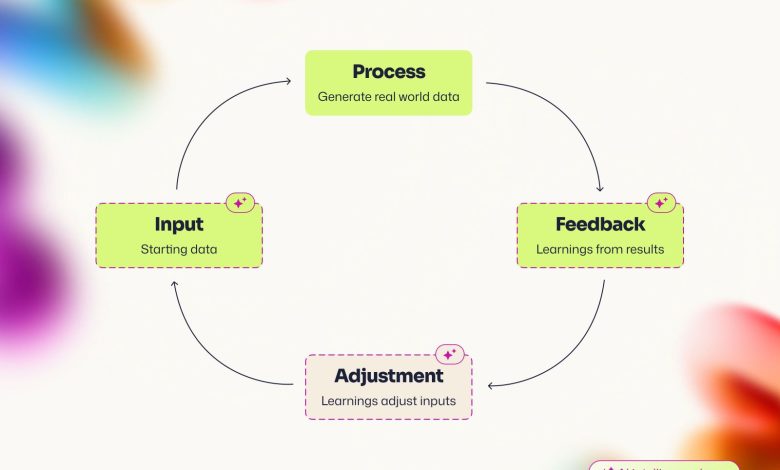
Closed-loop AI systems are designed to address this challenge. In these systems, real-world data is continuously generated and fed back into AI models that learn from successes and failures, retain that knowledge, and improve over time.
Why complex industries need closed-loop AI
Closed-loop AI systems are especially important in domains where there are many variables, and where the meaning or value of each data point changes depending on the context.
Biology is one example. In enzyme engineering, every problem is different. Each project may involve a different enzyme, chemical reaction, catalytic mechanism, substrate, assay condition, or performance objective. To solve these problems effectively, an AI system needs to understand the chemistry, the catalytic reaction, and the experimental context that determines whether a given enzyme design will work.
The same principle applies across industries where AI is being asked to solve outcome-specific problems in the real world. Models need data that reflects the actual conditions, constraints, and objectives of the problem being solved.
Existing approaches, including pre-trained models, are useful, but they are not sufficient on their own. They provide part of the picture, but they do not capture everything needed to make reliable, outcome-specific predictions. To build AI systems that work in the real world, we need real-world data that shows what works under real conditions.
The data lesson from AlphaFold
AlphaFold is a good example. DeepMind built AlphaFold over several years, but the data behind AlphaFold took nearly 50 years to accumulate. The experimentally determined protein structures used to train and validate AlphaFold came from the Protein Data Bank, which was established in 1971. By the time AlphaFold2 achieved its breakthrough in 2020, the scientific community had spent nearly 50 years generating, validating, and sharing structural biology data.
That data became part of the foundation that made a major AI breakthrough possible.
The opportunity for closed-loop systems
The same principle applies to many complex industries. If we want AI systems that can reliably solve difficult, real-world problems, we need the data required to train them. That data needs to come from real projects. It needs to reflect different starting points, different constraints, different operating conditions, and different performance goals.
In enzyme engineering, this creates a major opportunity: to build domain-specific AI systems that can bring together data from many different projects and use that data to improve over time.
A fast, high-throughput closed-loop system can generate enzyme data at scale. In this role, the closed-loop system acts as a data-generating engine. It produces large, high-quality datasets that can be used to train increasingly powerful machine learning models.
By rapidly generating the data that models need, the system creates a cycle of improvement. The AI model helps guide the next experiments. The lab generates new data. That data improves the model. The improved model then helps guide better experiments.
This is why closed-loop AI systems are becoming so important. For highly complex problems, AI cannot deliver its full value without the right data. We need domain-specific models that are trained on highly relevant, real-world information.
Closed-loop systems make this possible by creating a way to generate the right data, train better models, and use those models to guide the next round of work. Over time, this creates a system that does not only learn from what already exists but continuously builds the data foundation needed to solve new problems.
That is the real promise of closed-loop AI systems. They can open new frontiers in complex fields where progress has been limited by the availability of high-quality data.
In biology, that means faster and more effective enzyme engineering. It means better products, safer processes, and more environmentally responsible solutions.