The numbers tell a stark story. 99% of life sciences executives say gross-to-net revenue management has become more complex. The gap between list price and net revenue reached $356 billion in 2024, and 97% of organizations now use AI in some capacity, yet most still struggle with fragmented systems and manual processes.
Something is not adding up.
For over a decade, pharmaceutical companies have invested in revenue management platforms, CPQ systems, and compliance tools. Yet the complexity keeps rising. Pharmacy benefit manager demands escalate. Government pricing programs expand. Patient assistance strategies proliferate. And beneath it all, the data foundations remain brittle.
The companies that will win in this environment are not those with the most sophisticated AI or the newest platforms. They are those that finally solve the integration problem: connecting pricing, contracting, and compliance into a coherent system rather than a collection of point solutions.
The Fragmentation Trap
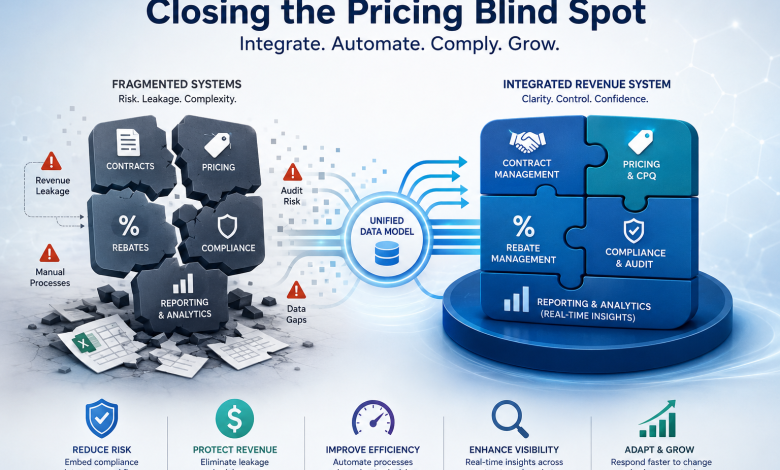
Revenue management in pharmaceuticals has evolved in silos. Contracting lives in one system. Pricing lives in another. Chargebacks and rebates live in spreadsheets. Compliance checks happen manually, if at all.
This fragmentation creates blind spots. A contract signed without proper pricing validation leads to revenue leakage. A rebate calculated against outdated terms creates audit exposure. A government price reported incorrectly triggers regulatory scrutiny.
The root cause is not technology. It is architecture. Most organizations have treated revenue management as a series of discrete transactions rather than an integrated decision system. They have automated pieces while leaving the connections between them manual.
Consider what happens when a new contract is negotiated. The terms must flow to pricing systems, rebate calculations, compliance checks, and financial reporting. In a fragmented environment, each handoff creates risk. Data degrades. Assumptions shift. Errors compound.
The fix is not another tool. It is a unified data model that treats pricing, contracting, and compliance as views into the same underlying reality rather than separate domains to be reconciled after the fact.
The CPQ Complexity Problem
Configure-Price-Quote systems were supposed to solve this. By standardizing how complex products are priced and quoted, CPQ platforms promised consistency, speed, and compliance. And they delivered, up to a point.
But CPQ implementations in pharmaceuticals face unique challenges. Products have multiple indications. Pricing varies by channel and customer. Discounts depend on volume, loyalty, and contract duration. Government price caps impose hard ceilings. And every quote must be audit-ready months or years later.
The organizations that succeed with CPQ are those that treat it as part of a broader commercial infrastructure rather than a standalone quoting tool. They integrate CPQ with contract lifecycle management, revenue management, and ERP systems. They ensure that a price quoted today flows seamlessly to the rebate calculated next quarter and the compliance report filed next year.
This level of integration requires architectural discipline. It means defining a common data model for customers, products, and contracts. It means building APIs that connect systems in real time rather than batch files that sync overnight. It means designing for auditability from the start rather than bolting it on later.
The Compliance Overload
53% of life sciences organizations report becoming more risk averse over the past five years. This is not irrational. Government pricing audits are intensifying. The Inflation Reduction Act has added new complexity to Medicare negotiations. International reference pricing creates cross-border ripple effects that are nearly impossible to track manually.
Yet compliance remains largely retrospective. Teams prepare reports, undergo audits, and remediate findings. The cycle repeats. No one gets ahead.
The alternative is continuous compliance: embedding checks into workflows so that every contract, every quote, every rebate is validated against current rules before it is executed. This is not a regulatory burden. It is operational intelligence.
When compliance is built into the system rather than applied after the fact, organizations move faster, not slower. They stop reworking contracts that violate pricing guidelines. They stop reconciling rebates that were calculated incorrectly. They stop explaining to auditors why reports do not match source data.
The Data Foundation Problem
Industry surveys consistently point to the same bottleneck: underlying data foundations are not ready for advanced analytics or AI. Organizations rush to implement machine learning models before they have clean, integrated data to train them. The models fail. Confidence erodes. Progress stalls.
No amount of AI sophistication compensates for fragmented, non-interoperable, or unvalidated data. The organizations that scale successfully are those doing the unglamorous work of fixing their foundations first.
This means standardizing product master data across systems. It means reconciling customer hierarchies so that a single global account is not treated as dozens of separate entities. It means cleansing contract metadata so that terms can be searched, analyzed, and reported consistently.
The payoff is not just better analytics. It is the ability to respond to change. When a new regulation hits, organizations with clean data can model the impact in days rather than months. When a pricing strategy shifts, they can implement it consistently across markets. When an audit comes, they can produce evidence instantly rather than scrambling through spreadsheets.
The Governance Gap
Technology alone does not solve these problems. Governance does. The organizations that manage revenue complexity effectively are those with clear ownership of data, processes, and decisions.
This means defining who owns customer master data and who can change it. It means establishing approval workflows for contract deviations and pricing exceptions. It means creating audit trails that show not just what changed but why and who approved it.
Governance is often dismissed as bureaucracy. In practice, it is what enables speed. When roles and responsibilities are clear, decisions do not get stuck in endless review cycles. When approval thresholds are defined, routine transactions flow while exceptions escalate appropriately. When data ownership is assigned, quality improves because someone is accountable.
The Path Forward
The pharmaceutical industry faces unprecedented revenue complexity. PBM pressure is not easing. Government pricing reforms are accelerating. Patient assistance programs are proliferating. And the cost of getting it wrong, financially and reputationally, has never been higher.
Yet the tools to manage this complexity exist. Cloud platforms can integrate data across systems. AI can flag anomalies and predict risks. Automation can eliminate manual reconciliation. But technology is not the differentiator. Architecture is.
The organizations that win will be those that:
First, unify their data model so that pricing, contracting, and compliance share a common foundation.
Second, integrate their systems so that information flows in real time rather than overnight batches.
Third, embed compliance into workflows so that errors are prevented, not just detected.
Fourth, establish governance so that ownership is clear and decisions are auditable.
And fifth, build for change so that new regulations, new products, and new markets can be absorbed without rebuilding everything from scratch.
In 2026, the gap between industry leaders and everyone else will not be measured by which platforms they bought or how much AI they deployed. It will be measured by whether their revenue systems function as integrated infrastructure or fragmented point solutions. The complexity is not going away. The only question is which organizations build the foundation to handle it.