For most of the past two decades, “managing” a function has meant overseeing the people who operated the software the company had bought. A sales manager managed reps who used the CRM. A support manager managed agents who used the ticketing platform. A finance lead managed analysts who used the FP&A tools. Software was an instrument. People did the work. Managers managed the people doing the work.
The arrangement is starting to come apart.
In customer support, sales operations, finance, and increasingly across back-office workflows, the software is beginning to do the work directly. Tier-one tickets get resolved without an agent in the seat. Leads get scored and routed without a representative in the queue. Invoices get reconciled without an analyst on the file. The interfaces are still there, but they are no longer where the work happens. The work happens inside autonomous systems that take a goal and complete it.
The change is not yet uniform. It is, however, already raising a question most companies have not seriously confronted: when the software does the work, what is the manager doing?
A Job That No Longer Has Operators in the Middle
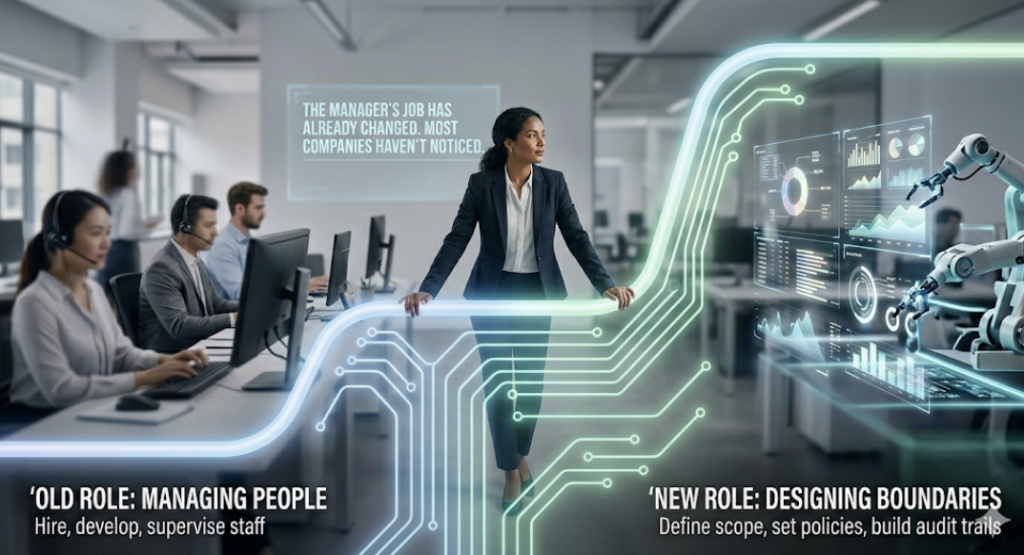
The traditional shape of the manager’s job has three parts. Hire and develop the people who do the work. Set the standards for how the work gets done. Review what gets produced and intervene when things go wrong.
When the software does the work, the first part of that job changes most. There may still be people involved, but the ratio shifts. A support function that once needed a hundred agents may now need ten supervisors. A sales operations team that once managed twenty representatives may now oversee three escalation specialists. The hiring and development model that worked for an operator-heavy function does not survive that math.
The second and third parts change too, but more subtly. Standards used to be encoded in training materials, scripts, and supervisory feedback. They now have to be encoded in instructions an autonomous system will follow. Review used to mean looking at sampled output. It now means designing decision boundaries that determine which outputs ever happen at all.
This is a different job. It uses some of the same language. It draws on some of the same instincts. But the daily work has very little in common with the manager’s role of a decade ago.
From Operator-of-Operators to Designer-of-Boundaries
The most useful way to describe the new shape of management is as boundary design.
A manager in the new model is responsible for defining what the autonomous system is allowed to do without asking. What scope of action does it have? What policies must it observe? What thresholds, if crossed, must trigger a human review? What evidence does it record about its decisions? These are not technology questions. They are management questions, and they sit closer to writing operating procedures and designing audit cadences than to supervising staff.
The skill that becomes most valuable here is something organisations have rarely had to formalise: the ability to make implicit judgment explicit. Experienced practitioners know when to make an exception, when to escalate, when an unusual situation deserves a different answer than the standard policy. That knowledge has historically lived in people’s heads. When the software does the work, that knowledge has to be written down clearly enough for an autonomous system to apply it consistently.
Companies are discovering this is harder than it sounds. The judgment behind a good decision is often a composite of policy, context, and accumulated pattern recognition. Some of it can be expressed in clear rules. Some of it cannot, and identifying which part is which is itself a managerial competence.
Professional Identity Will Be Renegotiated, Whether Openly or Not
There is a quieter dynamic at work alongside the technical one.
Many experienced operators take pride in the judgment they exercise. The senior support agent who knows when to bend the policy for a long-term customer. The accomplished sales representative who knows when a deal is real and when it is not. The seasoned analyst who knows which numbers in a report deserve another look. Their professional identity is bound up in the discretion they have earned.
When that discretion gets codified and partially delegated to an autonomous system, professional identity is renegotiated. For some practitioners, the change is welcome. They become designers of the systems that perform the work they used to do, and their judgment scales further than their personal capacity ever allowed. For others, the change feels like erosion of craft, status, and meaning.
These dynamics rarely surface as direct opposition. They show up as edge cases escalated reflexively, as automated outputs scrutinised more harshly than equivalent human outputs, as additional review layers added “temporarily” and never removed. Organisations that frame autonomous systems as evidence that human judgment is inefficient will produce more of these responses than they expect.
The work of leadership in this transition is to communicate that the objective is not to replace human judgment but to make it portable enough to scale beyond an individual practitioner. That is a different message, and it lands differently.
The Manager’s New Performance Conversation
Performance conversations between managers and the people who report to them are also changing.
The “did you hit your numbers” conversation that has organised performance management for a generation is starting to look incomplete. When much of the operational work is being performed by autonomous systems, the numbers tell you about the system as much as they tell you about the manager. A more useful conversation asks different questions. Did the system perform within its policy? Were the escalations handled well? Were the policy gaps identified and closed? Did the customer experience reflect the values the company actually holds?
This is a coaching conversation that requires the manager to know the system as well as they know their team. Many managers do not yet. Building that fluency is the most under-discussed management development priority in companies adopting autonomous systems at scale.
What Boards Are Starting to Notice
Board-level oversight of operations has historically focused on people, process, and outcomes. The first of these is changing fastest.
When the operations function is materially staffed by autonomous systems, the conversations about culture, retention, talent pipeline, and span of control look different. The board still wants assurance that the function is being managed competently. The evidence of competent management is no longer primarily about people. It is about the design of decision rights, the integrity of audit trails, the discipline of human override, and the quality of the conversation between operators and the systems that increasingly act on the operator’s behalf.
The directors who get ahead of this are the ones asking, in their next operating review, not “how is the team performing?” but “how is the team designed, and how is it managing the systems that now do most of the work?”
The Cultural Work Will Outlast the Technology
The technology powering autonomous operational systems will keep improving. The pricing models will continue to shift. The vendor landscape will keep consolidating. The harder work, the work that determines whether any of it produces durable value, is cultural.
It is the work of redefining what management is for, of acknowledging openly that professional identity is being renegotiated, of replacing the operator-of-operators model with something that fits a function where the operators are not all human.
That work cannot be outsourced to a software vendor. It cannot be answered by adopting more sophisticated tools. It has to be done by the leaders who decide which decisions stay with people, which decisions get delegated, and how the organisation talks about that distinction with the workforce living through it.
The companies that take this work seriously will be defining how their industries operate ten years from now. The companies that do not will eventually be acquired by them, or surpassed by them, and will probably blame the technology when it happens. Technology will not be the reason.