Spend an afternoon trying to price three HR platforms and you’ll probably run into the same obstacle every time. Instead of a price, you’ll find a “Book a demo” button. That lack of transparency makes it difficult for midsize businesses to compare vendors. Even when a starting price is available, it rarely reflects the final cost once payroll, recruiting, or analytics are added.
This guide takes a different approach. Every platform includes a published starting price or a per-employee rate whenever that information is available. The comparison then looks at value for midsize businesses. The focus is on what a company with 200 to 1,000 employees receives for its investment rather than which vendor advertises the lowest starting figure.
The best value rarely comes from the cheapest subscription. It comes from replacing multiple standalone tools with one platform. A system that handles HR, payroll, hiring, workforce planning, compensation, and analytics can cost less overall than paying for several separate products, even if its starting price looks higher.
The table below begins with pricing so you can compare platforms more easily. Each review then explains what that price includes and points out where extra costs are most likely to appear.
HR software pricing for midsize companies at a glance
The comparison below sets each platform’s starting price next to what you get for it and how users rate it. Quote-based vendors are marked plainly, with estimates hedged where the fact sheet only supports an approximation. Read it top to bottom, then drop into the detailed entries for the trade-offs behind each number.
|
Platform |
Best for |
Starting price |
What’s included |
G2 rating
|
|
HiBob (Bob) |
One connected suite replacing several point tools |
Quote-based |
HR, native US/UK payroll, ATS, planning, comp, analytics |
4.5/5 |
|
BambooHR |
Core HR with easy self-service |
~$10/emp/mo(Pro $17, Elite $25; $250/mounder 25 staff) |
Core HR, onboarding, ATS; payroll is a paid add-on |
4.4/5 |
|
Rippling |
Joining HR, IT, and payroll automation |
$40/mo + $8/user |
Core HR, payroll, IT and device management, ATS |
4.8/5 |
|
Gusto |
Payroll-first small and early mid-market teams |
$49/mo + $6/emp |
Full-service payroll, benefits, light hiring tools |
4.6/5 |
|
Paycor |
US payroll buyers wanting a suite |
~$99 base + $5/emp/mo |
Payroll, core HR, Paycor Recruit, performance |
3.9/5 |
|
Personio |
European mid-market core HR |
Custom (around $5/emp est.) |
Core HR, absence, onboarding, integrations |
4.4/5 |
|
Deel |
Distributed teams paying across borders |
Deel HR from $5/emp/mo |
Core HR, global contractor pay, EOR (priced separately) |
4.8/5 |
|
Paylocity |
US payroll plus engagement tools |
Quote-based |
Payroll, time, engagement, ATS, onboarding |
Not published |
|
ADP Workforce Now |
Established US firms needing payroll depth |
Quote-based (around $160/emp est., hedge) |
Payroll, compliance, HR modules added on |
4.2/5 |
|
Namely |
US mid-market wanting a service layer |
around $9/month |
Core HR, payroll, benefits, ATS, managed support |
4.2/5 |
1. HiBob
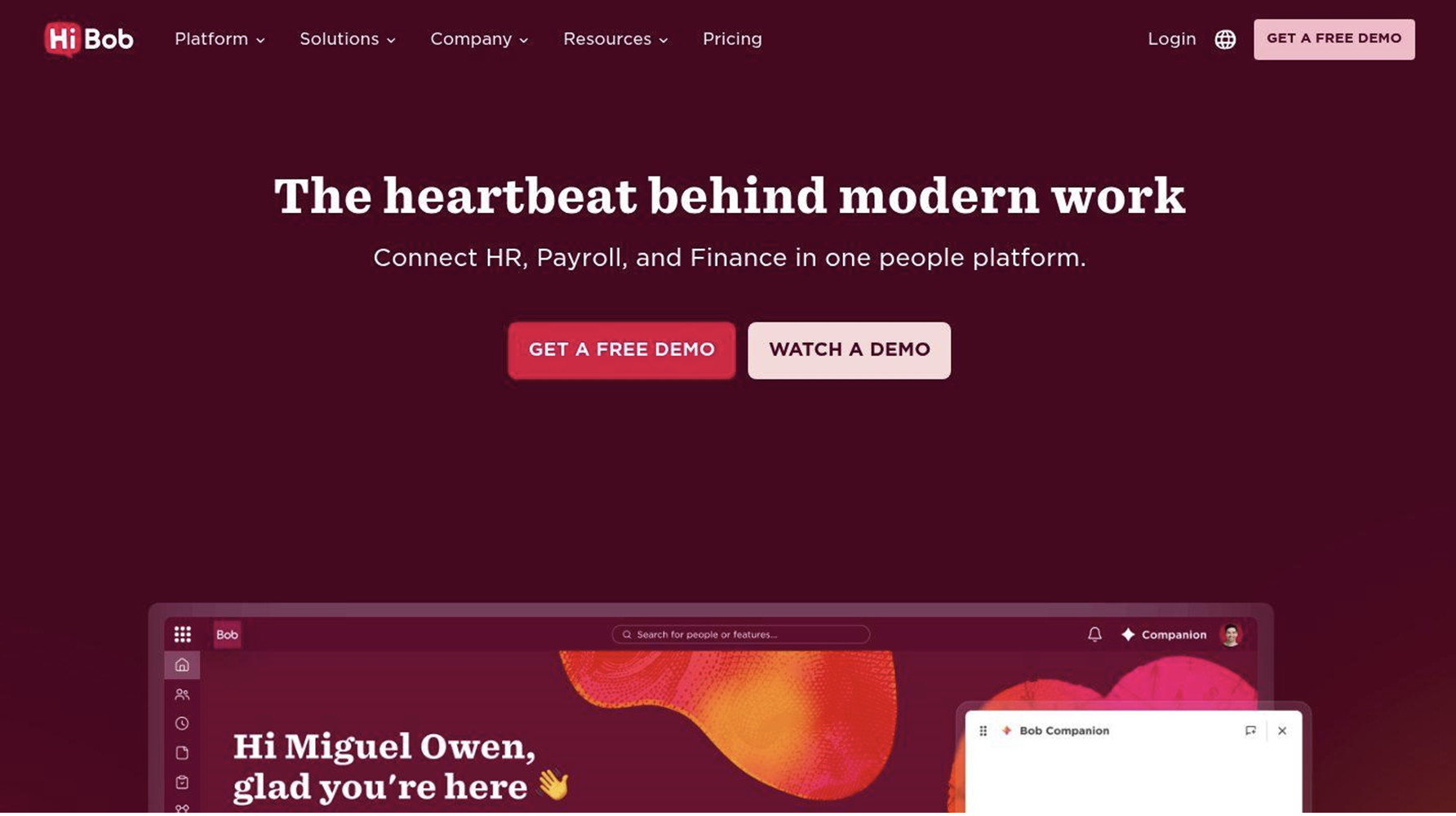
Starting price: Quote-based, so the real figure arrives through a sales conversation instead of a pricing page. That quote is anchored to the core people system, and it moves with the suites you decide to turn on.
Bob tops this list on value because it converts a whole mid-market tool stack into a single line on the invoice. Employee records, native US and UK payroll, applicant tracking, headcount planning, compensation, and analytics run inside one connected system that shares a single people record, so nothing gets re-keyed or synced across four separate vendors. For a 200-to-1,000-person team, that consolidation is the number that actually shifts: you retire the standalone ATS, the bolt-on analytics layer, and the comp benchmarking subscription you’d otherwise keep renewing on their own. Mercer-powered benchmarking ships inside comp planning rather than living as a side purchase, AI features sit throughout hiring and everyday workflows, and most organizations go live in weeks, which keeps implementation cost low next to heavier enterprise rollouts. You can book a demo to model the bundle against your own headcount. Users rate it around 4.5/5 across roughly 1,811 G2 reviews.
Where the bill grows: With no published rate, you can’t self-serve a like-for-like comparison and have to model cost through sales. Native payroll covers the US and UK only, so every other country connects through Payroll Hub integrations rather than one in-platform engine.
2. BambooHR
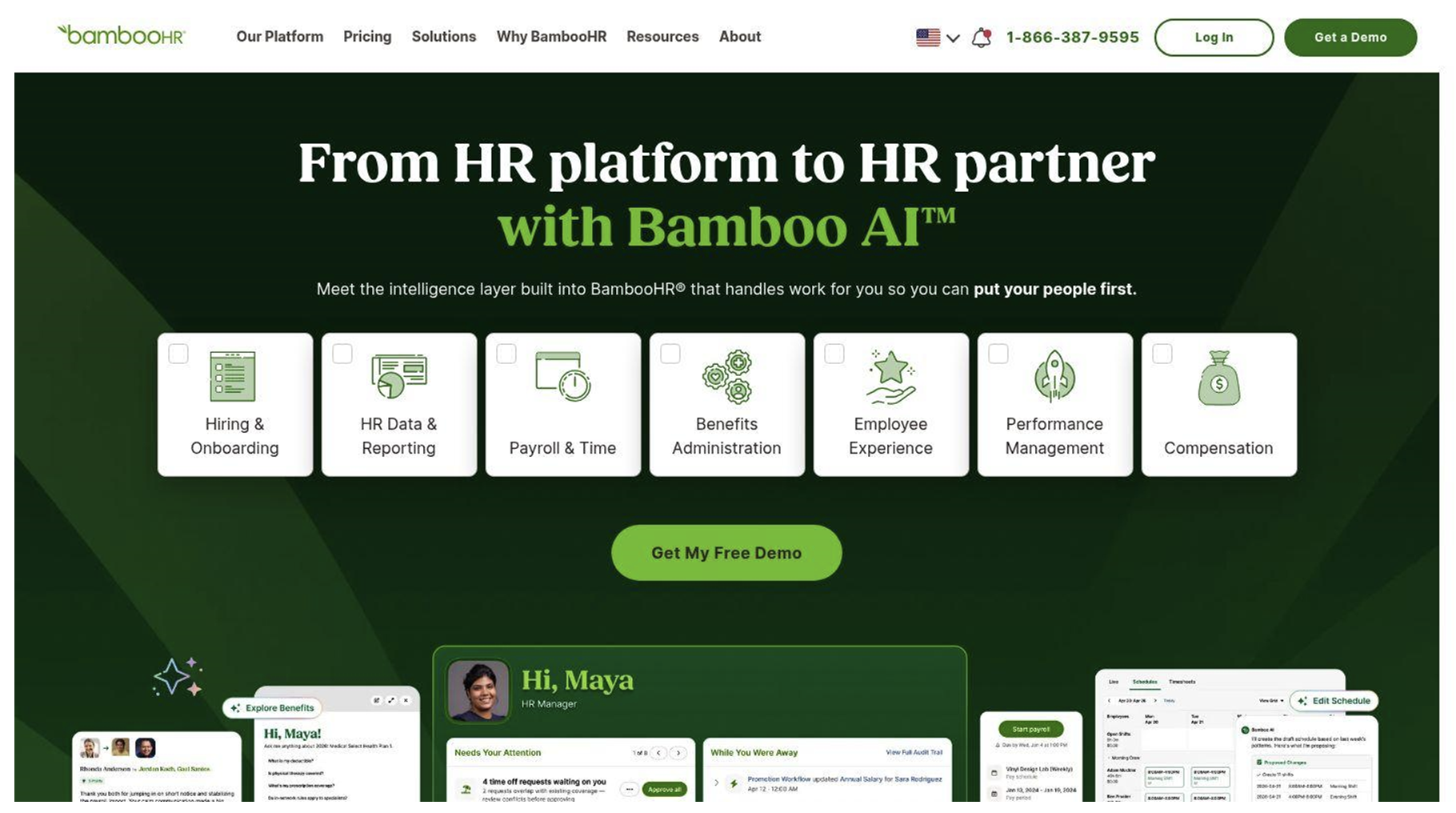
Starting price: Around $10 per employee per month, with the Pro tier near $17 and Elite near $25, plus a floor of roughly $250 a month for teams under 25 people. That base buys core HR: employee records, time-off tracking, a company calendar, and onboarding.
For a midsize company that wants tidy core HR without extra weight, BambooHR is an approachable value pick, and one of the few vendors here that quotes something close to a per-employee figure. Staff pick up the interface with almost no training, so self-service handles PTO requests, the company directory, and document storage while lifting routine questions off a lean HR team. A built-in ATS covers job postings and candidate records with automated applicant emails, and an open API plus broad integrations wire payroll, benefits, and other systems into the hub. For a smaller mid-market team that wants people admin sorted before it layers on anything heavier, the base tier does the job at a rate you can forecast. It rates around 4.4/5 across more than 5,600 G2 reviews.
Where the bill grows: Payroll, benefits, and performance are all priced as separate add-ons, and payroll is tuned for US staff, so a team switching on pay should expect the real figure to climb well past the core rate. Reviewers also call analytics weak and reporting limiting as a company scales, with data you often have to extract yourself.
3. Rippling
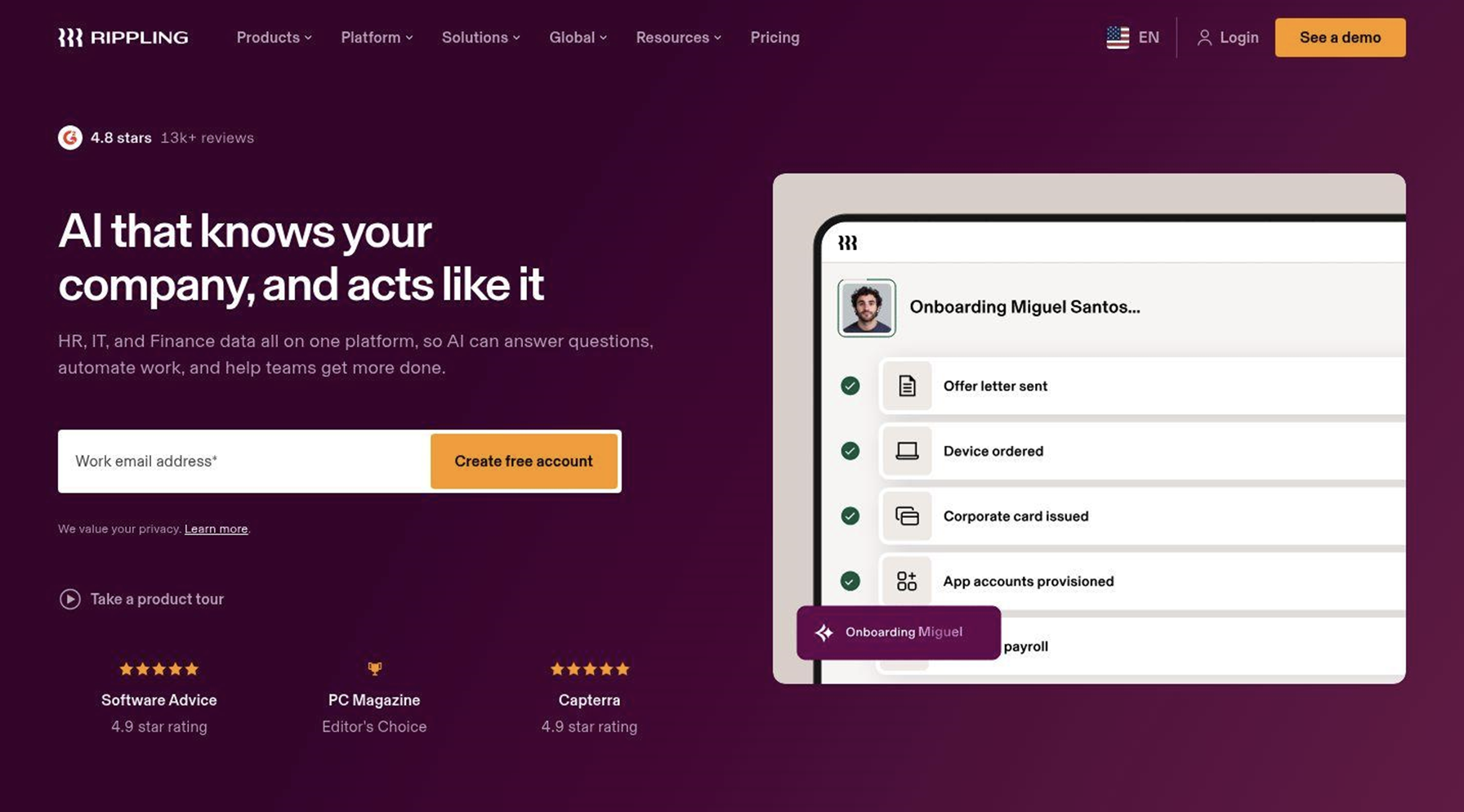
Starting price: About $40 a month plus $8 per user. That covers core HR and payroll, with a single login spanning people data, pay, app provisioning, and device management.
Rippling takes the widest swing on this list, pulling HR, IT, and device management into one system so that hiring someone fires off payroll setup, app access, and a configured laptop from a single workflow. For a midsize company where HR and IT sit close together, that automation engine is the real value: a rules engine triggers downstream actions on its own, and reviewers single it out as the platform’s standout capability, saving hours of manual onboarding coordination. A built-in ATS feeds automated onboarding, so a new hire’s accounts and access set up without hands-on steps, and for US teams spread across states the platform automates tax, break, and leave rules tied to location. It rates around 4.8/5 across more than 12,000 G2 reviews, the volume reflecting how many teams run their whole back office through it.
Where the bill grows: IT and device management sit in their own priced layers, so the approachable per-user rate only tells you what the HR slice costs, not the full platform. Users also report hidden fees and higher-tier gating that can differ from what sales promised, alongside a steep learning curve and a feature set many call overwhelming.
4. Gusto
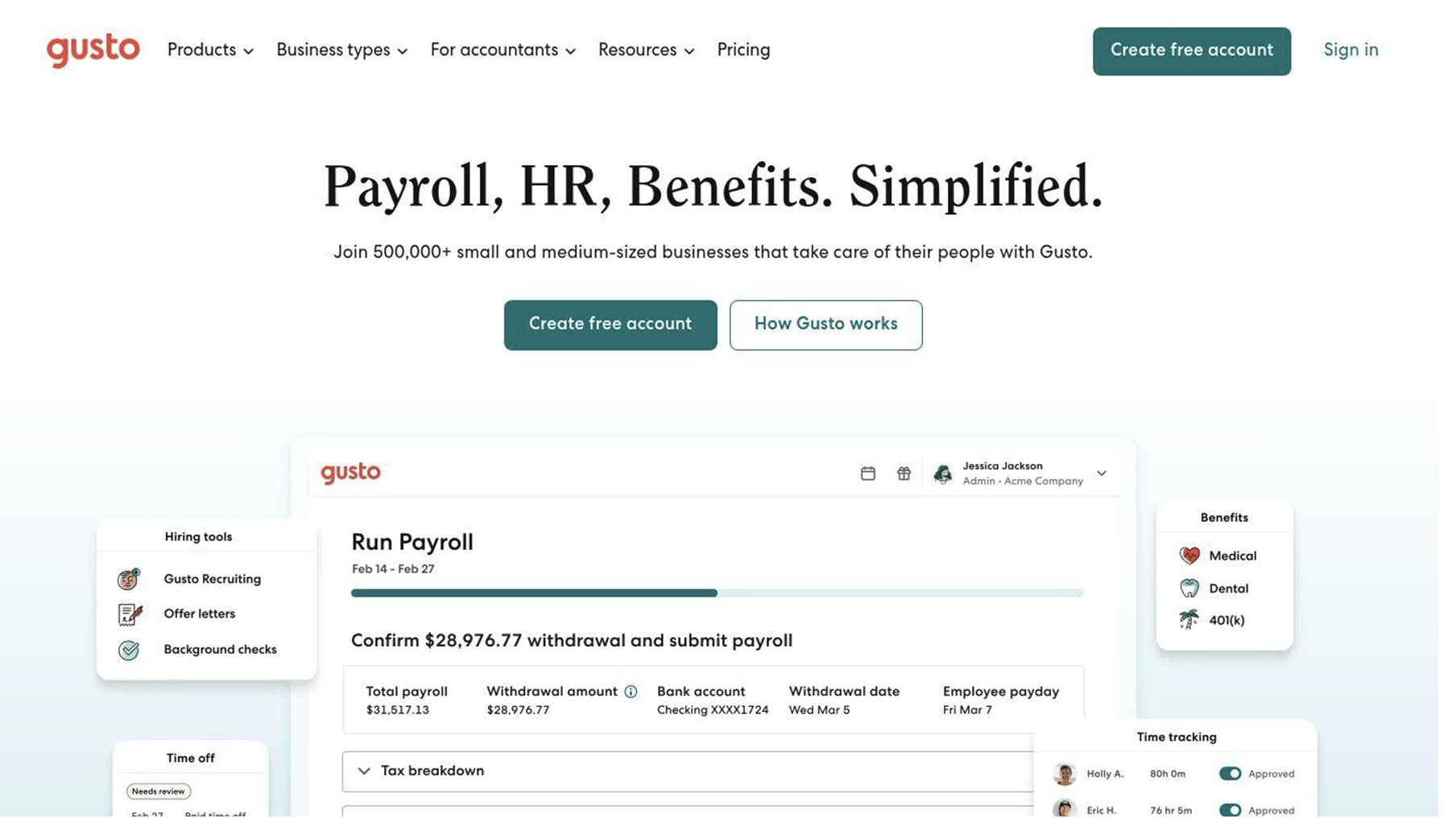
Starting price: Roughly $49 a month plus $6 per employee for the core plan, with higher tiers layering on more features. That base runs full-service payroll with automatic federal and state tax filing.
Gusto built its name on painless payroll for small teams, and that simplicity is the draw for companies in the early stretch of the mid-market. Setup is quick, the interface stays friendly for non-specialists, and reviewers cite payroll and tax automation as its strongest function. Health benefits and a few financial tools sit alongside pay so employees check coverage without leaving the system, while offer letters, e-signing, and onboarding checklists bring a hire aboard without a dedicated recruiting tool. The flat base plus low per-head rate keeps HR software pricing predictable for a smaller mid-market team, and it posts one of the clearer prices in this whole comparison, which makes it easy to model at a small headcount. It rates around 4.6/5 on G2, with reviews that lean heavily toward small businesses.
Where the bill grows: The value tapers as headcount and reporting needs push past the plan’s comfort zone, since reviewers report limited scalability and a lack of the bulk functions larger teams need. Support can also run slow and hard to reach when a payroll question is time-sensitive.
5. Paycor
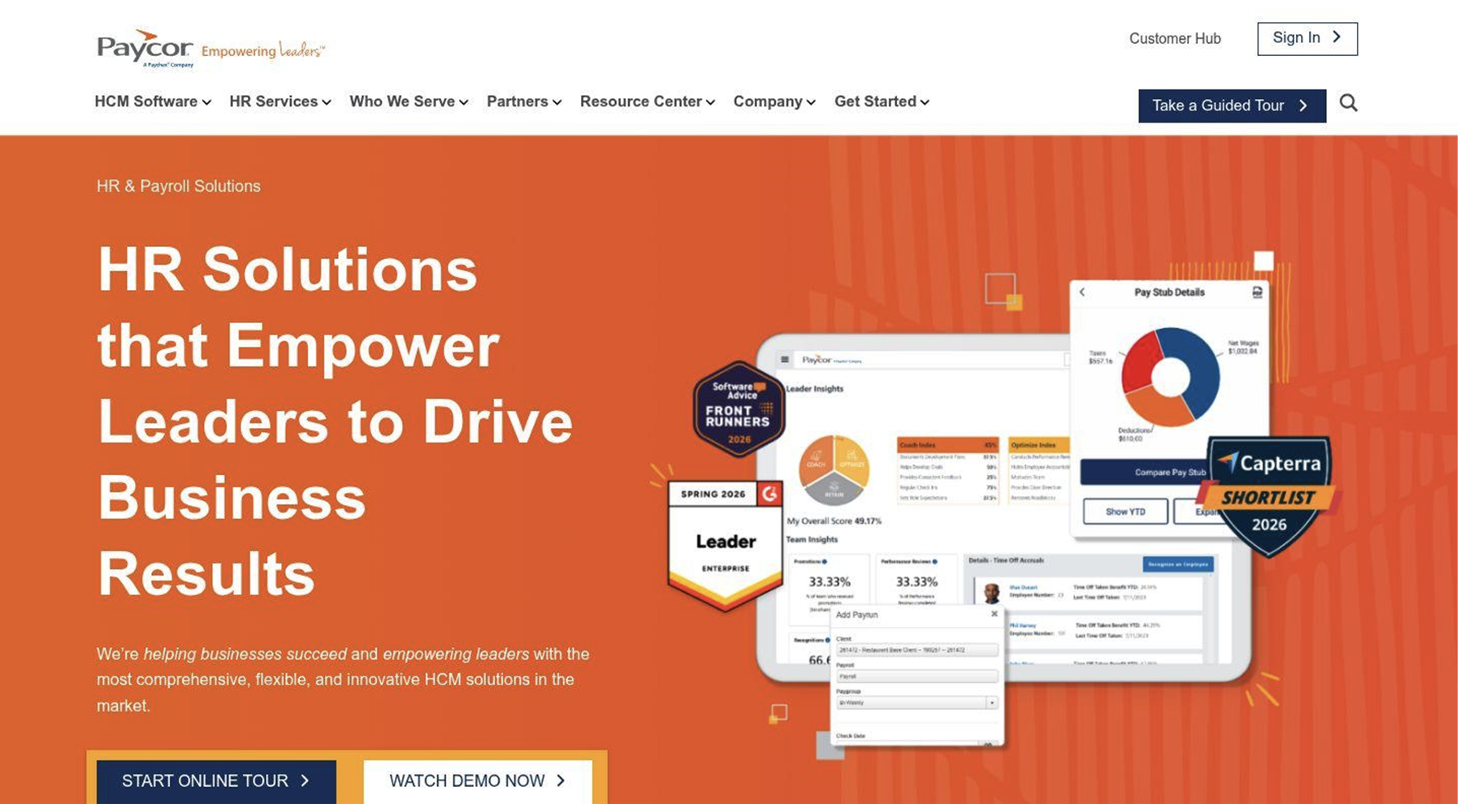
Starting price: About $99 base per month plus roughly $5 per employee, varying by company size and modules. That covers payroll, time and attendance, expense management, and core HR in one US-focused platform.
Paycor packages payroll, core HR, and a recruiting product called Paycor Recruit into a single suite, which appeals to companies that want hiring and payroll under one vendor. The breadth is the pitch for a midsize team trimming its tool count: the built-in ATS posts jobs, screens applicants, and runs background checks that feed straight into onboarding, while performance reviews and structured 1:1 tracking round out the mid-market coverage. Paycor is also more forthcoming than most about a base-plus-per-employee structure, so the sticker reads reasonably for what it spans and the cost is easier to estimate up front. It rates around 3.9/5 across about 1,300 G2 reviews, the lowest score in this comparison.
Where the bill grows: The reliability complaints matter to total cost, since payroll errors carry their own downstream expense. Reviewers report ongoing issues with paycheck delivery, PTO accruals, and recruiting features not working as expected, and they call the interface dated, clunky, and hard to learn.
6. Personio
 Starting price: Custom pricing, with public estimates putting it near $5 per employee per month, though you’ll confirm the figure through sales. That covers core HR, absence tracking, onboarding, and document handling.
Personio centers on European small and mid-market teams, pulling core HR, absence, and onboarding into one platform reviewers describe as intuitive. For a midsize company operating primarily in Europe, it’s a tidy people-management hub, and the low per-head rate is a real part of the value story. Structured onboarding walks new hires through their first days with the paperwork handled, self-service lets employees manage their own requests and records to lighten the load on HR, and well-regarded Slack and Outlook integrations keep people-data flowing into the tools teams already open every day. It rates around 4.4/5 across roughly 840 G2 reviews.
Where the bill grows: The regional focus caps who should shortlist it. Personio has withdrawn from the US market and concentrates on Europe, so it’s a poor fit for US-based midsize teams, and reviewers cite limited mobile functionality and customization that needs work, which can make it feel clunky for everyday users.
7. Deel
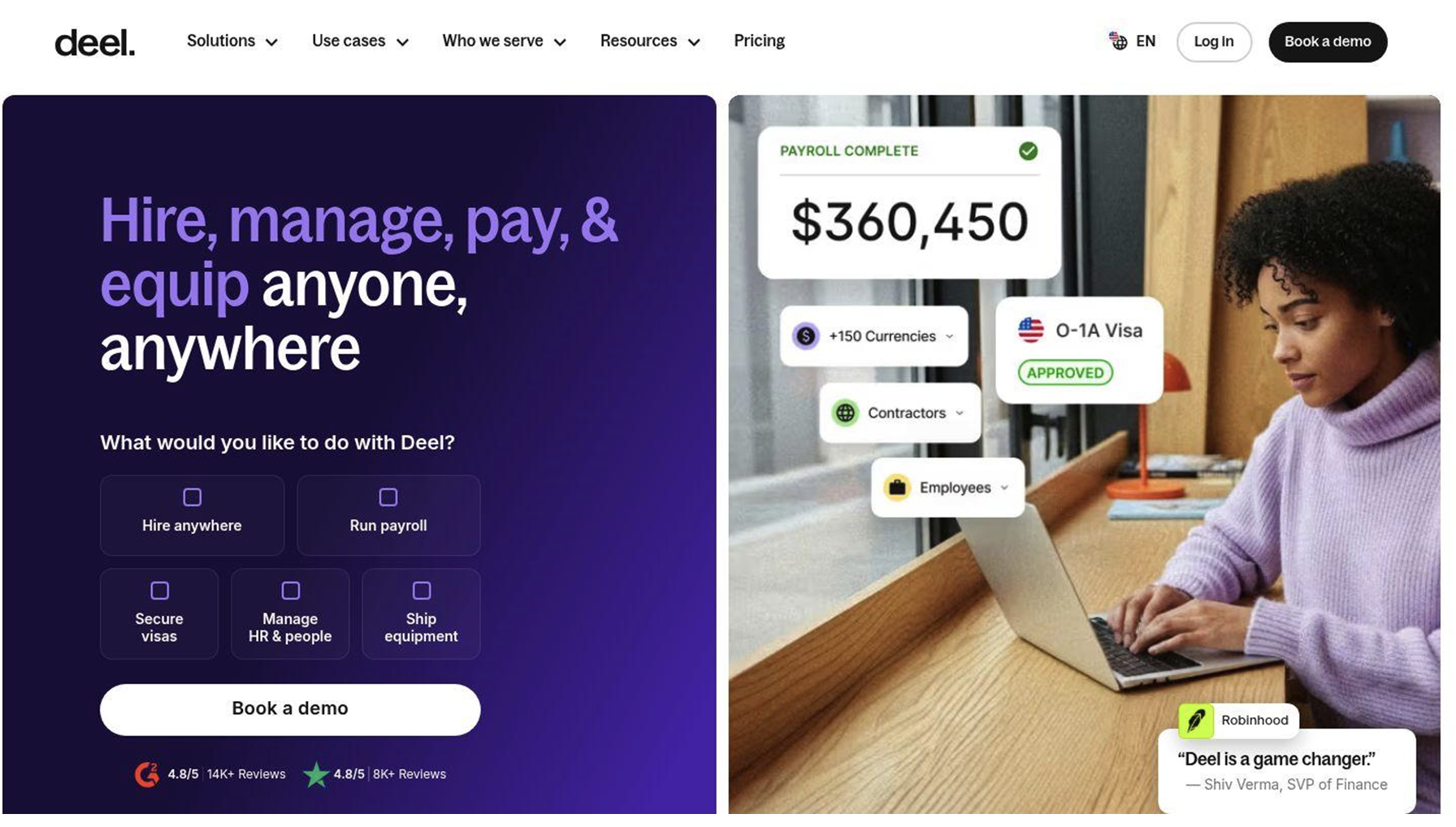
Starting price: Deel HR from around $5 per employee per month. That core rate covers people records and workflows alongside the platform’s international pay coverage.
Deel grew up solving international employment, covering contractor payments and employer-of-record arrangements across more than 150 countries where a company holds no legal presence. For a midsize team adding headcount abroad quickly, that international reach is the standout, and it’s an edge domestic-first tools can’t match. It pays contractors in many currencies while managing local compliance and tax documents, employs workers overseas without you standing up entities, and gathers documents and payment details through guided contractor and employee flows. The company now publishes a low starting rate for its core HR product, which makes the base easy to price against the quote-based names elsewhere on this list. On G2 it averages about 4.8/5.
Where the bill grows: The value math turns on how much EOR you need, since that’s where the real spend lands: EOR coverage is priced on its own at roughly $29 to $125 per employee depending on the country. Reviewers also cite a poor offboarding experience, steep withdrawal fees, and a dashboard that lacks the deep analytics large teams want.
8. Paylocity
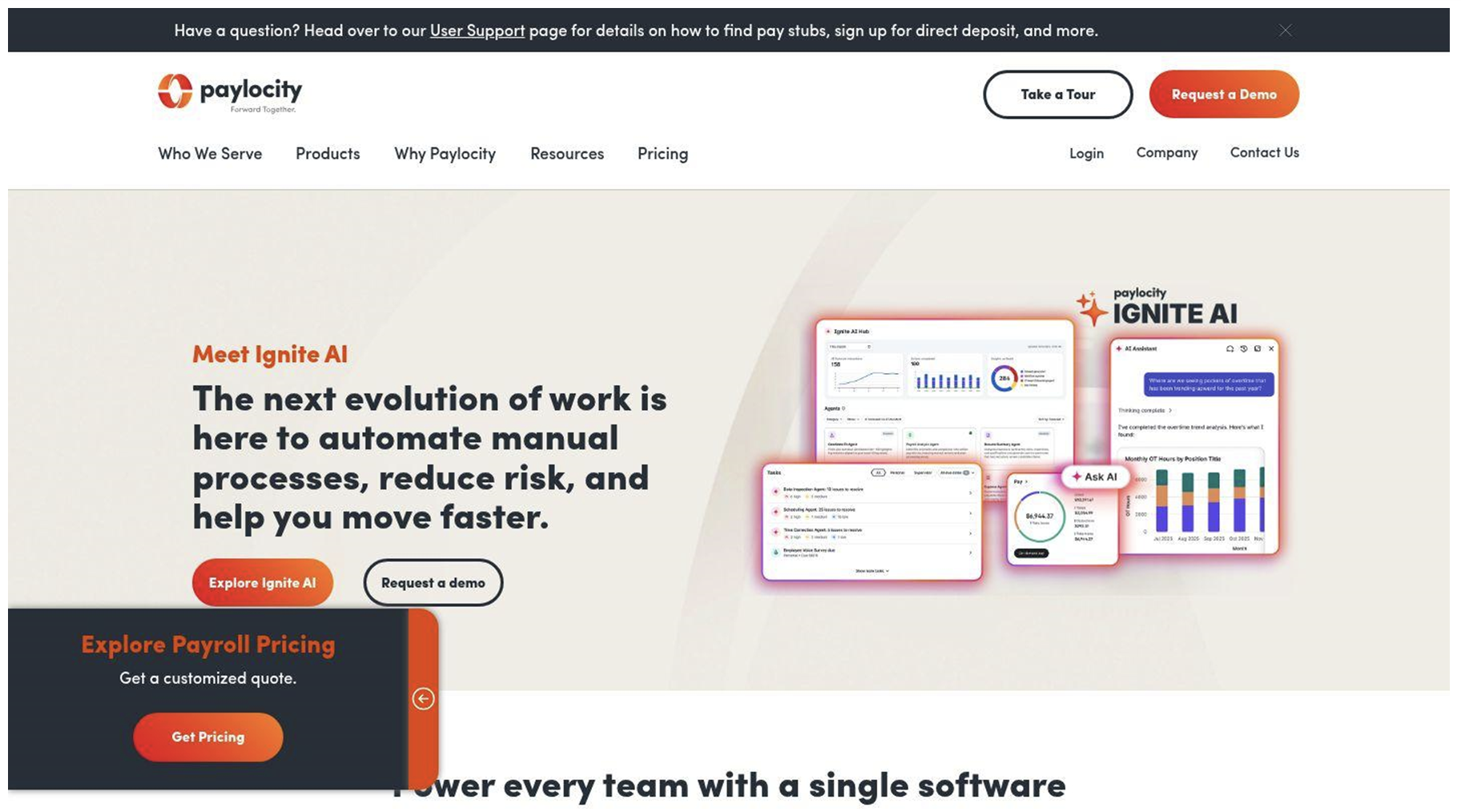
Starting price: Quote-based and tied to headcount and modules, so you’ll need a sales conversation to get a figure. There’s no published per-employee rate to anchor against.
Paylocity pairs US payroll with a strong set of employee engagement and communication tools, and that engagement layer is its value differentiator in a crowded field. Core payroll, time and labor, and PTO management anchor the platform, while recognition, surveys, and a company feed give the employee experience more depth than payroll-only rivals. Reviewers praise the reporting, and a flexible report writer lets admins build non-standard reports that power users appreciate. A built-in ATS and onboarding modules bring hires aboard, so for a midsize US team that wants payroll plus culture tools in one place, it’s a frequent shortlist entry.
Where the bill grows: The quote-based model makes it hard to compare against vendors that publish a per-employee rate, and there’s no G2 score posted to weigh either. The platform is heavily US-based and can’t manage a global workforce, per an enterprise reviewer, and support quality runs inconsistent with a learning curve until the terminology clicks.
9. ADP Workforce Now
Starting price: Quote-based with no published rates. A Forbes estimate puts it near $160 per employee, which is a rough, hedged figure rather than a quote, and it swings with the modules a company gates on.
Plenty of established US companies already run payroll on ADP, and Workforce Now extends that reputation into a broader HR suite with deep tax and compliance coverage. For a midsize firm that values decades of payroll scale, it’s a safe institutional pick: Workforce Now handles complex multi-state payroll and tax filing with mature compliance tooling, configurable analytics let admins filter workforce data and act on trends, and employees view pay, request time off, and acknowledge policies from a mobile app. The vendor’s scale means peers already use it and admin skills transfer readily across the market, which lowers the risk of a bad hire or a stalled rollout. It rates around 4.2/5 across more than 11,000 G2 reviews.
Where the bill grows: Module gating is the value watch-out. The payroll core is strong, but hiring, onboarding, and a fuller HR footprint sit as add-on modules layered onto that core, so you pay up tier by tier. Reviewers report aggressive upselling and call the interface dated, with basic tasks scattered across disconnected areas.
10. Namely
Starting price: Around $9 a month, scoped to company size and modules. That covers core HR, payroll, and benefits administration in one mid-market platform.
Namely aims at US companies in the middle of the market, bundling core HR and payroll with a managed-support layer for teams that would rather lean on a contact than configure everything themselves. That service component is the value pitch for a lean HR function: it gives thin teams a support contact for setup and troubleshooting, so they handle configuration without deep in-house expertise. Built-in hiring and onboarding tools bring candidates into the system with e-signing and automated tasks, and performance reviews plus employee-facing social features round out the platform. The interface stays friendly, and a low listed rate makes Namely easy to model against the quote-based names above. It rates around 4.2/5.
Where the bill grows: Outcomes depend on the assigned support contact, so quality and continuity vary with the people behind the contract. Teams that prefer to own and adjust their own system tend to find the reliance on a service layer limiting rather than a saving.
What per-employee HR software pricing really buys you
A per-employee rate is only half a price. The other half is the list of tools you still have to buy because the platform doesn’t cover them. This is where midsize buyers get caught: a $10-per-head core HR system looks cheaper than a suite until you add a payroll module, an ATS, a comp benchmarking tool, and an analytics layer, each with its own fee. The add-on model isn’t hidden so much as easy to overlook. BambooHR’s payroll add-on and ADP’s module gating are the clearest examples on this list, where the number that gets quoted is a floor, not a ceiling.
Suites change the math by folding those separate line items into one bill. When HR, payroll, hiring, planning, comp, and analytics share a single system, you’re not renewing four subscriptions and paying to integrate them. That’s the case Bob makes at the top: a quote-based price that looks less transparent on paper can still be the lower total once it retires the point tools around it. The honest test is to price your whole intended stack, not the entry tier, then compare totals.
How to compare HR software cost for a midsize company
Real value shows up in the total cost of ownership, not the starting rate. As you compare, weigh each option against these checks:
- Price the full stack, not the base tier: List every capability you need on day one, from payroll to analytics, and get each vendor to quote that exact mix rather than a headline figure.
- Count the add-ons: Flag which functions cost extra. Payroll, recruiting, and benefits are common upsells that move the total well past the per-employee rate.
- Model the bill as you grow: A per-head rate that fits at 200 employees can strain at 800, so ask how the number scales with headcount.
- Factor implementation: A rollout measured in months carries its own cost in staff time; a go-live measured in weeks keeps that line small.
- Weigh consolidation: Count how many current subscriptions a suite would replace, since retiring three point tools can offset a higher sticker.
- Read support reviews: A midsize team seldom has the depth to absorb slow help during a payroll crunch, and support failures carry real financial risk.
- Confirm what payroll covers: Check which countries run natively versus through an integration, since a gap there means another tool and another bill.
Getting the best value from HR software for midsize companies in 2026
The best-value HR software for midsize companies isn’t the one with the smallest number on its pricing page. It’s the one whose total cost, add-ons included, buys most of what a 200-to-1,000-person team actually needs. Gusto and BambooHR keep early mid-market HR simple and cheap to start, Rippling and Paycor bundle broad suites, Personio and Deel solve European and cross-border edges, and ADP, Paylocity, and Namely center on US payroll with different service and engagement layers. Each publishes, or at least estimates, a price you can now weigh against the trade-offs above.
Bob earns the top spot because it answers the value question most directly for this size of company. One connected suite runs HR, native US and UK payroll, hiring, planning, comp, and analytics, which lets a midsize team replace several point tools it would otherwise pay for and integrate separately. The price is quote-based, and that’s worth stating plainly, though the number is built from suites that cost less bundled than stacked, and go-live lands in weeks rather than months. When HR software cost is measured as total cost of ownership across a whole stack, that consolidation is what turns a higher sticker into a lower bill.
Frequently asked questions
How much does HR software cost for a midsize company?
It ranges widely because pricing models differ. Published per-employee rates in this comparison run from about $5 a month (Deel HR, Personio estimates) to roughly $10 to $25 (BambooHR tiers), while flat-plus-per-head models like Gusto sit near $49 a month plus $6 per employee. Quote-based platforms such as Paylocity and ADP don’t post rates, and estimates for ADP reach around $160 per employee. The practical figure depends on which modules you switch on, so the honest answer for most midsize teams is that the full bill only becomes clear once you price the exact mix of capabilities you need.
What does per-employee HR pricing actually include?
Usually less than buyers assume. A per-employee rate typically covers core HR, meaning records, time off, and self-service, while payroll, recruiting, benefits administration, and advanced analytics arrive as priced add-ons. BambooHR’s payroll add-on is a clear example. That’s why a suite matters: Bob’s quote bundles HR, payroll, hiring, planning, comp, and analytics into one price, so the number reflects the whole platform rather than a base tier you keep adding to. Always ask a vendor to itemize what the headline rate does and doesn’t include.
Why do so many HR vendors hide their pricing behind a demo?
Two reasons dominate. Pricing at this size scales with headcount and modules, so vendors prefer to scope a quote rather than post a rate that misleads. There’s also room to negotiate, and a public number narrows that room. The downside for buyers is a shortlist you can’t compare on price, so it’s worth pressing any sales team to explain how a quote is built and where a bundled suite costs less than stacking individual modules.
Which HR software gives the best value for money?
Value depends on what a platform lets you stop paying for elsewhere. For a midsize team, the strongest value tends to come from consolidation: a suite that replaces a separate ATS, analytics tool, and comp benchmarking subscription can beat a cheaper core-HR product once those extras are added back. Bob is built around that logic, running HR, native US and UK payroll, hiring, planning, comp, and analytics in one system, which is why its quote-based price can still produce a lower total. The lowest sticker rarely wins once the full stack is priced.
How do you compare HR software total cost of ownership?
Price the entire stack you intend to run, not the entry tier, then add the costs that hide around it: payroll and recruiting add-ons, implementation time, integration upkeep between disconnected tools, and the headcount growth that pushes per-employee bills up. Weigh that against how many current subscriptions a suite would retire. A platform like Bob that folds several functions into one bill and goes live in weeks can lower total cost even when its headline looks higher, because the comparison that matters is total spend across every tool, not one line item.