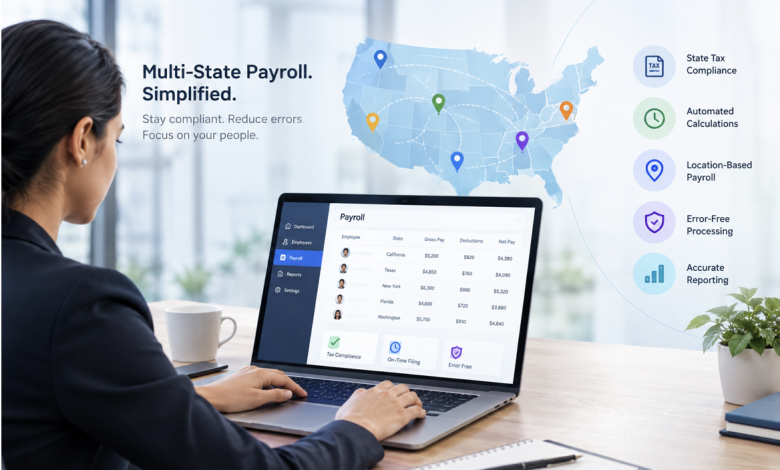
Managing payroll becomes significantly more complex when a business has employees working across multiple states. Different states will have different tax laws, minimum wage laws, overtime rules, leave policies, deductions, and payroll filing requirements. Processing all these things manually can be cumbersome and can lead to errors in payroll management.
This is where the use of payroll management software comes in handy for companies looking to manage multi-state payrolls. Through payroll management software, it can become easier to handle payroll in various locations and maintain consistency at the same time.
Understanding Multi-State Payroll Compliance
Multi-state payroll compliance refers to the proper paying of employees in accordance with the relevant laws and regulations of the states in which they work. For instance, some of the issues that could be faced by a business might include state income tax withholding, local tax withholding, wage/hour law, unemployment insurance, and paid time off among others.
Some of the issues faced when dealing with multi-state payroll for a company expanding its operations in multiple states include:
- Keeping track of different state tax requirements
- Applying location-specific wage and overtime rules
- Managing employees who relocate or work remotely
- Maintaining accurate employee work locations
- Meeting different payroll filing deadlines
- Calculating deductions and contributions correctly
- Keeping payroll records updated as regulations change
A centralized payroll management system can help HR and payroll teams organize these processes more efficiently.
How Payroll Management Software Supports Multi-State Compliance
1. Centralizes Employee and Payroll Data
If information regarding employees is spread out in different spreadsheets or systems, payroll record keeping will be hard.
There is payroll management software that helps centralize information regarding the employees, such as work location, remuneration details, tax information, deductions, attendance, and payroll details. All this will make it easy to avoid double entries.
It is easy for payroll teams to identify employees from various states if the organization operates in many places.
2. Helps Automate Payroll Calculations
Each state will likely have its own guidelines concerning employee compensation. Calculating payroll manually for each state creates a higher chance of errors.
Payroll processing systems are designed to handle repetitive calculations using configured payroll guidelines. Payroll professionals are able to use payroll processing systems to calculate salaries, deductions, overtime, taxes, and other payroll items in a consistent manner.
This could also minimize the time that payroll professionals spend handling repetitive administrative tasks, as they will be able to dedicate their time to addressing payroll exceptions.
3. Supports Location-Based Payroll Management
The employee’s location of work plays an important role in payroll processing and compliance. The issue becomes particularly vital when the organization employs remote workers or workers that travel from one state to another.
Modern payroll software allows sorting the information of each employee by their location of work, thus making it possible for the payroll team to understand which compliance rules apply. Using payroll and workforce management software together makes it possible for the payroll team to understand more about the attendance, working hours, scheduling, and location of the employee.
The payroll and workforce management integration can lead to greater consistency in payroll processing.
4. Reduces Manual Errors
Payroll mistakes occur when there is inaccurate data on employees, obsolete tax settings, missed deductions, incorrect work hours, or manual calculations.
Repetitive payroll processes can be automated, thereby decreasing the chances of human error. Payroll departments can design standard workflow procedures that utilize system calculations and reporting to check their payrolls prior to processing.
This is especially useful for organizations with employees from various states because the complexity of variables becomes greater as the workforce expands.
5. Improves Payroll Compliance Monitoring
An essential payroll compliance best practice is having an accurate and updated payroll information system.
Payroll software can assist in setting up effective procedures for gathering employees’ details, payroll information review, and record keeping. Additional automated tools like alerts, validations, reports, and approvals can also be used in helping identify any problems before completing the payroll process.
It is also essential to check on regulatory changes and configure the payroll software accordingly.
6. Simplifies Payroll Reporting
Different types of payroll reports might be required by multi-state businesses for managerial, accounting, tax, and compliance purposes.
Use of payroll management software will help the organization maintain payroll data in one place and create payroll reports according to various dimensions like employee-wise, department-wise, location-wise, or payroll period-wise.
This will eliminate the manual efforts of collecting data from many spreadsheets to create payroll reports.
Benefits of Automated Payroll Compliance Software
The benefits of automated payroll compliance software extend beyond simply calculating employee salaries. For growing organizations, automation can improve the overall payroll management process.
Key benefits include:
Greater accuracy: Automated calculations reduce repetitive manual work and help minimize common payroll errors.
Time savings: Payroll teams can spend less time entering and calculating payroll data manually.
Better visibility: Centralized payroll information makes it easier to monitor employee compensation and payroll activity across locations.
Consistent processes: Standardized workflows can help businesses maintain consistent payroll procedures as they expand.
Scalability: A centralized payroll system can support growing employee numbers and additional locations without requiring the same level of manual administration.
Improved record management: Payroll information can be organized and accessed more efficiently for reporting and internal reviews.
Best Practices for Managing Multi-State Payroll
While technology can simplify payroll administration, businesses should also establish strong internal processes. Some important practices include:
- Maintain accurate employee locations
Regularly verify where employees work, especially when employees relocate or work remotely. - Keep payroll rules updated
Review applicable state and local requirements regularly and ensure the payroll system reflects relevant changes. - Integrate attendance and workforce data
Connecting payroll with workforce management can improve the accuracy of working-hour and attendance information. - Use approval workflows
Establish payroll review and approval procedures before final processing. - Monitor payroll reports
Regularly review payroll data to identify unusual calculations, missing information, or location-related discrepancies. - Maintain proper records
Keep organized payroll records to support internal reviews and applicable reporting requirements.
Choosing the Right Payroll Management Software
Not all payroll systems are geared towards meeting the same needs. While choosing a payroll management system, businesses need to take into account a number of aspects such as automation, management of information about employees, integration with attendance tracking software, reports, scalability, security, and user friendliness.
It is especially important for companies dealing with dispersed workforce to choose an appropriate platform that will integrate payroll with other HR processes and procedures.
WeekMate offers a solution for HR and payroll management that can help businesses integrate employees, attendance tracking, workforce, and payroll procedures into one single system.
Conclusion
The process of handling payroll for many states goes beyond just ensuring that employee salaries have been calculated.
Payroll management tools can aid in streamlining such processes by providing centralized payroll data, automating calculations, facilitating location-specific management, enhancing reports and minimizing the need for manual work.
With an increasing number of employees in different states, companies will benefit from adopting payroll management solutions to streamline payroll handling while strengthening the compliance process.
Are you ready to streamline payroll and workforce management? Try out WeekMate today to integrate all your HR, payroll, attendance and workforce management processes into one cohesive platform.