Why the Future of Digital Transformation Depends on Human Agency
Artificial intelligence is no longer an emerging technology discussion. It is now an operational reality shaping how organizations make decisions, manage risk, optimize labor, engage customers, and compete globally.
But while enterprises continue to invest billions into AI infrastructure, automation platforms, and digital transformation initiatives, many leadership teams are asking the wrong question.
The conversation should not be, “How fast can we automate?”It must be, “How do we preserve human judgment, adaptability, and trust while integrating intelligent systems into the core of business?” That distinction matters more than most executives realize.
Across industries, organizations are discovering that digital transformation is not failing because of weak technology. It is failing because leadership models, workforce structures, and operational cultures were never redesigned to evolve alongside the technology itself.
The next era of transformation will not belong to the companies with the most AI tools. It will belong to the organizations that understand how to balance machine intelligence with human agency.
Digital Transformation Has Entered a New Phase
For the past two decades, digital transformation largely focused on efficiency.
Companies digitized records, migrated to the cloud, implemented ERP systems, modernized supply chains, and introduced automation into repetitive workflows. The objective was straightforward: reduce friction and improve scale.
AI changes the equation entirely. SuperIntelligence.
Unlike previous waves of transformation, AI systems can now influence decision-making, pattern recognition, forecasting, customer interactions, quality control, and operational planning in real time. This creates a fundamentally different leadership challenge.
Organizations are no longer simply deploying software. They are introducing systems that increasingly shape how humans work, think, and respond.
According to McKinsey & Company, organizations accelerating AI adoption are already seeing measurable operational gains across productivity, analytics, and customer engagement. At the same time, many executives report significant organizational uncertainty around governance, workforce readiness, and long-term implementation strategy.
The gap is widening between companies that deploy AI tactically and organizations that rethink operations systemically. That gap is where the next competitive advantage will emerge.
Automation Without Alignment Creates Fragility
One of the biggest misconceptions surrounding AI transformation is the belief that more automation automatically creates stronger businesses. In reality, poorly aligned automation can create operational brittleness.
When organizations automate without redesigning decision-making structures, communication systems, or accountability frameworks, they often create environments where employees become disconnected from outcomes. Institutional knowledge erodes. Teams become overly dependent on opaque systems they do not fully understand. Decision velocity may increase while strategic clarity decreases.
This becomes especially dangerous in manufacturing, logistics, healthcare, cybersecurity, and industrial environments where operational precision and human oversight remain critical.
The focus is not simply on deploying intelligent systems, but on designing industrial intelligence ecosystems where humans and AI operate collaboratively and that distinction is critical.
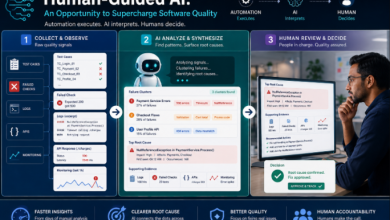
The future of AI is not human replacement, it is human amplification.
The organizations that succeed will build systems where AI enhances visibility, predictive capabilities, operational resilience, and workforce adaptability while still preserving human accountability and contextual reasoning.
The Rise of “Invisible Leadership Debt”
Most executives understand technical debt. Far fewer understand leadership debt.
Leadership debt occurs when organizations modernize technology faster than they modernize leadership capability, workforce communication, or organizational trust.
This is becoming one of the defining risks of AI transformation. Many enterprises now have access to sophisticated AI platforms but still operate with outdated organizational assumptions:
- Leadership communication remains reactive rather than adaptive.
- Workforce development focuses on task execution instead of critical thinking.
- Cross-functional collaboration remains siloed.
- Employees are expected to trust systems they were never trained to understand.
The result is resistance, disengagement, and transformation fatigue.
A recent report from Deloitte Insights noted that organizations achieving stronger AI outcomes are prioritizing human-centered transformation strategies alongside technical implementation. This includes leadership education, workforce transparency, governance frameworks, and change management systems.
Technology adoption alone does not create transformation. Operational trust does.
AI Will Reshape the Meaning of Leadership
The executive role itself is changing. Historically, leaders were valued for expertise accumulation, information access, and decision authority. AI compresses all three. Information is now abundant. Pattern recognition is increasingly automated. Operational visibility is becoming real-time.
As a result, the most valuable leaders of the next decade will not simply be the most technically informed. They will be the most adaptable, emotionally intelligent, ethically grounded, and operationally aware. Future-ready leadership will require the ability to:
- Translate technological complexity into organizational clarity
- Build trust during periods of rapid transformation
- Navigate ambiguity without paralysis
- Preserve human creativity and accountability within automated systems
- Make principled decisions under increasing algorithmic influence
This is why human agency matters. Human agency is the ability to maintain intentionality, judgment, ethics, and ownership within increasingly automated environments.
Without it, organizations risk building highly optimized systems that ultimately weaken resilience, culture, and innovation capacity.
Industrial AI Will Define the Next Competitive Era
While much public conversation around AI remains centered on chatbots and consumer tools, the most profound economic impact will likely occur within industrial transformation.
Manufacturing, logistics, energy, supply chain infrastructure, robotics, predictive maintenance, and operational intelligence are entering a new phase of convergence. This is where embodied AI, digital twins, industrial automation, and intelligent systems begin transforming physical operations at scale.
According to PwC, AI-driven operational transformation could contribute trillions in global economic impact over the coming decade, particularly across industrial sectors. But industrial AI adoption introduces another critical challenge: balancing speed with systems integrity. Executives face increasing pressure to modernize operations rapidly while still maintaining cybersecurity, workforce continuity, compliance, and operational reliability.
This requires a more integrated transformation philosophy. Digital transformation can no longer operate as a standalone IT initiative. It must become a leadership discipline.
The Workforce Does Not Fear AI as much as becoming irrelevant and there is widespread discussion about whether AI will replace jobs. The more immediate issue inside many organizations is whether employees feel they still matter.
When workers lose visibility into how decisions are made, how performance is evaluated, or how AI systems influence operational outcomes, disengagement accelerates. The organizations best positioned for long-term success will not merely train employees to “use AI tools.” They will build cultures where employees understand:
- Why AI is being implemented
- How decisions are made
- Where human judgment still matters
- What new value humans are expected to contribute
This is a strategic leadership issue, not simply an HR initiative. Employees who understand their evolving role within intelligent systems are far more likely to adapt, innovate, and participate constructively in transformation efforts. Organizations that fail to communicate this clearly risk creating fear-based cultures where AI becomes associated with instability instead of opportunity.
The Future Belongs to Human-Centered Transformation
AI will undoubtedly transform business operations more profoundly than any technology wave in modern history. The defining differentiator will be whether organizations can preserve humanity while scaling intelligence.
This is not a soft-skills conversation. It is a resilience, leadership and competitive advantage conversation. The future will favor organizations that:
- Build adaptable operational cultures
- Invest in ethical and transparent AI governance
- Preserve human accountability within automated systems
- Develop leaders capable of navigating technological and human complexity simultaneously
- Treat transformation as a human systems challenge, not merely a software deployment exercise
The companies that understand this early will not simply adopt AI more effectively. They will build organizations that remain trustworthy, resilient, and innovative in a world increasingly shaped by intelligent systems. Ultimately, that “intelligent” application may become the most valuable competitive advantage of all.