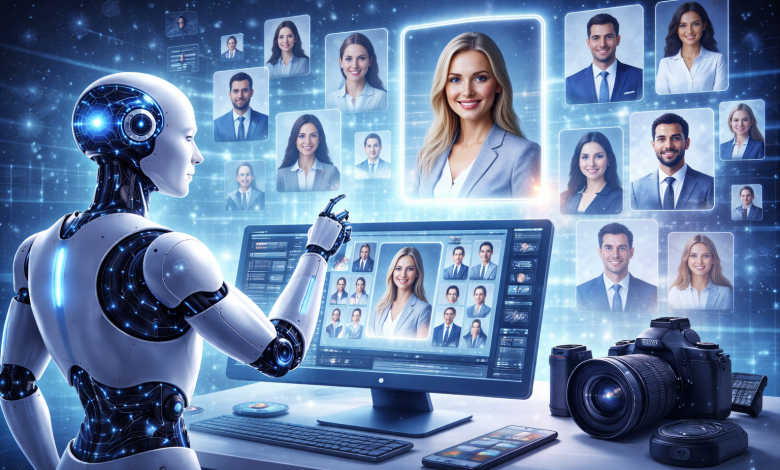
Booking a corporate photographer used to mean three things: a scheduling headache, a four-figure invoice, and two weeks of waiting. In 2026, most companies are skipping all three.
AI headshot generators have quietly become the default tool for corporate visual identity — not just for startups pinching pennies, but for enterprise HR teams managing hundreds of distributed employees across multiple cities. Industry estimates put the AI headshot market at over $350 million in 2025, with projections pointing north of $450 million in 2026. Whether or not those figures are precise, the direction is not in dispute.
The Economics No Longer Favor Traditional Photography
The cost comparison has always been the headline argument, and by 2026 it’s lopsided enough to be decisive.
Standard corporate headshot sessions run $125–$300 per person nationally, with premium markets like New York pushing that to $300–$700 or more. At enterprise scale, the numbers compound: a full-day shoot for 50–100 employees typically runs $7,500–$15,000 total once photographer fees, studio rental, coordination time, and retouching are factored in. That works out to $150–$300 per person before hidden overhead.
AI headshot platforms operate at $20–$50 per person with no scheduling overhead, no geographic constraints, and no dependency on a single photographer’s availability. For a 100-person organization, the difference between traditional and AI photography routinely exceeds $10,000 per cycle — and that’s before accounting for the HR hours spent coordinating shoot days.
Cost alone doesn’t explain adoption at this scale. The more important factor is what the cost savings unlock operationally.
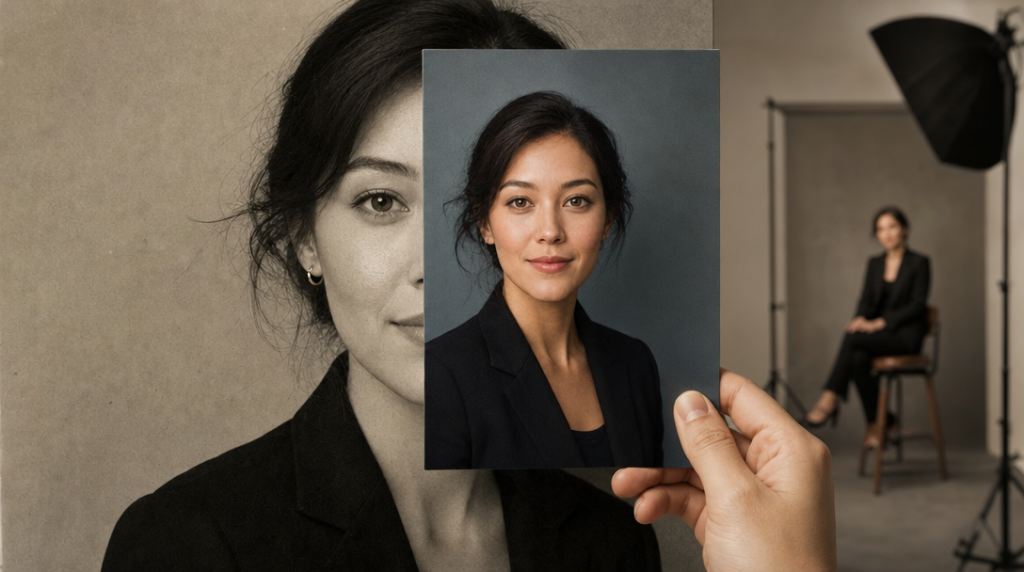
The Technology Gap Has Closed
Early AI headshot tools had a visible problem: they looked like AI headshots. Plastic skin textures, identity drift between upload and output, expressions that no real person would hold. Corporate communications teams rejected them outright, and the criticism was fair.
That’s no longer the baseline. The current generation uses fine-tuned diffusion models trained specifically on portrait photography. In blind evaluations, AI-generated headshots are increasingly indistinguishable from — and in some cases technically superior to — what most professionals achieve in standard sessions, particularly in lighting consistency and background control.
Delivery speed has also become a fundamentally different category of product. Services like OmniPhoto turn uploaded photos into LinkedIn-ready, print-quality headshots across a wide range of customizable styles in minutes. No booking window, no travel, no waiting a week for edited files.
The Enterprise Problem AI Actually Solved
The most significant corporate adoption story isn’t about individual professionals saving $200. It’s about a coordination problem that money alone couldn’t fix.
Consider a company with offices across multiple countries, remote employees in dozens of cities, contractors who need to be included in directories, and new hires joining every two weeks. A traditional photo day works for the employees within driving distance of headquarters. It does nothing for everyone else. The result — without AI — is a team page assembled from three different companies: some studio-quality, some outdated selfies, some missing entirely.
AI headshot programs solve this at scale. An entire 100-person rollout can complete in 48–72 hours regardless of where employees are located. Every output uses the same style parameters, backgrounds, and lighting treatment — producing the consistent visual identity that enterprise communications teams actually need. The stakes are real: according to LinkedIn’s own platform data, profiles with professional photos receive 21 times more views and 36 times more messages than those without. When consistency is the goal, AI doesn’t just reduce cost — it delivers an outcome that traditional photography structurally cannot match at distributed scale.
Where Traditional Photography Still Holds
Balance matters here. The picture isn’t entirely one-sided.
Face likeness remains the most cited complaint among dissatisfied AI headshot users. Some tools handle identity preservation well; others — particularly at the budget end — produce outputs that look professional but don’t quite look like the person. That’s a real limitation for anyone whose headshot will be recognized by clients or colleagues they’ve already met in person.
There’s also the expression problem. What skilled photographers describe as the “confident neutral” — the subtle micro-expressions, relaxed jaw, and genuinely engaged eyes that come from a real session with good direction — remains difficult to replicate algorithmically. The AI version often looks technically correct while feeling slightly composed rather than captured.
And certain industries retain genuine reservations. Professional services firms in law, finance, and healthcare — where the headshot’s implicit promise is “this is the person you’ll meet” — are slower to adopt, and their caution isn’t irrational. Authenticity signaling has real value in high-trust client relationships.
The honest assessment: AI wins decisively on cost, speed, and scale. Traditional photography wins when individual authenticity, creative direction, and brand trust at the highest tier are non-negotiable.
A Hybrid Market Is Already Here
The most accurate description of 2026 is not “AI replaced corporate photography.” It’s “AI replaced the part of corporate photography that was a commodity.”
Standard employee headshots for internal directories, LinkedIn profiles, company websites, and conference speaker bios? Largely AI territory now. High-stakes individual portraits for C-suite pages, investor materials, and press coverage? Still predominantly traditional — because the cost of getting it wrong exceeds the cost of a photographer.
The professionals thriving in this environment repositioned around what AI headshot generators can’t replicate: live creative direction, the guarantee of authentic capture, and the bespoke work that requires someone to actually show up in a room. Those who competed primarily on producing technically acceptable portraits at moderate prices are now facing direct substitution.
The Takeaway
Five years ago, AI headshots were a curiosity. Today, they’re the default choice for most professionals and the only scalable option for distributed corporate teams.
The technology gap that once made AI images visibly artificial has closed. The cost gap between AI and traditional photography — $20–$50 versus $125–$300 per person at the standard tier — has not. That combination of quality parity at a fraction of the cost is what drives structural displacement, not hype.
For individual professionals and corporate HR teams, the decision in 2026 is rarely “AI or photographer.” It’s “which AI tool, and when does the use case actually justify a real shoot.”