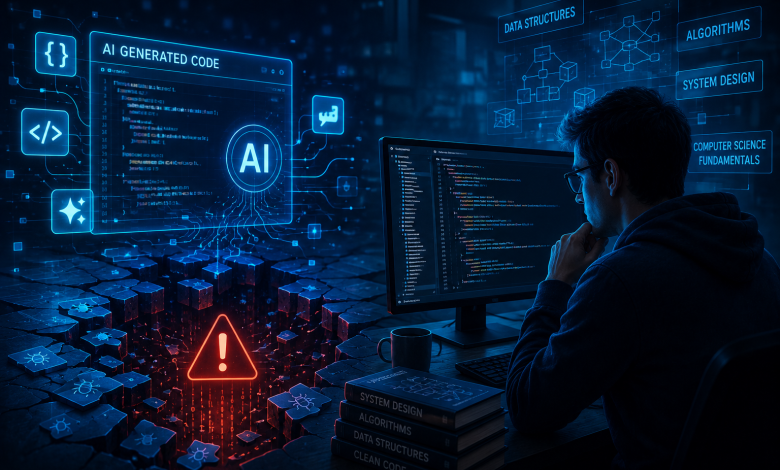
In short: AI coding assistants speed up development, but research from Veracode, Anthropic, and BairesDev shows AI-generated code carries meaningfully higher security risk and that junior developers who lean on AI without understanding fundamentals retain less and debug worse. Companies that skip fundamentals-first training are deferring a cost, not avoiding one.
A CTO at a mid-sized fintech company recently described the moment her team’s confidence in AI-assisted development cracked: a junior developer had shipped an authentication feature that worked perfectly in staging. Code review passed. Tests passed. Three weeks later, a security audit found the AI-generated logic had skipped a permission check in an edge case nobody had tested for — because nobody on the team had looked closely enough to know what to test for in the first place.
Stories like this are becoming less anecdotal and more measurable. AI coding assistants have quietly become standard equipment on most engineering teams, and the productivity gains are real. What’s also real, and increasingly well-documented, is the gap between code that runs and code that’s actually sound — and how much that gap costs when nobody on the team can tell the difference.
The Data on AI-Generated Code Is Not Reassuring
Independent security testing has moved this from a theoretical concern to a measured one. Veracode’s ongoing testing of over 100 large language models found that 45% of AI-generated code samples introduce at least one OWASP Top 10 vulnerability — a pass rate that has stayed roughly flat across multiple testing cycles since 2025, despite vendor claims of improvement. Separate analysis from CodeRabbit, comparing vulnerability density across thousands of repositories, found AI-generated pull requests carry a 2.74x higher vulnerability rate than human-written code.
The risk isn’t evenly distributed across problem types, either. Veracode’s testing shows models handle well-known patterns like SQL injection reasonably well, but perform “very poorly” — and are not improving — on cross-site scripting and log injection, the kind of subtler, context-dependent flaws that require understanding why an approach is unsafe, not just recognizing a common pattern.
Why This Falls Hardest on Junior Hiring
The skills gap shows up most clearly — and most measurably — at the junior level. A 2026 global survey by BairesDev, covering over 1,500 developers across 77 countries, found that 85% of junior developers believe AI tools have improved their understanding of software development. Senior engineers see it differently: only 16% believe juniors fully understand the AI-generated code they submit.
A controlled study from Anthropic makes the mechanism behind that gap concrete. Junior engineers who used AI to answer conceptual questions while learning a new library scored 65% or higher on a follow-up comprehension test. Those who delegated the actual code generation to AI scored below 40% — roughly a two-letter-grade gap on the same material, with debugging skills showing the steepest decline of all. Notably, the AI-assisted group finished only about two minutes faster on average, a difference that wasn’t statistically significant — meaning the trade was weaker skill retention for speed gains that, in this study, barely materialized.
For hiring managers, that reframes a familiar question. It’s no longer just “how fast can my team ship code?” but “does my team have people who can tell the difference between code that works and code that’s actually right?”
What Changes in Java, Specifically
This distinction matters more in languages like Java, still heavily used across enterprise backend systems, financial infrastructure, and Android development, where code tends to live in production for years and gets touched by many hands over time. A junior hire who understands Java’s object-oriented structure, exception handling, and memory model can evaluate and adapt AI-generated code with confidence. One who doesn’t is effectively operating on trust in a tool that carries no accountability when it’s wrong — and, per Veracode’s data, is wrong on security-sensitive logic close to half the time.
Technical interviews are starting to reflect this shift. Interviewers increasingly ask candidates to explain why a piece of code behaves the way it does, or to spot a deliberately introduced bug in AI-style output, rather than simply asking them to produce working code from scratch. The signal companies are optimizing for has moved from “can this person write code” to “can this person reason about code.”
What Engineering Leaders Should Do Differently
A few practical implications follow from the data above:
Screen for comprehension, not just output. Take-home projects and live coding challenges can be completed with heavy AI assistance in ways that obscure whether a candidate understands the underlying language. Ask candidates to explain their reasoning, not just produce a working solution.
Don’t skip fundamentals because AI writes the first draft. Teams that assume AI tools remove the need to learn core language fundamentals often find the gap resurfaces later, at a more expensive point in the development cycle — closer to Veracode’s 45% vulnerability rate than to a clean audit. A structured, fundamentals-first course — a structured Java fundamentals course, for instance — builds the judgment AI tools can’t supply on their own.
Treat AI-assisted code review as its own category. Reviewers who assume AI-generated code carries the same reliability as human-written code are missing a category of risk that standard review checklists weren’t built for.
Frequently Asked Questions
Is AI-generated code less secure than human-written code?
Independent testing suggests yes, on average. Veracode’s research found 45% of AI-generated code samples introduce at least one OWASP Top 10 vulnerability, and CodeRabbit’s analysis found AI-generated code carries a 2.74x higher vulnerability density than human-written code.
Does relying on AI tools hurt a junior developer’s learning?
A randomized study from Anthropic found junior engineers who delegated code generation to AI scored roughly two letter grades lower on comprehension tests than those who wrote the code themselves, with the steepest drop in debugging ability.
Should companies stop using AI coding assistants?
The evidence doesn’t point to abandoning AI tools — it points to pairing them with developers who have strong fundamentals. The risk isn’t AI-generated code itself; it’s AI-generated code with no one able to evaluate it critically.
The Bottom Line
AI hasn’t eliminated the need for developers who understand what they’re building — the data suggests it has made the gap between those who do and those who don’t more consequential, and more measurable than ever. Companies that treat AI coding tools as a replacement for fundamentals, rather than an accelerant for developers who already have them, are likely to discover the cost later than they’d like: in a security audit, in production, under pressure — exactly when it’s most expensive to fix.