AI Has Accelerated 3D Creation, but Printing Still Requires a Complete Workflow
Artificial intelligence is changing the way digital content is created. From text generation to image creation, AI tools have significantly reduced the time between an initial idea and a digital result. The same transformation is now happening in the world of three-dimensional design.
The emergence of the AI 3D model generator has made it possible for more creators to explore 3D content without relying entirely on traditional modeling workflows. Instead of manually building every detail from scratch, users can generate models from images or concepts and begin their creative process faster.
However, the development of AI-generated models has also revealed a new challenge. Creating a digital 3D model is only the beginning. Turning that model into a printable, practical physical object requires additional steps, including structural preparation, color optimization, model separation, and printing arrangement.
This gap between AI generation and real-world manufacturing has become one of the most important challenges in modern 3D printing.
Hi3D focuses on this transition by combining AI-powered creation with practical preparation workflows. Rather than treating AI generation as the final destination, Hi3D explores how AI can help creators move from digital ideas to physical production more efficiently.
-
The Rise of AI-Generated 3D Content
The development of generative AI has expanded beyond traditional digital content. While early AI applications focused mainly on text and images, three-dimensional creation represents the next major stage of AI-assisted creativity.
The ability to generate 3D models through AI is changing how creators approach design, prototyping, and production.
1.1 How AI Is Changing the Beginning of the 3D Creation Process
Traditional 3D modeling often requires users to understand professional software, geometry construction, and complex editing workflows.For experienced designers, these tools provide extensive creative control. However, for beginners and creators from other fields, the learning curve can become a significant barrier.The development of the AI model generator provides a different starting point. Instead of building every component manually, creators can use AI assistance to transform visual concepts into three-dimensional assets.
This approach allows users to spend more time improving ideas and less time handling repetitive technical steps.The growth of the 3D model generator market reflects a broader change in digital creation: AI is becoming a creative partner that helps more people participate in 3D design.
1.2 Why AI 3D Generation Is Only the First Step
Although AI can generate impressive digital models, a model that looks complete on screen may not always be ready for physical production.A printable object must be considered more than appearance. It needs suitable geometry, practical dimensions, and preparation for manufacturing limitations.This means the future of AI-driven 3D creation is not only about producing models faster. It is about building a complete workflow that connects generation, optimization, and production.
-
The Current Challenges of AI 3D Printing Workflows
AI has simplified the process of creating digital models, but physical printing introduces new technical challenges.
For creators who want to transform AI-generated designs into real objects, several important problems still need to be addressed.
2.1 Generated Models Are Not Always Print-Ready
One of the biggest challenges in AI-assisted 3D printing is the difference between a visually complete model and a manufacturing-ready model.A generated object may contain complex structures, detailed surfaces, or unnecessary elements that require further preparation before printing.Traditional workflows often require creators to manually inspect and modify models. This process can be difficult for users who are new to 3D printing.As AI tools continue developing, the role of an AI 3D modeling workflow is becoming more important. The goal is not only to create models but also to support the steps required before production.
Hi3D addresses this challenge by providing tools that help users prepare AI-generated models for practical applications.
2.2 Multi-Color Printing Creates a Digital-to-Physical Challenge
Modern creators increasingly want to produce colorful and detailed 3D printed objects. However, converting digital colors into physical materials is not always simple.Digital environments allow unlimited color variations, while physical printing depends on available materials and filament choices.
AI-generated models may include complex textures and multiple color areas that require optimization before printing.Without proper preparation, creators may experience difficulties such as excessive material changes or inconsistent color results.This is where the concept of an AI 3D print generator becomes valuable. A complete AI printing workflow should consider not only how a model is generated but also how its visual information can be transferred into a physical object.Hi3D’s multi-color printing workflow helps creators better prepare colorful models for real-world production.
2.3 Large and Complex Models Require Smarter Preparation
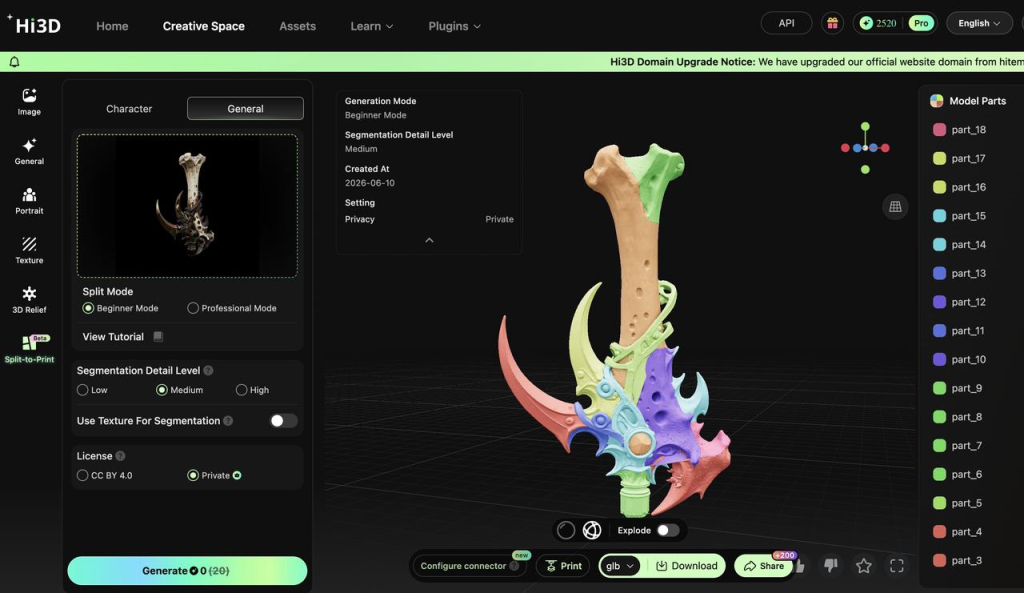
Another challenge appears when creators work with large characters, collectibles, or detailed objects.Many 3D printers have limited build areas, meaning some models cannot be printed as a single piece.
Traditionally, creators need to manually divide models into different parts and determine how those pieces should be assembled after printing.This process requires technical experience and can become time-consuming.AI-assisted splitting provides a new approach by helping creators prepare complex models more efficiently.
-
How Hi3D Builds a Bridge Between AI Generation and Printing
The value of AI in 3D creation is not only measured by how quickly it produces models. A more complete solution should help creators continue from the generation stage toward practical applications.
Hi3D focuses on connecting different parts of this workflow.
3.1 Creating Models Through AI Image-to-3D Generation
Image-to-3D generation is one of the key capabilities of modern AI creation platforms.Instead of manually reconstructing an object from a reference image, users can begin with visual input and generate a three-dimensional model with AI assistance.
For creators exploring a 3D model AI generator, this provides a more intuitive way to enter the world of 3D design. A designer can visualize an early product concept. An artist can transform an illustration into a 3D asset. A maker can develop models for future printing projects.By simplifying the initial modeling process, Hi3D helps more users explore three-dimensional creativity.
3.2 Supporting Multi-Color Printing Workflows
Creating a model with rich visual details is only useful when those details can be effectively translated into physical output.Hi3D’s multi-color printing workflow focuses on helping users prepare colorful models for printing.
This reduces the difficulty of managing complex color information and makes AI-generated designs more practical for physical production.The combination of AI generation and printing preparation represents an important step toward more accessible digital manufacturing.
3.3 Preparing Models Through Splitting and Arrangement
Large models often require additional preparation before printing.Hi3D provides features designed to help users split models into printable parts and organize components before production.Smart arrangement helps users prepare model components more efficiently, reducing the manual effort required before printing.Through these workflows, Hi3D connects AI creation with practical manufacturing needs.
-
The Future of AI-Powered 3D Manufacturing
The future of 3D printing will not only depend on better hardware. Software intelligence will play an increasingly important role in helping creators design, prepare, and produce objects.
4.1 AI Will Move from Generation Toward Complete Production Assistance
The next stage of AI development will focus on supporting complete creative workflows.A powerful 3D AI model generator will not only create digital assets but also help users prepare those assets for different applications.
AI will become a connection between imagination, digital design, and physical manufacturing.Hi3D represents this direction by combining AI-powered creation with practical printing preparation features.
4.2 Making 3D Creation More Accessible
As AI technology continues improving, more people will be able to participate in 3D creation.The development of the free AI 3D model generator concept shows that creators increasingly want easier ways to experiment with digital manufacturing.The future of the 3D model generator AI ecosystem will be defined by tools that reduce complexity while expanding creative possibilities.
-
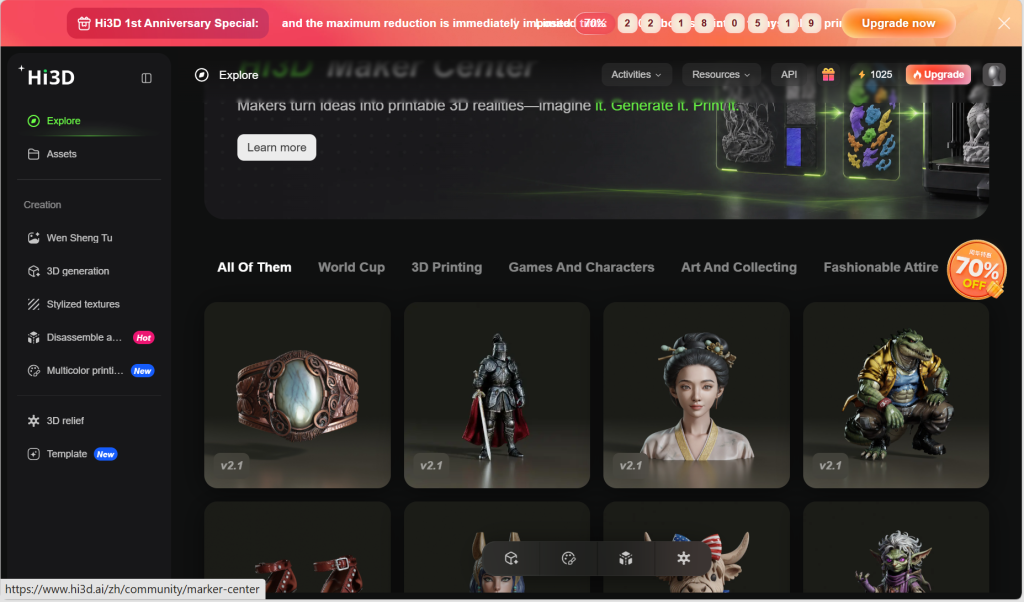
Celebrate Hi3D Anniversary: Explore AI 3D Printing with 70% OFF
To celebrate Hi3D’s anniversary, creators can enjoy a special limited-time promotion with 70% OFF.This anniversary offer provides an opportunity for designers, makers, and creative users to explore AI-powered 3D workflows at a more accessible price.
Whether users are interested in an AI 3D model generator free experience, exploring AI-assisted design, or preparing models for physical printing, Hi3D provides a workflow that connects digital creativity with real-world production.
As artificial intelligence continues transforming the manufacturing landscape, Hi3D demonstrates how AI can move beyond simple generation and become a practical assistant throughout the entire 3D creation journey.