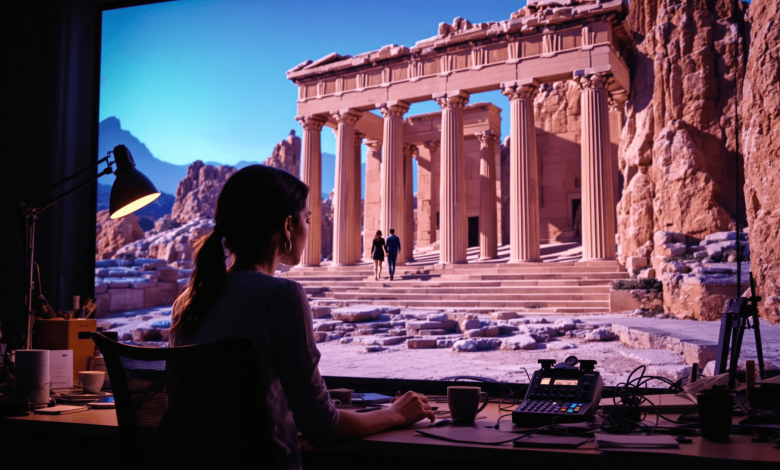
The footage looked like we had flown a crew to Athens. Towering columns of ancient stone, sunlight cutting through marble the way it only does in the Mediterranean afternoon, two people moving through it the way people in love move. Unhurried. Close. As if the rest of the world had agreed to wait. Every shadow was correct. Every texture held under scrutiny. The relationship pillar sequence for Pillars of Power required imagery that carried thousands of years of human love inside a single frame, and the AI-generated footage delivered it completely. No location scout. No international crew budget. No permits from the Greek government. It was photorealistic, perfectly matched to the scene, more precise than anything a stock library had ever handed us.
It was also, in that first silent playback, utterly empty.
Then the composer’s score came in. Then the voiceover. And the ancient stones woke up. Two people walking through a civilization’s ruins became something every person watching had felt before. The particular quiet of being completely certain about someone. The way love makes even marble feel warm. Nothing about the image changed. The columns were the same columns. The light was the same light. Everything about what the audience experienced did.
That gap, between technical perfection and emotional truth, is where the entire future of journalism lives.
The industry conversation frames this as a competition: algorithmic efficiency on one side, human storytelling on the other. That framing misses the point entirely. The real question is not which one wins. It is which one drives, and which one serves.
What AI could not do was make an audience lean forward. That required a human being who understood why the moment mattered, who had lived inside enough human experience to know which musical note would unlock the feeling, which words spoken in which rhythm would close the distance between screen and viewer. The algorithm delivered the image. The human delivered the intention behind it. Those are not the same thing, and organizations that treat them as interchangeable will discover the difference in their audience numbers.
The Dentsu 2026 Media Trends report makes this explicit: beneath layers of automation and AI-driven interfaces, people are still guided by simple, enduring truths. They want clarity before complexity, connection before consumption, and meaning before noise. Too much efficiency strips away trust, choice, and depth. For journalism, that is not a philosophical observation. It is an operational warning with direct revenue implications.
News executives across 51 countries are already responding. The Reuters Institute found that organizations are shifting editorial priorities toward more original reporting, contextual analysis, and human-centered stories, content they describe as less likely to be commoditized by AI chatbots. The smartest newsrooms are not retreating from AI. They are getting precise about where the human layer belongs and protecting it deliberately, rather than letting efficiency logic erode it by default. The ones that fail to make that distinction will not lose it suddenly. They will lose it gradually, one optimized decision at a time, until the audience they built stops recognizing them.
Research on algorithmic influence in journalism shows that digital platforms increasingly redefine newsworthiness as “shareworthiness,” privileging virality and visibility over depth, with scholars warning these conditions jeopardize journalistic integrity as editorial practices adapt to meet algorithmic imperatives. Efficiency without editorial judgment does not just flatten the content. It trains audiences to expect less, and audiences that expect less eventually stop showing up entirely.
The business case for protecting human judgment is stronger than most executives realize. Content that generates clicks is not the same as content that generates loyalty. Algorithmic optimization produces the former reliably. It has no mechanism for producing the latter. Reader trust, subscription retention, and brand authority are built through the accumulated weight of stories that made people feel something real. You cannot A/B test your way to that. You cannot automate it. You hire, develop, and protect the people who know how to do it, and you give them tools that free them from everything beneath their skill level so they can spend their time at the level that actually moves people.
What we discovered producing Pillars of Power holds across every media format. The AI did not fail. It delivered exactly what it was designed to deliver. The ancient columns were there. The light was there. The two people moving through centuries of human history were there. What was missing was someone who understood what any of it was for. A human being had to decide what that image meant, what it should make the viewer feel, what story those stones were actually telling. That decision cannot be delegated. It can be informed by data, shaped by research, supported by every AI tool in the production stack, but the moment of editorial judgment, the choice about what a piece of media is for and who it is meant to reach and why any of it should matter, belongs to a human being every single time.
Long-form journalists writing about this moment have described it plainly: AI may outline the skeleton, but only humans can infuse the flesh, through senses that capture what algorithms can approximate but never inhabit. It is an architectural truth about how resonance works. The skeleton is genuinely useful. Nobody builds without it. Synthetic B-roll, automated research, and AI-assisted editing are real tools producing real value in production pipelines right now. But infrastructure is not a story. It is what makes telling the story possible.
Audiences have not rejected news. They have rejected empty journalism, content that is repetitive, shallow, and disconnected from real concerns. The response cannot be more content. It must be better content. AI produces volume at scale. Humans produce meaning at depth. Organizations that confuse one for the other will find themselves with extraordinarily efficient pipelines delivering content that no one waits for, no one shares, and no one pays to keep receiving.
The model is already proven. We kept the footage. We built around it. We used every advantage AI generation gave us, and then we put human hands on everything that surrounded it, the score, the voice, the editorial judgment about what two people walking through ancient stone were supposed to awaken in the person watching. More accurate than any stock library, faster than any location scout, and still utterly dependent on a human being who understood what it was for. The technology gave us the image. The humans gave it a reason to exist. That is not a limitation of AI. It is the entire point.
The future of journalism is not being written by the technology. It is being written by the people who know exactly when to hand it back.