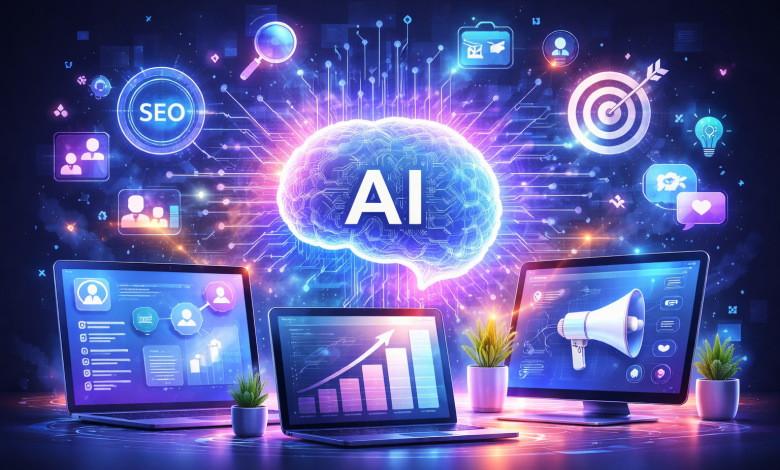
Artificial intelligence has quickly moved from a nice-to-have tool to a core part of modern business operations. A few years ago, entrepreneurs mainly used AI for simple tasks like writing emails or generating social media captions. Today, the most successful founders are building complete AI-powered systems that help them hire talent, manage teams, create content, improve search visibility, and strengthen their brands. The businesses growing the fastest are not necessarily the ones with the biggest teams. They are often the ones using technology to work smarter and scale faster.
The challenge for many entrepreneurs is knowing where to start. New AI tools seem to appear every week, each promising to save time and increase productivity. Without a clear strategy, it is easy to end up with dozens of disconnected tools that create confusion instead of efficiency. The real advantage comes from building an AI stack where every tool supports a larger business goal. Instead of treating AI as a collection of individual solutions, ambitious entrepreneurs are treating it as an integrated system that powers every stage of growth. From recruiting employees to generating leads and building authority online, AI can now support nearly every important business function.
A well-designed AI stack helps entrepreneurs focus their time on leadership, creativity, and decision-making while automation handles repetitive tasks. This creates more room for innovation and growth. It also allows smaller companies to compete with much larger organizations by improving speed, consistency, and efficiency. The future belongs to businesses that understand how to connect AI tools into a complete operating system rather than relying on isolated applications.
Building the Foundation: AI for HR and Team Operations
Every growing business eventually reaches a point where managing people becomes more complicated than managing products or services. Hiring, scheduling, onboarding, communication, and performance tracking all require time and attention. As teams grow, administrative work can quickly consume hours that would be better spent on strategy and growth. This is why many entrepreneurs are starting their AI stack with workforce management.
Modern HR platforms can automate scheduling, track attendance, manage employee requests, and reduce administrative burdens that often slow down growing businesses. These systems not only save time but also improve employee experiences by creating more predictable and transparent processes. When team members can access schedules, submit requests, and communicate through centralized systems, productivity improves across the organization.
According to Kyle Bolton, Founder, CrewHR, AI should eliminate operational friction rather than add complexity.
“When I built CrewHR, my goal was simple: remove one of the biggest operational headaches for business owners. I worked with companies spending five to ten hours every week manually creating schedules, resolving conflicts, and managing last-minute changes. By automating scheduling based on availability, business rules, and staffing needs, we helped some teams reduce scheduling time by more than 90 percent. I believe the best AI solutions are the ones that quietly handle repetitive work so leaders can focus on growth, culture, and customer experience.”
His approach highlights an important principle. Before entrepreneurs focus on marketing or growth, they need systems that allow their teams to operate efficiently. AI-driven workforce management creates the foundation upon which everything else can scale.
Using AI to Build a Marketing Engine That Never Sleeps
Once internal operations are running smoothly, entrepreneurs can turn their attention toward customer acquisition and marketing. This is where AI has arguably made the biggest impact. Content creation, campaign planning, customer segmentation, ad testing, email marketing, and performance analysis can now be accelerated through intelligent automation.
The most effective entrepreneurs use AI as a strategic assistant rather than a replacement for human creativity. AI can generate content ideas, identify trends, analyze customer behavior, and automate repetitive marketing tasks. However, the human element remains essential for storytelling, relationship building, and strategic decision-making.
For example, a founder can use AI to analyze customer feedback from hundreds of reviews in minutes. Those insights can then be used to create targeted content, improve messaging, and refine product positioning. Marketing teams that once needed weeks to gather and interpret customer data can now generate actionable insights almost instantly.
AI also allows entrepreneurs to create content at a scale that would have been impossible just a few years ago. Blog articles, social media posts, video scripts, email sequences, and advertising copy can all be produced faster while maintaining consistency across channels. The result is greater visibility, stronger customer engagement, and more efficient marketing operations.
However, content production alone is not enough. Businesses must also ensure they are discoverable in an increasingly AI-driven search environment.
SEO Is No Longer Just About Google
For years, SEO meant optimizing websites to rank higher in traditional search engines. While search rankings remain important, consumer behavior is changing rapidly. More people are now using AI platforms to research products, compare solutions, and make purchasing decisions. Businesses that focus only on traditional SEO may miss a growing portion of future demand.
Today’s entrepreneurs must think beyond keywords and backlinks. They need to understand how their brand appears inside AI-generated responses, recommendation engines, and large language models. Visibility is no longer limited to search result pages. It now extends into the answers people receive directly from AI systems.
This shift requires a new approach to digital authority. Brands need clear positioning, trustworthy content, strong online signals, and consistent messaging across platforms. AI systems evaluate information differently than traditional search engines, making credibility and context increasingly important.
Meriem Aousaji, Marketing Director, Algomizer, believes businesses must adapt their visibility strategies to match how consumers are discovering information today.
“Over the last year, I have watched brands realize that visibility is no longer limited to search rankings alone. Many customers now begin their research inside platforms like ChatGPT, Gemini, and Perplexity before they ever visit a website. At Algomizer, we help organizations understand how AI systems interpret, evaluate, and surface brand information. The companies that invest early in AI visibility are creating a significant competitive advantage because they are becoming part of the answers customers trust.”
Her observation points to a larger trend. SEO is evolving into a broader discipline that includes AI visibility, digital authority, and content credibility. Entrepreneurs who recognize this shift early will be better positioned to capture future opportunities.
Why Personal Branding Has Become a Critical Layer of the AI Stack
Technology can automate many business processes, but people still buy from people. Trust remains one of the most valuable assets in business, and personal branding has become one of the fastest ways to build that trust. As AI-generated content becomes more common, authentic human voices become even more important.
Entrepreneurs who build strong personal brands create a competitive advantage that technology alone cannot replicate. Customers, partners, employees, and investors often connect with the people behind businesses before they connect with the company itself. AI can support personal branding efforts by helping create content, identify audience interests, and streamline distribution, but authenticity must remain at the center.
The most successful founders use AI to amplify their expertise rather than replace it. They share experiences, insights, lessons, and perspectives that only they can provide. AI helps organize and distribute those ideas, making it easier to reach larger audiences consistently.
Ryan Doser, AI Marketing Expert, Ryan Doser, believes personal branding and AI work best when they support each other.
“I spent years managing large marketing campaigns, but one of the biggest lessons I learned is that people connect with people far more than logos. Today, I use AI to streamline research, content planning, and production so I can spend more time sharing real experiences and insights. By building AI-assisted content systems, I have been able to grow audiences across YouTube, newsletters, and communities while maintaining a consistent voice. The goal is not to sound more robotic. The goal is to create more opportunities for genuine human connection.”
His perspective reflects the future of entrepreneurial marketing. AI can increase reach and efficiency, but trust remains deeply human.
Connecting Every Layer Into One Growth System
The most ambitious entrepreneurs are no longer thinking about AI as a collection of individual tools. They are building connected systems where each component strengthens the next. HR automation improves operational efficiency. Marketing automation generates demand. AI-focused SEO increases discoverability. Personal branding builds trust and authority.
Together, these elements create a powerful growth engine. A company can recruit and manage talent more effectively, produce content consistently, improve visibility across both search engines and AI platforms, and strengthen customer relationships through authentic leadership. Each layer contributes to a larger ecosystem designed for sustainable growth.
What makes this approach so powerful is that it allows entrepreneurs to focus on their highest-value activities. Instead of spending hours on repetitive administrative work, they can invest their energy in innovation, strategy, and relationship building. AI handles the routine tasks while leaders focus on creating value.
Conclusion
Artificial intelligence is no longer a standalone tool. It has become the operating system behind many of the world’s fastest-growing businesses. Entrepreneurs who want to compete at the highest level must think beyond individual applications and build a complete AI stack that supports every stage of growth.
From workforce management and marketing automation to AI visibility and personal branding, each layer plays an important role in creating a scalable and efficient business. The insights shared by Kyle Bolton, Meriem Aousaji, and Ryan Doser demonstrate that successful AI adoption is not about replacing people. It is about empowering them to work smarter, move faster, and focus on what matters most.
The entrepreneurs who embrace this mindset today will be the ones leading their industries tomorrow. AI is not simply changing how businesses operate. It is redefining what ambitious growth looks like in the modern era.