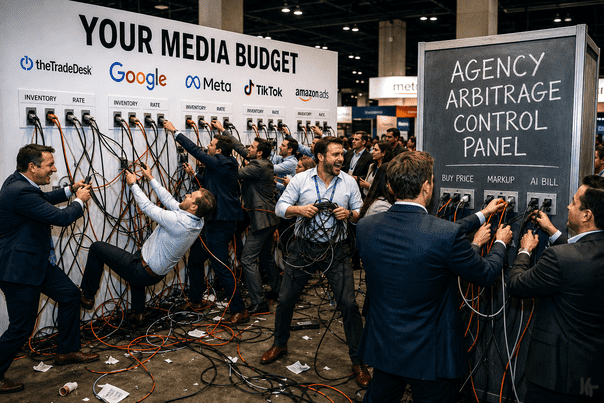
Somewhere inside your agency is an AI bill with your name on it.
Tokens. Compute. Models. Agents. Infrastructure. Tools.
You’re not going to receive that invoice. Instead, you may pay it somewhere else.
Where you ask? In your media spend.
Because when an agency buys media for $X and charges you $Y, they’ve just made money on the media. That’s arbitrage. Also known as “arbing the media”. And now comes a very interesting question. What additional margin tactics on the media advertisers purchase from their marketing agencies is helping pay for the AI?
AI isn’t free.
Let’s get one thing out of the way. I’m not arguing that agencies don’t have AI costs. They absolutely do.
Side rant. If your marketing agency calls themselves “AI Forward”, I would sprint in the other direction. I don’t even really know what that means when I hear agency people say it.
AI infrastructure costs money. Tokens cost money. Compute costs money. Building and maintaining proprietary AI systems costs money. Hiring the people who build those systems costs money. And agencies have been absorbing a lot of those costs while trying to figure out what the hell AI actually means for their business model. That’s changing.
Recent reporting from Digiday makes that pretty clear.
One CMO negotiating with a “big 5” agency was reportedly offered a deal where the agency would absorb the client’s entire AI infrastructure cost if 70% of the media budget ran through the holding company’s principal inventory. The inventory was bought in bulk and resold to the client with a markup, with that markup helping fund the AI commitment. (Digiday)
Well…now that is an interesting arrangement.
And I don’t think the interesting part is that someone called it “principal media.”
The interesting part is the arbitrage that was allowed to happen.
Let’s call it what it is.
I’m going to use a term throughout this article that isn’t limited to one specific agency structure:
“Arbing the media”
I’m using “arb” to describe the underlying economic behavior. An agency acquires media, inventory, access, or some media-related asset at one price and charges the advertiser another price. The agency keeps the spread.
Sometimes that’s through principal inventory.
Sometimes it’s a CPM markup.
Sometimes it’s a pre-negotiated rate.
Sometimes there are rebates, discounts, credits or other commercial terms involved from where and who your agency buys the media from.
The mechanics can vary. The economic relationship is what matters. They bought it for X. They sold it to you for Y. They kept the difference. That’s the arb.
And I’m not saying there’s anything inherently illegal about it. There isn’t.
Agencies can make money on media, negotiate advantageous rates and they can always take risk. They can bundle services and build commercial models that work for both sides.
The problem starts when the advertiser doesn’t understand the economics of the transaction or doesn’t know that the economics could influence the recommendation.
AI just gave the arb a new job.
This is where I think the current conversation gets really interesting.Agencies have spent the last couple of years telling clients that AI is going to make everything faster, cheaper and more efficient.
Did your agency charge you less?
Did your revenue go up while your marketing agency fees stayed flat?
Did your marketing agency take people off your account to make the reporting more seamless while simultaneously driving better performance.
(Crickets…..)
AI also creates a very real cost structure inside your marketing agency. Digiday reported earlier this year that agencies were already struggling with how to account for token costs, with some passing them through to clients, some absorbing them and others building them into broader pricing structures. (Digiday)
And more recently, Digiday reported that agencies are increasingly looking at ways to fold those AI costs into larger commercial arrangements.
That’s where the media arbitrage topic sticks out for somebody like me who now advocates for advertisers
Why? Because the agency already has a mechanism for generating margin. Your Media.
This isn’t a new problem.
The advertising industry has been dealing with versions of this for years.
There have been investigations and reporting around undisclosed rebates, commercial incentives, media markups and other non-transparent practices.
The Association of National Advertisers’ 2016 K2 Intelligence investigation, for example, found evidence of undisclosed rebates and other non-transparent practices in the media buying ecosystem.
The industry has spent years arguing about disclosure, principal transactions, rebates and transparency. Now AI has entered the same economic system.
And suddenly there’s another cost that needs somewhere to go. Shocker… that would be the marketing agency token bill.
Advertisers should start asking better questions.
Don’t just ask your agency:
“Are you using AI?”
Of course they are.
Ask:
How are you paying for it?
Ask:
Are AI costs included in our fee?
Are they passed through to us?
Are they being subsidized somewhere else in our commercial relationship?
Are you buying media at one price and charging us another?
What is the spread?
Do you receive rebates, credits, discounts or other incentives tied to the inventory you’re recommending?
And perhaps the most important question:
Would you recommend the same media mix if you made exactly the same amount of money regardless of where we spent our budget?
That’s the question you want answered.
Because I don’t actually care what you call it.
Principal media.
Programmatic arbitrage.
Inventory markup.
Preferred inventory.
Commercial optimization.
Whatever the industry’s favorite euphemism is this quarter.
I care about the economics.
What did you pay?
What did I pay?
What did you keep?
And did that economics influence what you recommended?
(I imagine everyone that actually got to this point starts pacing the room and saying out loud, “This Kevin Teeven guy! He really got me thinking about or ad spend.”)
And the AI revolution makes it more important.
Because the agency business is going through a massive economic transition. AI is compressing labor.
It’s changing production.
It’s changing media planning, reporting, analytics and how many people it takes to do the work.
And it’s creating a new category of infrastructure costs at exactly the same time.
Agencies have to figure out how to pay for all of this. That’s fair. But how they pay for it matters. If an agency wants to charge you for AI, send the receipts!
If it wants to increase your retainer because it’s delivering significantly more value, I am sure you would have that conversation. If it wants to absorb AI because AI makes the agency more efficient, great. If it wants to create a transparent technology fee, fine. But don’t tell your clients the AI is free while quietly changing the economics of the media relationship to make the money back. Because that’s not free. That’s an arb.
Let’s put a bow on this one. The question every advertiser (this is your marketing leadership and probably the CEO too) should be asking is: How are we paying for AI in our marketing and ad spend?
Because somewhere inside your marketing agency sits an AI invoice with your name on it.
They’re just not going to send it.