People might not remember every moment of an experience, but they remember how particular moments make them feel.
Authenticity has shaped the live entertainment industry for generations and remains just as relevant in the age of artificial intelligence. While AI is transforming how organisations operate, the experiences that matter most to audiences still depend on emotional intelligence, creative judgement, and human connection.
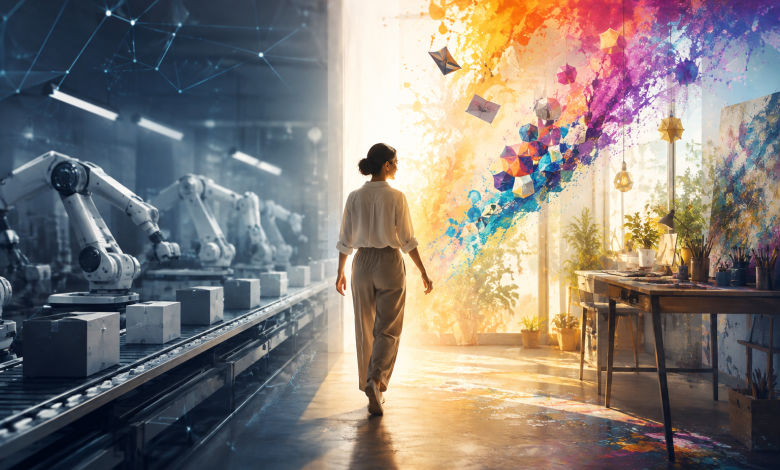
For creative businesses, the opportunity is not to automate creativity itself. It is to remove the administrative burden, operational complexity, and friction that surround it. When applied thoughtfully, AI gives talented people more time to focus on the storytelling, design, and creative decisions that create moments into memories.
AI Should Handle Complexity. Humans Should Make Decisions.
Creative work rarely happens in isolation. It relies on collaboration between teams, disciplines, and stakeholders, often across complex production environments. A human-centric approach treats AI as a support system that helps reduce friction throughout that process.
Whether it’s managing version control, enriching metadata, streamlining approvals or coordinating workflows, AI-driven automation can help teams work more efficiently behind the scenes. But creative concepting and execution should remain driven by human insight, imagination, and experience. AI enhances our capabilities rather than replacing them.
This shift is also evident in creative industries, where AI in book publishing is helping authors and publishers streamline workflows, refine content, and focus more on storytelling and creative expression.
The objective is simple: we must free creative teams to spend less time on administration, and more time making decisions that shape meaningful audience experiences.
By embedding intelligence into the systems that support production, organisations can move faster and operate more effectively. This is particularly relevant in the live entertainment industry, where creativity is not a “nice to have”, but the foundation of every audience moment.
Where AI Stops, Creativity Begins
The entertainment industry is built on originality, emotion, human connection. As AI adoption accelerates, protecting creative integrity becomes more important than ever.
Relying entirely on AI to generate creative ideas or define creative direction can risk diluting the authenticity that brands are built on and audiences connect with. This is why all organisations, specifically creative ones, must establish clear boundaries when it comes to using AI.
AI should not be asked to generate story tone, emotion, intent, or original creative content. Those are judgement-led, empathy-driven decisions that require human imagination and accountability. Instead, AI’s role is to support the process by reducing complexity, managing routine tasks, helping teams work more efficiently.
Ultimately, clear boundaries will help build trust from beginning to end. Creative professionals need confidence that AI is being used to heighten their expertise. In addition, clients and partners benefit from greater transparency and accountability, and, most importantly, audiences can trust that the experiences they engage with remain authentic.
In an industry built on human connection, knowing what not to automate may be one of the most important AI decisions we make.
Responsible AI Adoption Requires More Than Technology
AI can streamline workflows, accelerate decision-making, and remove operational friction, but responsibility does not transfer to technology.
Even as AI becomes more embedded in business processes, people remain accountable for how it is used and the outcomes it produces. That requires clear boundaries, human oversight, and a shared understanding of where AI adds value and human judgement must lead to ensure AI systems remain accountable.
The organisations that will benefit most from AI are not necessarily those adopting it fastest but those adopting it most intentionally.
Just as importantly, employees need practical training that helps them understand both AI’s strengths and limitations. When people are equipped with the right knowledge, AI becomes a long-term valuable tool that supports innovation aligned with the company values, rather than a source of risk or uncertainty.
Conclusion
By taking on operational complexity, AI gives creative teams more time to focus on the ideas, stories, and experiences that have the greatest impact. The real advantage of AI in the creative industry is its ability to strengthen the infrastructure behind great experiences, while people will always be responsible for creating the emotions those experiences evoke.