What arrives when you order a medical alert bracelet: a wrist button that summons a live dispatcher in seconds, or an engraved band that tells a paramedic about your allergies but can’t call anyone? The search term hides both products. An engraved ID from a maker like MedicAlert Foundation speaks for you at the scene; a monitored bracelet connects the wearer to a staffed 24/7 response center on a button press. The rankings below score the monitored kind, five providers on four weighted dimensions, and the buyer’s guide farther down explains where the engraved tag still fits.
How we scored the best medical alert bracelets
Each brand carries one score out of 5, built from four weighted dimensions.
Wearability (35%): asks whether the company sells a true bracelet and how the band feels through a full day of wear.
Response and monitoring (30%): covers timed pickup speed and who answers, human or machine.
Value (25%): totals the first year: monthly rate, hardware charge, activation fee, and fall-detection add-on.
Proof (10%): weighs third-party scores against verified review volume. Inputs come from hands-on 2026 tests at SafeHome and TheSeniorList, timed response calls, shower checks, and each brand’s published price page. A 4.0 still beats most of the market; the spread shows where each brand gives ground.
1. Bay Alarm Medical
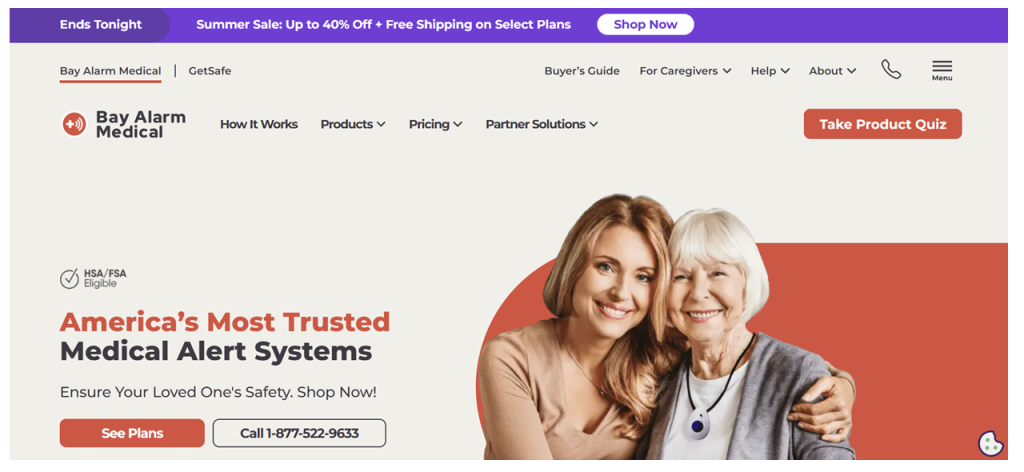
Best all-around wearable bracelet
Score: 4.9/5 · Wearability 5/5 · Response 5/5 · Value 4.5/5 · Proof 5/5
- Starting price: $27.95 per month, no contract
- Worn as: an all-in-one wrist band; pendant and belt-clip forms also ship
- Waterproofing: IP67; survived shower wear at two review labs
- Trial: 15 days with a full refund
The scoring story: Wearability lands at 5/5 because the SOS Micro runs fall detection on the band itself, a feat most of this list can’t match, and the SOS line covers the wrist alongside pendant and clip forms. Response earns the second 5/5 on a 16-second average pickup that reviewers timed at the company’s Five Diamond, UL-listed US centers, close to four times faster than the 60-second industry norm, with a person on every call.
Proof scores 5/5 on four separate signals: a 9.3 from SafeHome, a 4.8 from TheSeniorList, a 9.8 from NCOA on the systems side, and a Google base past 18,000 five-star reviews. Value settles at 4.5/5 for one documented reason, the $149 one-time hardware charge on mobile devices that the landline plan avoids.
Bay Alarm Medical device options:
- SOS Micro: all-in-one wrist unit that runs on-band fall detection and reports location over live GPS
- SOS Home: in-home base with a wristband button; test calls connected in as few as 9 seconds on landline
- SOS Smartwatch: a screen-forward wrist option at $199 hardware
- Caregiver app: live GPS location sharing for family on mobile plans
- Spouse coverage: a second wearer joins at no added monthly charge
What Bay Alarm Medical costs:
|
Wear scenario |
Monthly |
Equipment |
First-year total
|
|
In-home wristband (SOS Home) |
$27.95 |
$0 |
about $335 |
|
All-in-one bracelet (SOS Micro) |
$34.95 |
$149 |
about $568 |
2. Medical Care Alert
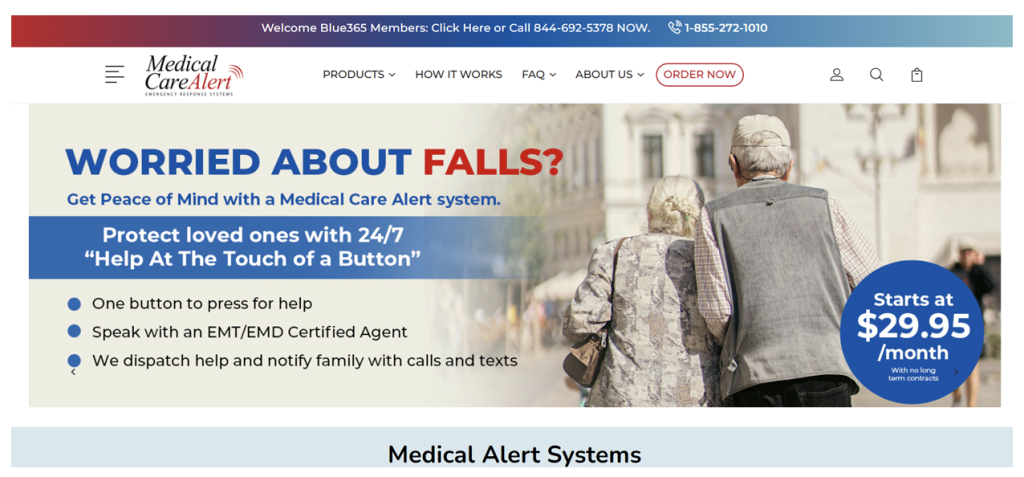
Best value wrist button
Score: 4.5/5 · Wearability 4/5 · Response 4.5/5 · Value 5/5 · Proof 4.5/5
- Starting price: $29.95 per month, no contract
- Worn as: a wrist button that swaps between a bracelet strap and a neck cord
- Waterproofing: shower-safe button
- Trial: 14 days
The scoring story: Value tops the pool at 5/5 because both plans skip hardware and activation charges outright, and no contract binds the service. Proof sits at 4.5/5 on a strong stack for a small brand: a 9.7 average across 2,324 TrustSpot reviews, an A+ from the BBB, five-star Google and Facebook pages, and seven Angie’s List Super Service awards.
Response earns 4.5/5 since EMT and EMD-certified US operators answer every call. Wearability stays at 4/5 for documented reasons: the catalog offers fewer wrist styles than the majors, and setup leans on video with no printed manual, an omission NCOA flagged. The 14-day trial also runs one day shorter than the leader’s window.
Medical Care Alert device options:
- Home system: base station paired with the shower-safe wrist button at $29.95 per month
- Home & Away: GPS mobile unit for errands and travel at $39.95 per month
- Convertible button: the same button clips into a bracelet band or hangs as a pendant
- Watch option: needs $149.95 hardware, the lineup’s one gear charge
What Medical Care Alert costs:
|
Wear scenario |
Monthly |
Equipment |
First-year total
|
|
In-home wristband (Home) |
$29.95 |
$0 |
about $359 |
|
Mobile system (Home & Away) |
$39.95 |
$0 |
about $479 |
3. ADT Health
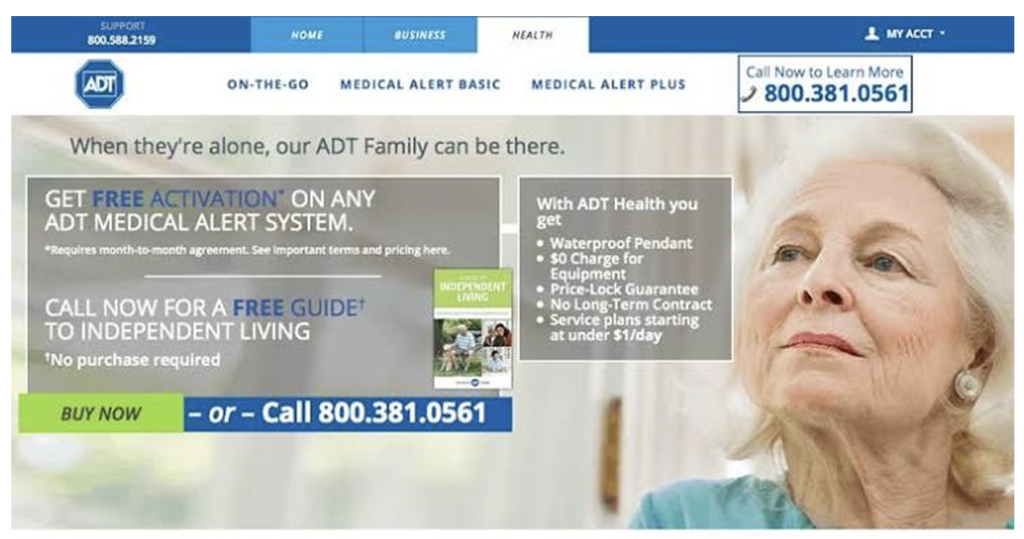 Best in-home bracelet with a free wristband
Score: 4.2/5 · Wearability 4.5/5 · Response 4.5/5 · Value 3.5/5 · Proof 4/5
- Starting price: $26.99 per month (Basic)
- Worn as: an included wristband button; a pendant ships as the alternate form
- Waterproofing: buttons survived both shower wear and drop tests
- Terms: month-to-month, $99 activation
The scoring story: Wearability reaches 4.5/5 because every ADT package ships a wristband button at zero hardware cost, a giveaway no rival here copies, though the Basic band is plastic and testers found it less comfortable than rubber rivals. Response matches at 4.5/5 on the steady 14-second pickups TheSeniorList logged.
Value falls to 3.5/5 on four documented counts: a $99 activation fee applies, some buyers owe up to three months of monitoring at signup, fall detection runs $11 a month against a $10 market norm, and the catalog holds no all-in-one bracelet or smartwatch since medical alert is a side business for a security giant. Proof lands at 4/5 with an 8.9 from SafeHome and a 4.7 from TheSeniorList, marks that trail the leaders.
ADT Health device options:
- Basic: landline base with the free wristband at $26.99 per month
- On-The-Go: mobile GPS unit at $36.99 per month
- Temperature monitoring: the base flags unsafe heat or cold in the home
- Lifetime warranty and rate lock: the monthly price holds after signup
What ADT Health costs:
|
Wear scenario |
Monthly |
Equipment |
First-year total
|
|
In-home wristband (Basic) |
$26.99 |
$99 activation |
about $423 |
|
Mobile unit (On-The-Go) |
$36.99 |
$99 activation |
about $543 |
4. MobileHelp
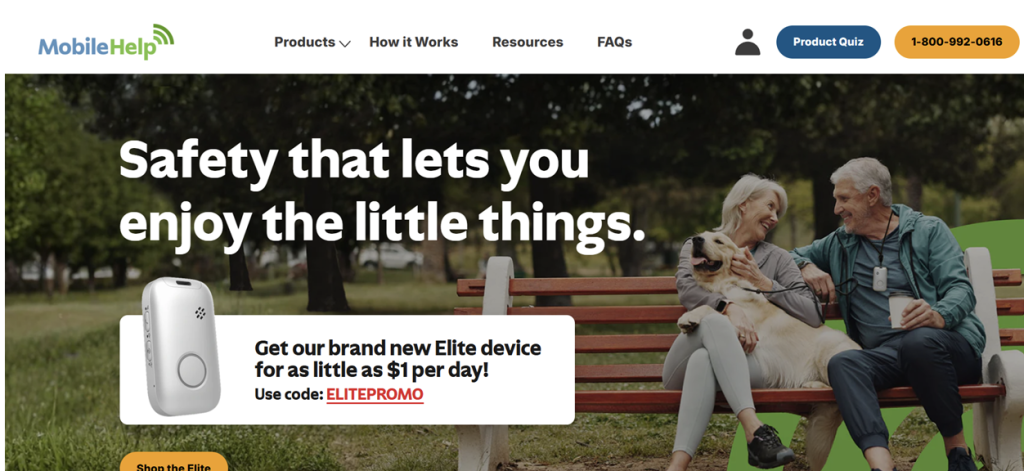
Most affordable bracelet
Score: 4.0/5 · Wearability 3.5/5 · Response 3.5/5 · Value 5/5 · Proof 4.5/5
- Starting price: $24.95 per month, the lowest rate in this group
- Worn as: an in-home wrist button; a pendant version also ships
- Waterproofing: waterproof band that dries fast after a shower
- Terms: no contract; zero equipment or activation fees
The scoring story: Value earns a perfect 5/5 on the cheapest monthly rate here with no hardware or startup charges attached, plus a Duo bundle that puts two wearers on one plan. Proof holds at 4.5/5 through a 4.5 from TheSeniorList and a 4.7 from U.S. News, with NCOA adding a 9.7 on the brand’s wider systems.
Wearability drops to 3.5/5 on the documented catch: the wrist button pairs with the home base alone, so a wearer who leaves the house gets no GPS bracelet at any price. Response sits at 3.5/5 after testers waited about 26 seconds for a pickup, the slowest here, and the brand ships no caregiver app; its $2.99-a-month text alerts send a single location snapshot rather than a live map.
MobileHelp device options:
- Classic: cellular home base with the waterproof wrist button at $24.95 per month
- Duo bundles: shared coverage that lets couples split one monthly bill
- Text alerts: $2.99 per month for snapshot location notices to family
What MobileHelp costs:
|
Wear scenario |
Monthly |
Equipment |
First-year total
|
|
In-home wristband (Classic) |
$24.95 |
$0 |
about $299 |
|
GPS bracelet |
n/a (wrist form stays in-home) |
n/a |
n/a |
5. Medical Guardian

Best mobile bracelet
Score: 4.3/5 · Wearability 5/5 · Response 4/5 · Value 3.5/5 · Proof 4.5/5
- Starting price: $27.95 per month (MGHome)
- Worn as: the MGMini Lite all-in-one band, or the MGMini with a wristband add-on
- Waterproofing: water-resistant, safe in the shower
- Terms: no contract, no free trial
The scoring story: Wearability matches the leader at 5/5 because the MGMini Lite squeezes GPS and a speaker into the smallest all-in-one band tested, about 1.4 by 1.5 inches, and the MGMini adds a wristband for $2.99 a month without forcing a fall-detection subscription. Response drops to 4/5 despite an advertised 8-second pickup: testers logged occasional false fall alerts and SafeHome hit a setup snag on the home unit, while the brand markets AI inside its call workflow where rivals staff every step with people.
Value takes the pool’s toughest mark at 3.5/5 on documented grounds: bracelet pricing tops this group, hardware runs $149.95 to $199.95, shipping adds $12.50, and no trial window softens the commitment. Proof stays high at 4.5/5; SafeHome puts the brand at 9.1 and TheSeniorList at 4.7, with Google reviewers landing in the same range.
Medical Guardian device options:
- MGMini Lite: all-in-one GPS bracelet at $42.95 per month plus hardware
- MGMini: compact mobile unit; the wristband add-on costs $2.99 per month
- MGHome: in-home base from $27.95 per month plus $12.50 shipping
- MyGuardian app: caregiver app that testers ranked with the category’s best
What Medical Guardian costs:
|
Wear scenario |
Monthly |
Equipment |
First-year total
|
|
In-home button (MGHome) |
$27.95 |
$12.50 shipping |
about $348 |
|
All-in-one bracelet (MGMini Lite) |
$42.95 |
$149.95 to $199.95 plus shipping |
from about $678 |
Monitored bracelet or engraved ID: buyer’s guide
Five decisions separate a smart purchase from a returned box.
Decide which product you actually need
The two products behind this search term don’t compete; they solve different problems. A monitored bracelet holds a button wired to a staffed response center, so pressing it brings help even when the wearer can’t speak. An engraved ID stays silent and works the opposite way. Tags from American Medical ID or Lauren’s Hope display conditions for a responder to read, and ROAD iD adds a scannable profile.
MedicAlert Foundation goes further and backs its jewelry with a health record hospitals can phone in for. Buy the button if the risk is a fall or a crisis alone at home. Buy the tag if the risk is a responder missing your allergy. Many wearers pair one of each, and monitored providers also store medical details in digital form for dispatchers.
Match the bracelet to daily range
A wearer who stays home does fine with an in-home wristband in the $25 to $30 range, since the button talks to a base station with a few hundred feet of reach. Anyone who still drives or walks a neighborhood loop needs cellular hardware with GPS, which raises the monthly rate by $7 to $15 across this group. Check the wrist form itself: MobileHelp’s bracelet pairs with the home base alone, so its low rate buys no protection on the sidewalk.
Check fall detection works on the wrist
Fall detection reads motion through an accelerometer, and the chest gives that sensor a far cleaner signal than a wrist in constant motion. Most providers respond by certifying the feature on a neck pendant alone, which defeats the point for a shopper set on a bracelet. Two exceptions stand out in this group. Bay Alarm Medical activates the feature on the SOS Micro band itself, and Medical Guardian supports it on its all-in-one units, though testers there logged occasional false alerts. Ask the sales line one question before ordering: does fall detection work in the exact wrist form I’m buying?
Confirm waterproofing and comfort
The bathroom produces more senior falls than any other room, so a bracelet that comes off for the shower protects nobody. Look for a named standard; IP67 means the device survives half an hour under a meter of water, and reviewers wore IP67 bands through running showers. Comfort decides whether the band stays on at 2 a.m., when it matters most; rubber straps beat rigid plastic on that test, as tester complaints about ADT’s stiffer Basic band showed.
Total the first-year price
Monthly rates mislead. Add twelve months of monitoring, the hardware charge, any activation fee, and the fall-detection add-on before comparing brands. ADT starts at $26.99, the second-cheapest sticker here, yet its $99 activation fee pushes a Basic first year to about $423 before fall detection, more than Medical Care Alert’s $359 despite the higher sticker. Run the same math on mobile plans, where hardware charges from $149 to $200 swing the totals harder. Then test signal range and comfort during the trial window, 15 days at Bay Alarm Medical and 14 at Medical Care Alert.
Best medical alert bracelets: bottom line
The scorecard settles it by use case. Bay Alarm Medical takes the top mark at 4.9 because the SOS Micro answers the question most shoppers arrive with, a real bracelet that detects falls on the wrist, with the pool’s fastest verified service numbers. Medical Care Alert wins the first-year math, ADT fits at-home wearers who want the free wristband, MobileHelp guards the tightest budget, and Medical Guardian carries the smallest GPS band. The best medical alert bracelet matches the wearer’s day, so score your own routine against these four dimensions before you order.
FAQ: medical alert bracelets
Do paramedics and EMTs look for medical alert bracelets?
Yes. Crews learn to scan the wrist and neck for medical tags during patient assessment, so an engraved ID can speak for a patient who can’t. A monitored bracelet adds a second layer: the dispatcher who answers the button press holds the wearer’s medical profile and can brief the responding crew before it reaches the door.
Do doctors recommend MedicAlert or engraved ID bracelets?
Physicians often suggest engraved identification for patients with severe allergies, diabetes, epilepsy, or heart conditions, and MedicAlert Foundation comes up most because its tag connects to a phone-accessible health record. That advice covers identification alone. For a patient who falls or lives alone, the same doctor will point toward a monitored button as well, since a tag can’t summon anyone.
Does AARP recommend a medical alert bracelet?
No single brand carries an AARP endorsement. The organization points members toward traits instead of names: tested response speed, a waterproof rating, optional fall detection, and month-to-month terms. Ask each provider about a member discount before signing, since several extend one, and weigh that discount against the full first-year price rather than the monthly rate alone.
Where do you buy a medical alert bracelet, and how do you get one?
Providers sell monitored bracelets straight from their websites or by phone, and the hardware arrives paired to the monthly plan. Ask for the wristband form at checkout, since most companies default to a pendant. Bay Alarm Medical builds the wrist option into its whole SOS line. Engraved ID jewelry works as a one-time purchase from a jeweler, no subscription attached.
Why does fall detection often require a pendant instead of a bracelet?
An accelerometer reads the sharp drop of a falling torso with far more clarity from the chest than from a wrist that swings through cooking, walking, gesturing, and gardening. Most brands certify the feature on pendants alone for that reason. Bay Alarm Medical’s SOS Micro and a handful of smartwatches tune their sensors for the wrist, so confirm on-band support before buying.
Which medical alert bracelet earns the highest ratings?
Pooled third-party scores put Bay Alarm Medical in front: a 9.3 from SafeHome as its top bracelet pick, a 4.8 from TheSeniorList, a 9.8 from NCOA on the systems side, and a Google review base past 18,000 entries at five stars. Medical Guardian follows at 9.1 from SafeHome, and Medical Care Alert posts a 9.7 TrustSpot average from a smaller reviewer pool.
Does Medicare cover a medical alert bracelet?
Original Medicare treats alert devices as personal items outside its benefit rules, so Parts A and B pay nothing toward one. Some Medicare Advantage plans build in a benefit that reimburses personal emergency response devices, and a few state Medicaid waivers help as well, so call your plan before assuming either way. Budget for a monthly plan near $25 if coverage falls through.
Can I wear a medical alert bracelet in the shower?
You should. Bathrooms produce more falls than any other room in the house, which makes the shower the one place a bracelet earns its keep. Every pick on this page survived shower testing, and Bay Alarm Medical rates its devices IP67, a standard that handles full submersion. Confirm the specific rating on any model before you buy it.
Are there medical alert bracelets with no monthly fee?
Engraved ID bracelets carry no subscription; you buy the band once and wear it. Monitored bracelets can’t work that way, since a staffed response center answers every button press around the clock. Plans in this group start at $24.95 per month from MobileHelp, and Bay Alarm Medical runs $27.95 with no contract, so you can cancel any month.
How we researched these bracelets
The numbers behind the scores come from published 2026 hands-on evaluations at SafeHome and TheSeniorList, whose testers timed response calls, wore devices through showers, ran drop tests, and checked fall detection in wrist form. Verified review pools supplied the second layer, from more than 18,000 Google reviews behind Bay Alarm Medical to the 2,324 TrustSpot reviews behind Medical Care Alert. Every price above comes from the provider’s own rate page, pulled in July 2026.