
Tencent on Monday launched Hy4 flash, its latest language model and the most cost-effective Hy model to date. Priced at $0.07 per million input tokens, $0.281 per million output tokens, and just $0.003 for cache-hit requests, it represents a significant price reduction from Hy4.
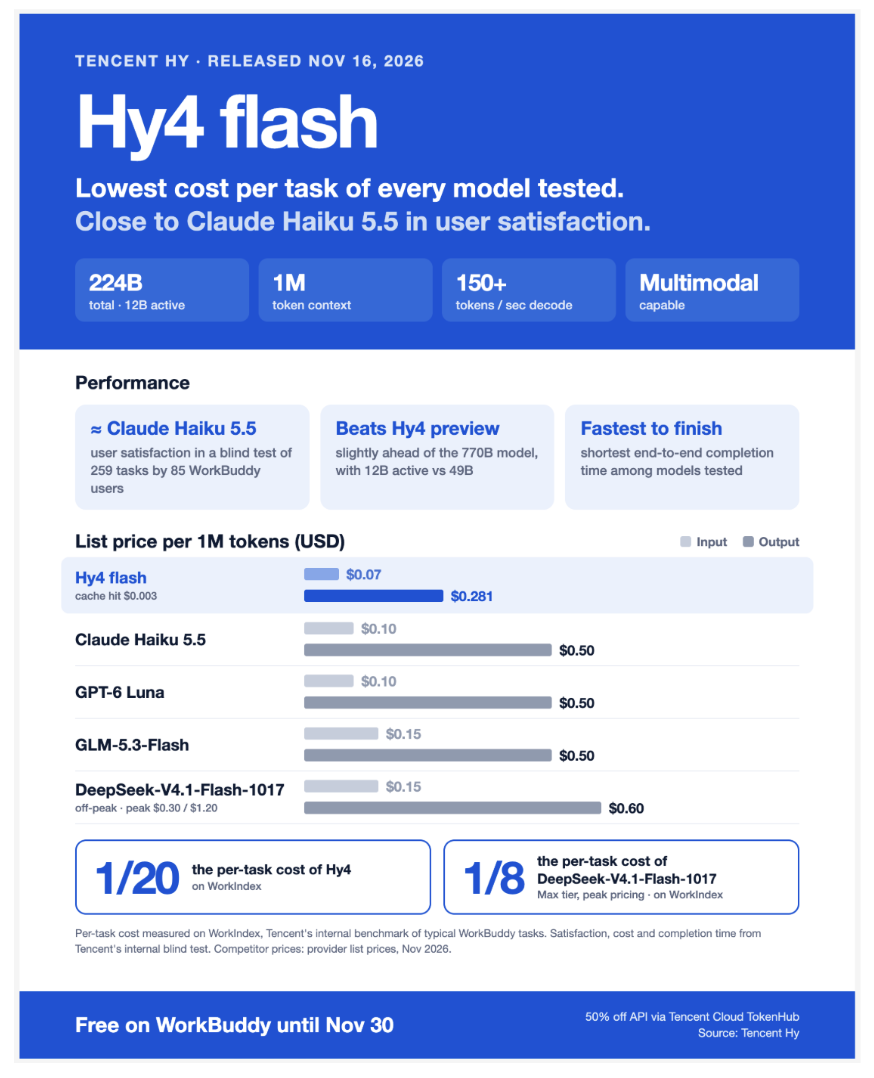
The model packs 224B total parameters (including 64B Engram parameters) but activates only 12B per forward pass. It supports up to 1M tokens of context and is multimodal-capable.
The company says the model was developed through a co-design approach with its AI products, a strategy it describes as central to how the team iterates. The guiding principle, according to Tencent, is practicality — pushing intelligence upward while keeping costs down.
To back that up, Tencent shared results from an internal blind test. 85 WorkBuddy users rated 259 tasks across 27 categories. Hy4 flash scored close to Claude Haiku 5.5 in user satisfaction (4-point scale), with the lowest per-task cost among all models tested and the shortest end-to-end completion time.
The engineering story behind those numbers spans four areas. During pre-training, the team added mixed attention, LatentMoE, and Engram, shrinking the KV cache to 1/24 the size of Hy3 and 1/6 of Hy4, with extensive scaling ladder experiments to validate performance.
In post-training, the model was self-distilled from Hy4 for general intelligence, then fine-tuned with reinforcement learning to cut output length by 50%.
For evaluation, the team built an internal benchmark called WorkIndex based on typical WorkBuddy tasks, combined with human ratings, focusing on real output quality, per-turn output length, and end-to-end latency rather than public leaderboard scores detached from daily work.
On the inference side, the team optimized aggressively with megakernel, 4-bit quantization, and DFly, pushing Hy4 flash decode speed past 150 tokens per second while enabling large-scale, low-cost deployment.
The end result, Tencent says, is a model that slightly outperforms the performance of the larger Hy4 preview — 770B total and 49B activated parameters — at a significantly lower cost.
On the Working Index benchmark, which covers tasks like slide creation and editing, document editing, spreadsheet repair, audio/video processing, and visual understanding, Hy4 flash costs 1/13 of Hy4 preview, 1/20 of Hy4, and 1/8 of DeepSeek-V4.1-Flash-1017 (Max tier, peak pricing) per task.
Hy4 flash is now live across Tencent’s product ecosystem, including Tencent Cloud TokenHub, WorkBuddy, Tencent Yuanbao, and other internal business lines, with OpenRouter integration coming soon. Until November 30, it’s free on WorkBuddy. API access via TokenHub is 50% off list price.
Tencent recommends Hy4 flash for everyday productivity work — research, slide decks, spreadsheets — and points users with heavier workloads like long-horizon software engineering to the full Hy4 model. The team says it plans to ship frequent updates to Hy4 flash going forward, with plans to release the model as open-weight as well.
The launch follows Tencent’s November 4 release of Hy4, which entered the top tier of open-source models. That model ranked second among Chinese models on the Artificial Analysis Intelligence Index and first among open-source models on the Agent Arena leaderboard.
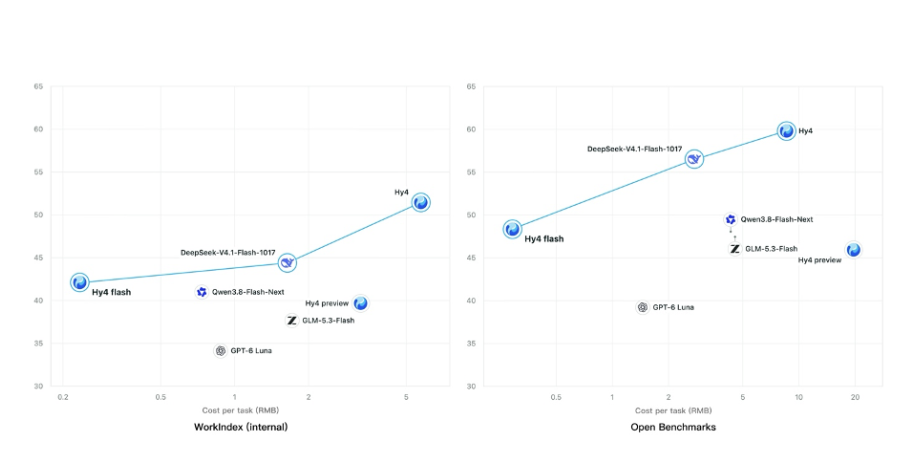
【Performance and cost across internal and external tasks. WorkIndex comprises 8 internal evaluation sets (PPT creation, PPT editing, PPT human-AI co-writing, Markdown human-AI co-writing, document editing, spreadsheet repair, audio/video processing, and visual understanding); Open Benchmarks comprises 7 public Agent evaluation sets (DeepSWE, ProgramBench, Terminal-Bench 4.0, APEX-Agents, AutomationBench, HLE, and OSWorld 2.1).】
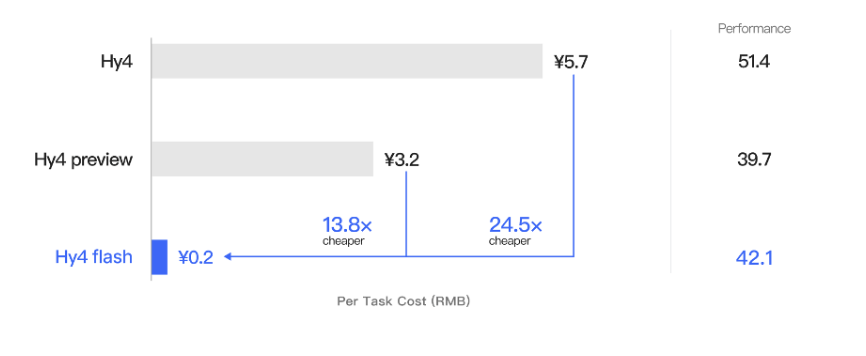
【On the internal benchmark Working Index, Hy4 flash significantly reduces task costs compared to its predecessor.】
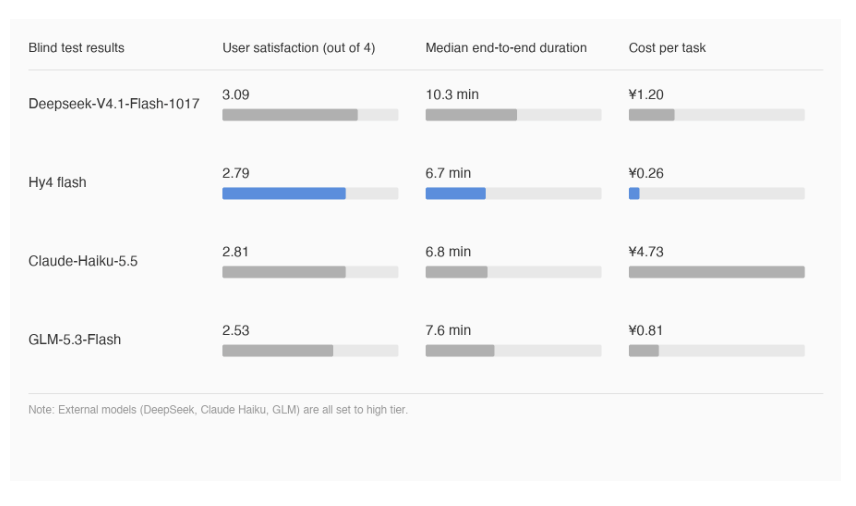
Pricing Reference:
GLM-5.3-Flash charges $0.15/$0.50 for input/output and $0.03 for cache hits.
DeepSeek-V4.1-Flash-1017 runs $0.15/$0.60 for input/output ($0.30/$1.20 at peak) and $0.003 for cache hits.