A new label has arrived on an old scam. Across Pakistan, sites that once sold a “SIM owner details online check by number” have rebranded as AI. The search box is the same, the promise is the same, and now a chatbot avatar sits beside it, implying a large language model will turn any mobile number into a name, an ID card number, and an address.
It will not, and the reason is worth an AI audience’s attention. This is a clean, public case of AI-branding pasted over a capability that does not exist. There is no database for the model to query, so a real answer cannot be retrieved and is instead invented. If you want the honest version of a real SIM owner details online check by number, it starts by separating what AI can genuinely do from what these pages pretend it does.
The distinction matters beyond one country. Retrieval-augmented systems are only as truthful as the source they are allowed to read. Point one at a registry with no public interface and it does not fail loudly. It hallucinates quietly, in a formatted card that looks exactly like a real record.

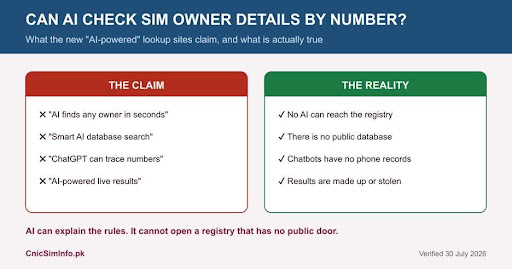
AI can explain the rules. It cannot open a registry that has no public door.
Key Takeaways
- No AI tool can run a SIM owner details online check by number in Pakistan for a stranger. The underlying registry has no public API for any software to read.
- When there is nothing to retrieve, a language model fills the gap with a plausible fabrication. That is a hallucination dressed as a lookup.
- Pakistan ties every SIM to a national ID card and a fingerprint. The record is real, but it is closed to the public by design.
- The only lawful online check returns your OWN record: cnic.sims.pk or SMS to 668 (about Rs 2). Neither returns a name.
- Obtaining another person’s identity data is an offense under Section 16 of PECA 2016, whether a human or an AI front-end does the asking.
Why an AI SIM Owner Details Online Check Cannot Work
Start with the plumbing, because it is where the promise breaks. A language model answers in one of two ways: from patterns learned in training, or from a live source it is allowed to read at query time through retrieval. A “SIM owner details online check by number” would have to use the second path, because no model is trained on a private national subscriber list.
That live source does not exist as anything a model can reach. In Pakistan the subscriber record sits with the licensed mobile operators, the identity layer sits with NADRA, the national database authority, and the regulator that writes the rules, the Pakistan Telecommunication Authority, holds no subscriber data at all. None of the three exposes a public API, a partner feed, or a bulk export. There is no endpoint for a model, an agent, or a plug-in to call.
So the retrieval step returns nothing. A well-built system would then say it cannot answer. These sites do the opposite: they hand the empty result to a generator and let it compose a record that fits the shape of the question. The output is confident, formatted, and untrue.
For anyone building with these tools, that is the lesson in one line. A model with no authoritative source does not abstain. It produces its most probable guess, and a probable-looking name beside a real phone number is indistinguishable from a fact to the person reading it.
What Is Actually Behind the AI Label?
Strip off the chatbot skin and three familiar mechanics remain, none of which needs a model at all.
- Recycled breach data. Old records leaked from various systems, cleaned and re-served. Some entries are real, which is what keeps the illusion alive, and all of them are stale. Calling the interface “AI” does not refresh a single row.
- Generated filler. When no record matches, and usually none does, the page produces a plausible name and ID number. This is the one place a language model may genuinely be used, not to find a person, but to manufacture a convincing one.
- Harvesting. Every number and ID card number typed into the box becomes inventory for the next dataset. The “AI search” is the bait; the visitor’s own data is the catch.
An AI badge raises the conversion rate on all three. It signals novelty and capability to a user who assumes a model can see more than a plain website could. The technology has not changed what is possible. It has only made the pitch more persuasive.
The Registry Is Real, and Closed by Design
It would be easy to conclude the data simply does not exist. It does. Pakistan runs one of the most tightly bound mobile identity systems anywhere, which is exactly why it is not open to a search box.
Every activated connection is tied to a Computerized National Identity Card, the CNIC issued by NADRA, and confirmed by a live fingerprint at an authorized outlet. The country recorded 204.771 million active mobile connections at the end of February 2026, and each one sits inside that system. Since December 2022 the device layer has been a multi-finger verification system that chooses which fingers to scan and asks for at most two successful impressions.
So the record is accurate and comprehensive. What it is not is queryable by the public. Operators are barred from sharing subscriber data with third parties, with narrow carve-outs for debt recovery, inter-operator provisioning, a legal obligation, or the customer’s prior informed consent. There is no exception for a website, an app, an agent, or an AI front-end. The closure is the security feature, not a gap waiting for smarter software to fill.
What a Lawful SIM Owner Details Online Check Actually Returns
The legitimate routes are narrow, cheap, and scoped to something you already hold. This is what a lawful SIM owner details online check returns, channel by channel, and every one of them answers about you, not about a stranger.

Every official channel answers about you, never about someone else.
- cnic.sims.pk is PTA’s free web portal. Enter your own CNIC number and it returns how many connections are registered against it on each network. No names, no addresses.
- 668 is the official SMS short code. Text your 13-digit CNIC without dashes, at a cost of about Rs 2, for the same per-network count by reply.
- 667 works only on the SIM already in your phone. It returns that line’s own registration record, which is how you confirm the connection in your hand is genuinely yours.
- 76367 accepts any number but returns only which network it currently sits on. It carries no identity information at all.
Read the pattern and the design intent is obvious. A SIM owner details online check exists in Pakistan, but it is a mirror, not a directory. It shows you your own record. It will not show you anyone else’s, and no amount of AI framing changes what the channel is built to return.
Where AI Genuinely Helps Here
None of this means AI is useless in identity and telecom. It means the useful jobs are the opposite of the one these sites advertise.
- Explaining the process. A model that has read PTA’s public guidance can walk a user through the lawful channels, the eight-SIM cap, and the disowning procedure in plain language. That is retrieval from public documents, which works.
- Fraud detection on data you already hold. A bank scoring its own signals, including a recent SIM change on a customer’s own consented account, is a legitimate and valuable model application. The data is owned and authorized, not scraped from strangers.
- Scam classification. Ironically, the strongest AI use in this space is spotting the fake lookup sites themselves. The tells are consistent: a perfect hit rate, no not-found state, no source, no date. Those are learnable features.
The common thread is authorization. AI adds value where the data is public or owned, and the task is reasoning over it. It adds only risk where the task is reaching data that the law and the architecture keep closed.
How to Spot a Fake AI SIM Owner Details Online Check
If you build or evaluate tools for a living, the fake lookup is easy to read from the outside. Five signals give it away, and every one is checkable in under a minute without installing anything.
- It answers every input. Feed it a number that was never issued, or eleven random digits, and it still returns a full record. A real retrieval system over a national registry misses often. A hundred percent hit rate means the output is composed, not fetched.
- It has no not-found state. On any genuine service the empty result is the most common screen, so it is designed with care. On these sites it does not exist, because it never fires.
- It shows no confidence or source. No match score, no collection date, no coverage note, no citation. A tool sure of its data says where the data came from; these describe theirs only with adjectives like fresh, live and complete.
- It demands your own CNIC before it will show a result. That is the harvesting step working exactly as designed, and an AI framing makes people surrender it more readily.
- It cannot name its model or its data partner. A service truly powered by AI can say which model and which licensed source. A rebranded scraper answers neither question, because the honest answer is none.
A SIM owner details online check that fails all five is not an AI product with rough edges. It is a fabrication engine with a chatbot sticker, and the sticker is the only new part.
The Enforcement Record Behind the Ban
This is not a gray area that regulation has yet to reach. Pakistan has spent two years actively shutting the trade down, AI-branded or not.
| Enforcement action | Figure | Date |
| Sites, apps and social pages blocked over the sale or sharing of personal data | 1,372 | by September 2025 |
| Platforms identified in a sweep led by the National Cyber Crime Investigation Agency | 139 | October 2025 |
| Citizens’ records compromised in the national identity database, per an FIA-led joint investigation | 2.7 million, 2019 to 2023 | March 2024 |
| PTA penalties on the cellular operators over SIM issuance controls | about Rs 740 million | July 2026 |
The legal line is drawn at the act, not the tool. Section 16 of the Prevention of Electronic Crimes Act 2016 covers obtaining, selling, possessing, transmitting or using another person’s identity information without authorization. A model that fetches it, an agent that requests it, and a person who types the number are all inside that sentence. Wrapping the request in a friendly AI interface does not move it outside the statute.
Frequently Asked Questions
The questions people most often ask about an AI or online SIM owner details check in Pakistan.
Can ChatGPT or any AI check SIM owner details by number?
No. No language model can run a SIM owner details online check by number for a stranger, because the registry has no public interface for any software to read. If a model appears to return such details, it is generating a plausible guess, not retrieving a record.
Are the new “AI-powered” SIM lookup sites real?
No. The AI label is marketing over the same three mechanics: recycled breach data, generated filler when no record matches, and harvesting of whatever you type in. None of them queries a live database, because no public one exists.
Is there any legitimate SIM owner details online check in Pakistan?
Yes, but only for your own record. PTA’s free portal at cnic.sims.pk and the SMS short code 668 return how many SIMs are registered against your own CNIC on each network, at little or no cost. Neither returns a name or an address, for you or anyone else.
Is using an AI lookup for someone else’s number illegal?
In Pakistan, yes. Section 16 of PECA 2016 makes obtaining another person’s identity information without authorization an offense, and it applies to the person making the request regardless of whether a website or an AI front-end performs it.
Why can AI answer other questions but not this one?
Because AI answers well when it can read a source, public documents, owned data, or its training set. A stranger’s SIM record is none of those. With no authoritative source to retrieve, the model has nothing to ground an answer in, so a confident output here is a fabrication by definition.
The Bottom Line for Builders and Users
The “AI SIM owner details online check by number” is a useful teaching case precisely because it is so clean. A real capability would need a source. There is no source. So the product cannot be retrieved, and whatever it returns is either stolen, invented, or a trap for the searcher’s own data.
For users in Pakistan, the takeaway is short: the only SIM owner details online check that is both legal and true is the one you run on your own CNIC. For builders, it is shorter still. An AI system is only as honest as the door it is allowed to open, and some doors are closed for a reason.