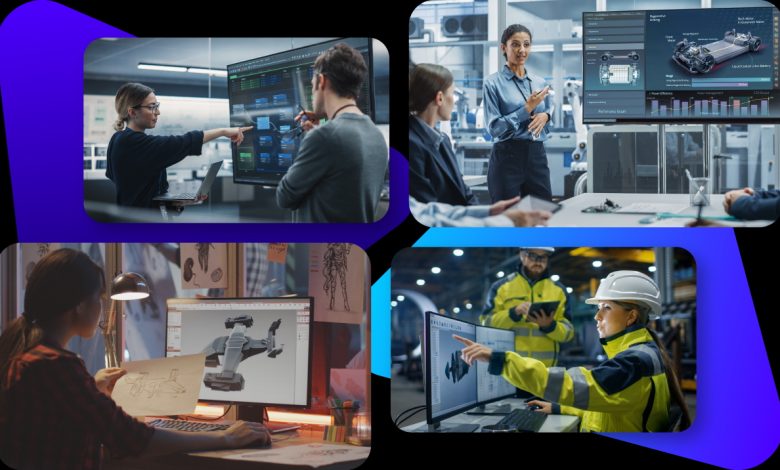
Perforce Software has released its annual State of Real-Time Workflows Report: Game Technology & Beyond, revealing how generative AI and real-time technologies are reshaping development and production workflows across gaming, media and entertainment, and automotive and manufacturing.
Produced in partnership with AWS and based on a global survey of more than 600 practitioners, the report suggests that while AI is delivering meaningful productivity gains, it is also raising concerns around job security, content quality, compliance, and visibility into AI-generated code and code changes.
According to the findings, job insecurity is now the top AI-related concern globally, cited by 50% of respondents. That is followed by concerns over content quality (49%), ethics and compliance (48%), and reduced creativity or human input (36%).
At the same time, some sectors are seeing clear operational benefits. Media and entertainment and automotive and manufacturing respondents led in both AI adoption and measurable gains, with 48% of media and entertainment respondents and 41% of automotive and manufacturing respondents reporting productivity increases of 11% to 50% after adopting AI.
Regionally, the report found that APAC reported the strongest AI-driven acceleration worldwide, at 74%, while concerns over AI-related job loss were highest in LATAM (83%)and North America (56%).
“AI is making teams faster, but faster doesn’t necessarily mean better,” said Brent Schiestl, Senior Director of Product Management at Perforce. “The same industries seeing some of the biggest productivity gains are also worried about compliance and content quality. As AI drives an explosion in digital assets, the competitive advantage won’t come from creating more content; it will come from knowing where that content came from, how it changed, and whether you can trust it.”
Beyond AI, the report also points to the continued spread of game technology into wider enterprise and industrial workflows.
Perforce said version control adoption reached 94% in 2026, up from 86% in 2025, while game engines are continuing to expand beyond their traditional gaming roots. In media and entertainment, 55% of respondents said they use game engines for film and television, while 32% use them for VFX.
Infrastructure trends are also shifting. The report found that hybrid cloud-and-on-premises server setups nearly tripled since 2025, with 27% of respondents now using a hybrid model, up from 10% in 2025 and 16% in 2024. According to Perforce, that now makes hybrid the leading setup, ahead of both cloud-only and on-prem-only approaches.
Taken together, the findings suggest that AI, version control, and game-engine technologies are now deeply embedded in real-time workflows across a growing range of sectors. However, the organisations moving fastest are also confronting the operational trade-offs more directly. Perforce noted, for example, that 55% of media and entertainment respondents are concerned about poorly produced content, while 37% of automotive and manufacturing respondents cited difficulty integrating AI tools into existing workflows.
The report will be released in three sections over the coming month. The first, covering real-time workflows and 3D technology trends, is available now, with later sections set to focus on AI trends and challenges, automotive and aerospace and defence, and media and entertainment-specific insights.
Read the report here: **perforce.com