It took a lot of time, effort, and expertise to design a home or any other space. However, now, with the emergence of AI tools, everything is much simpler. You are able to make layouts, visualize ideas, and even create entire designs within a few minutes. The issue is in the fact that there are various kinds of AI tools, and most of them may confuse people because they do not know what tool they really require.
This is where tools like the Floor-Plan.ai Floor Plan Creator and the Floor-Plan.ai AI 3D floor plan come in. On the surface, they may appear to be alike, as they use AI and design assistance. In practice, however, they have quite different functions: one assists you in planning your space, the other in viewing it in 3D.
So, how do you decide which one is right for you?
In this guide, we will dissect the actual distinction between an AI floor plan generator and an AI 3D generator in a straightforward and understandable manner. At the end, you will realize which tool is suitable for you specifically, or it is better to use both of them together.
AI Floor Plan vs AI 3D Generator – What’s the Difference?
On a fundamental level, the difference is straightforward: one of them assists you in planning your space, and the other one assists you in viewing it in a realistic manner.
A floor plan AI, such as the Floor-Plan.ai Floor Plan Creator, is a tool that specializes in 2D layouts. It assists you in determining where to place rooms, how many areas you will need, and how everything will be interrelated. This is normally the initial step in designing.
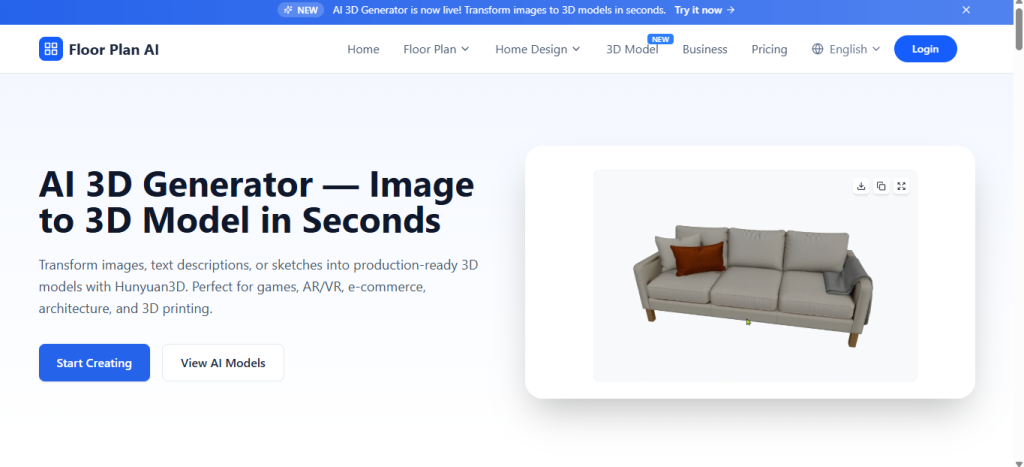
Conversely, the Floor-Plan.ai AI 3D Generator is an AI 3D tool that translates ideas into realistic 3D models. Rather than mere lines and layouts, you have a visual representation of your design with depth, textures, and a more realistic feel.
In a nutshell, a floor plan creator is what you require if you are still trying to figure out the structure and layout. However, to create and represent your design, a 3D generator is more appropriate.
Inside AI Floor Planning: How It Designs Your Space in Seconds
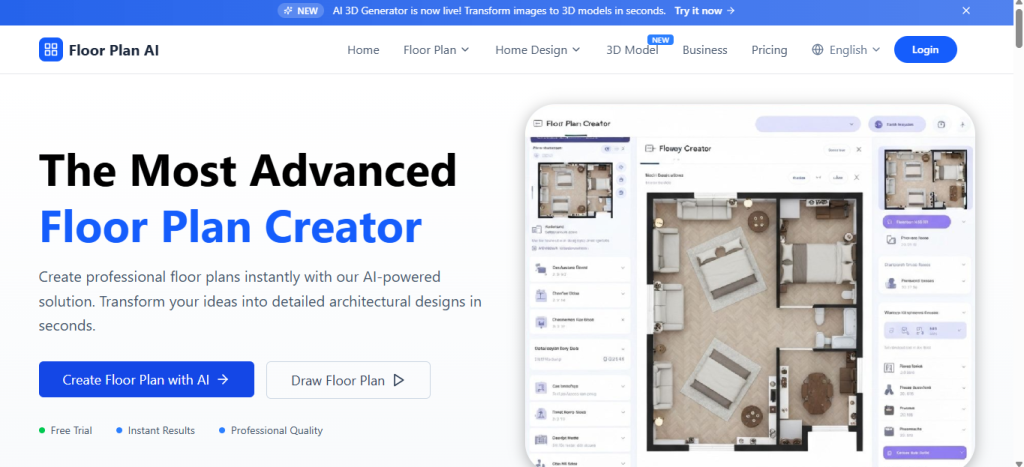
An AI floor plan creator is an application that assists you in creating the plan of a space in 2D without requiring technical expertise. Rather than having to draw it all by hand, you just input some basic information, such as the number of rooms or the size or type of building, and the AI software creates a full floor plan for you.
This is done quickly and easily with tools such as the Floor-Plan.ai Floor Plan Creator. In a matter of seconds, you are provided with a well-organized plan of the room structure and the way the space is arranged. This is time-saving in contrast to the conventional approaches to planning.
Planning and space management are the primary objectives of an AI floor plan creator. It assists you in determining where everything must be situated, makes better use of space, and experiments with various layout concepts with relative ease. Simply put, it provides you with a solid backbone and then proceeds to a detailed design or 3D visualization.
Inside AI 3D Modeling: How It Creates Objects in Seconds
An AI 3D generator is a software that transforms your concepts into life-like 3D models with the press of a button. Rather than spending hours in complex 3D software, you can just provide a text prompt, image, or sketch, and the AI can create a full 3D version of it.
An example is the Floor-Plan.ai 3D Generator, which can take simple inputs and create detailed 3D models with shapes, textures, and depths. This will make your design look more real and will help you know how your design will appear in real life.
Visualization is the primary goal of an AI 3D generator. It is not only about planning but also about the vision of the final result in a realistic form. That is why it is popular in such areas as games, architecture, product design, and interior visualization.
When Should You Use an AI Floor Plan Creator?
An AI floor plan maker is applicable in cases when you are only planning out a project, and you have to plan how to lay out space in a clear and practical manner. It will assist you in making decisions about how you want the rooms to be set up, how much space each area will occupy and how it all will interconnect in a well-organized way.
To illustrate, Floor-Plan.ai Floor Plan Creator can be used when you are interested in trying out the various possibilities of a house, office, or building layout. Rather than sketching, you can create numerous options within a few seconds and select the one you consider the most appropriate.
The tool can be of great use to homeowners, architects, and designers who wish to plan well before construction or renovation. Simply put, a floor plan generator is suitable when you are concerned with structure, space utilization, and initial stage design choices.
Final Verdict: Which One Do You Actually Need?
When deciding between an AI floor plan generator and an AI 3D generator, the choice is not about which one is better in general, but at which phase of design you are at.
The Floor-Plan.ai Floor Plan Creator is the appropriate place to start, provided that you are still trying to figure out layouts, room placement, and space planning. It assists you in transforming ideas into clear and structured plans within seconds and without any technical skills.
However, in the case you already have a layout and would like to find out how it will appear in real life, the better option will be the Floor-Plan.ai 3D Generator. It renders your design in realistic 3D visuals, textures, and depth.
The smartest approach? Combine the two- begin with a floor plan and then transform it into a 3D model to have a complete design process. Your time has come–use both and see how soon your ideas become actual designs.