Enterprise artificial intelligence has officially crossed the threshold from speculative experimentation into consequential production. For the past two years, boardrooms have lived through an intense cycle of breathless demonstrations, rapid prototyping, and endless vendor promises. Yet behind the excitement, a familiar tension is surfacing across corporate suites. The easy part of enterprise AI is generating enthusiasm; the hard part is running real business operations safely, reliably, and profitably.
Over two decades ago, when my teams and I were pioneering early cognitive systems as the founding leadership of IBM Watson, we learned an enduring truth: demos are magical, but production is messy. During a keynote address in Washington, D.C. before 8,000 attendees, we were demonstrating cognitive cancer diagnosis tools when an audience member stood up and interrupted me. His wife had third-stage breast cancer, and he pointedly asked how the system reasoned and what regulatory standards it adhered to. That moment proved that intelligence without explainability and verifiable boundaries cannot survive in the real world.
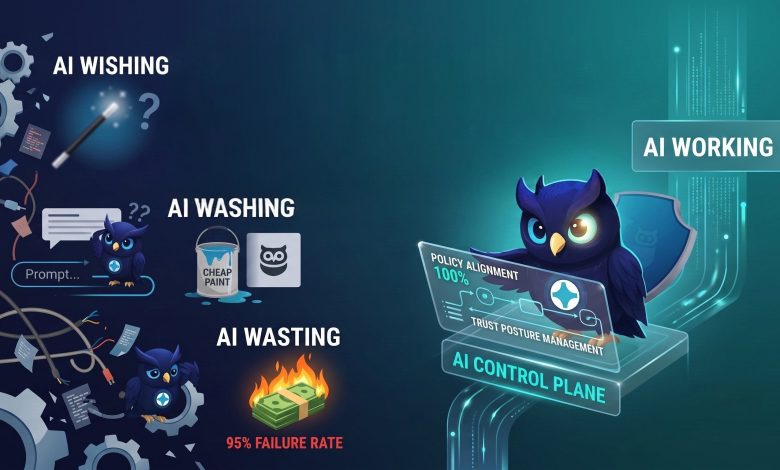
Today, the operational stakes have escalated dramatically. AI is shifting from advisory software that merely suggests recommendations to autonomous agents that act, execute workflows, and make financial commitments at machine speed. Despite this profound architectural leap, too many organizations still run their enterprise strategies on habits formed at the height of the hype cycle. Four distinct patterns have emerged across the enterprise landscape: three drain capital and introduce systemic risk, while the fourth unlocks durable business value.
AI Wishing: The Illusion of Frictionless Transformation
AI Wishing is the persistent belief that machine learning models can solve systemic business bottlenecks without the hard work of operational redesign. Many leadership teams assume that sprinkling generative models or agentic frameworks over disorganized workflows will spontaneously resolve structural inefficiencies. In practice, artificial intelligence does not fix broken business processes; it accelerates and scales whatever chaos already exists underneath.
Autonomous agents require unambiguous operating boundaries, explicit business context, and clean semantic definitions to function properly. When organizations deploy models without defining domain ownership or establishing clear task mandates, the systems quickly flounder. A foundation model trained on public web data cannot magically deduce your internal credit risk policies, regional compliance nuances, or supply chain constraints.
Wishing for automated magic without doing the foundational work of data curation, process mapping, and authority scoping inevitably stalls deployments. High-performing enterprise systems do not emerge from ungrounded optimism. They are engineered through rigorous architectural discipline and clearly defined business intent.
AI Washing: Rebranding the Ordinary
Just as the early cloud era suffered from cosmetic re-platforming, the enterprise technology market is now saturated with AI Washing. Vendors and internal IT departments alike are aggressively attaching AI labels to conventional rules engines, basic statistical scripts, and legacy SaaS workflows. Every database now claims to be cognitive, and every standard automation macro is suddenly marketed as an autonomous agent.
This superficial repackaging confuses the C-suite and dilutes meaningful transformation. When technology buyers cannot separate genuine agentic reasoning from glorified decision trees, they end up purchasing solutions that fail to move the needle. True enterprise AI is not a marketing veneer or an opportunistic feature add-on.
Authentic agentic capability requires dynamic planning, multi-step tool invocation, contextual memory, and the capacity to alter system states autonomously. Slapping a natural language interface onto an outdated database does not deliver autonomous capability. Until organizations look past vendor branding and evaluate architectural reality, AI Washing will continue to waste executive attention and budget.
AI Wasting: The Economic Hangover of Uncontrolled Sprawl
The inevitable consequence of widespread wishing and washing is AI Wasting. Across the Global 2000, enterprises are accumulating a quiet mountain of overlapping tools, fragmented licenses, duplicated internal models, and abandoned proof-of-concept projects. According to MIT research on enterprise AI pilots, up to 95 percent of generative AI pilots fail to reach enterprise production.
Part of what drives this waste is structural. Most enterprises cannot answer a basic question: what does our AI estate actually contain? Fleets of agents, models, tools, routes, and data interactions pile up faster than anyone can inventory them, let alone govern them as a single system. An organization cannot secure or optimize an estate it has never mapped.
The financial fallout extends far beyond sunk software licenses and stalled developer hours. When autonomous agents operate without real-time oversight, token consumption and compute expenditures frequently spiral out of control. We recently observed an autonomous agent in a major enterprise enter a recursive retry loop during a supply chain reconciliation task, consuming 35 times its expected token volume and burning through five months of compute budget over a single weekend.
This points to a question most enterprises are not yet equipped to ask correctly. The relevant metric is not simply how much an organization spends on AI. It is the cost per trustworthy response, the cost per trustworthy action, and the hidden economic drag of retries, loops, failures, and poor routing – what we think of as trustworthy AI economics.
Traditional monitoring dashboards logged the disaster on Monday morning, but logging is merely a digital autopsy that records failure after the damage is done. Furthermore, Gartner predicts that over 40 percent of agentic AI projects will be canceled by the end of 2027 due to escalating costs, unclear business value, and inadequate risk controls. The modern enterprise cannot afford an AI strategy characterized by unmetered spending and unmeasurable returns.
AI Working: The Discipline of Bounded Runtime Autonomy
In contrast to the first three failure modes, AI Working represents the emergence of an operational discipline centered on reliability, safety, and measurable outcomes. Making artificial intelligence work in high-consequence corporate environments requires treating autonomous systems not as software experiments, but as members of an authorized digital workforce. When AI moves from advising humans to executing transactions, the entire management paradigm must evolve.
To make AI work reliably, enterprises must solve four fundamental runtime requirements: authority, control, evidence, and economic optimization. First, organizations must define exactly what an AI system is authorized to access, modify, and decide within enterprise systems. Second, systems require active runtime control mechanisms that intercept, evaluate, and stop unapproved or unsafe actions before they execute.
Third, every consequential decision and tool execution must generate a tamper-evident audit trail for regulatory compliance, internal risk teams, and operational debugging. Fourth, enterprises must continuously optimize unit economics by monitoring Runtime Policy Alignment. When an organization achieves 95 to 100 percent runtime policy alignment, its autonomous systems operate predictably within approved risk and cost boundaries.
We call this discipline Trust Posture Management. It is the practice of continuously measuring, controlling, and proving whether an enterprise’s AI systems are trustworthy enough to act, not merely capable enough to impress in a demo. Just as cybersecurity posture management became a category enterprises had to staff, budget, and report on once networks grew too complex to secure by instinct, Trust Posture Management is becoming the equivalent discipline for the age of agentic AI.
The Architectural Mandate: Why AI Needs a Control Plane
In my years competing in endurance auto rallies, I learned that you never push a vehicle to maximum velocity if your only instrument is a speedometer. A speedometer merely tells you how fast you are crashing. Scalable performance in complex physical systems depends entirely on fly-by-wire control, responsive steering, and active traction management.
Enterprise AI skipped this vital architectural evolution during its initial generative rush. Companies connected reasoning models directly to internal databases and external APIs without an independent control layer to govern behavior in flight. Relying on post-hoc observability logs or static prompt instructions is the software equivalent of checking a dashboard hours after a collision.
Without that independent control layer, enterprises are exposed to what we call silent agentic breaches. An agent accesses data it was never authorized to touch. It deletes records it should have preserved. It takes an unintended action or enters a runaway compute loop, all without triggering a single conventional security alert. Nothing breached the perimeter. The system simply did what it was technically permitted, but never actually intended, to do.
To close this gap, forward-thinking enterprises are adopting dedicated control infrastructure, such as an “AI Control Plane.” As an independent runtime control layer, an AI control plane continuously evaluates agent actions against enterprise policy, enforces allowable action boundaries, and provides verifiable evidence of compliance. This architectural foundation allows enterprises to deploy autonomous agents with the same confidence and accountability they expect from human employees.
The Next Phase of Enterprise AI
The coming era of enterprise artificial intelligence will not belong to the organizations with the flashiest demos, the largest model collections, or the loudest press releases. Enterprises that build the structural capacity to make AI perform reliably, safely, and cost-effectively in production will win.
Moving from AI Wishing, Washing, and Wasting to AI Working requires a fundamental mindset shift across executive leadership. We must stop treating bounded runtime control as an administrative bottleneck and recognize it as the primary catalyst for scaling autonomy. When you have proven runtime control, you can finally move your AI systems out of the laboratory and put them to real work.