
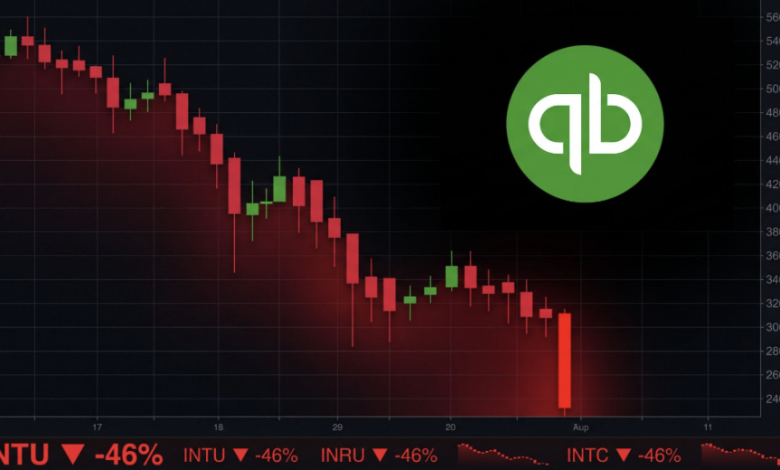
Intuit (INTU) is down about 46% this year. The parent of QuickBooks beat its latest quarter, then cut its outlook, and the stock slid again. Expensify, the public face of expense software, is about 96% below its 2021 IPO peak. Xero, still growing revenue, has been cut roughly in half over the past year.
The accounting software industry is taking a beating.
Wall Street has its explanations: slower growth, weaker guidance, desktop products fading, tax software getting repriced. Those are real. They are also not the most useful story if you run a small business.
The useful story is simpler. People still need their books done. They are just less willing to learn, pay for, and live inside a suite built for a different era. Instead, they are keeping the books with ChatGPT, Claude, and tools like ReceiptsAI, which make it much easier for owners to do the books themselves. For most small businesses, that is the digital transformation that matters: capture receipts, categorize expenses, and hand a clean file to the accountant. No one wants to learn how to use accounting software.
What these products actually are
QuickBooks is the default small business accounting system in the United States. You use it to keep a general ledger, send invoices, record bills, reconcile the bank, run payroll in some plans, and hand a year-end file to an accountant. That is why it won. If you needed “the books,” you opened QuickBooks.
Expensify sits one layer down. It is expense software: scan a receipt, submit a report, get it approved, push it into accounting. It was built for companies with employees, cards, and a reimbursement workflow. For a while, that was the grown-up way to stop using a shoebox and a spreadsheet.
Neither product became optional because bookkeeping became optional. The job is the same as it always was. Capture what you spent. Put it in the right place. Keep a record your accountant or the tax office can follow.
What is changing is how much software, process, and monthly cost a five-person business will tolerate to get that job done.
Why businesses are turning away
They are not turning away because they stopped needing books. They are turning away because a lot of this software got heavy.
QuickBooks can do a great deal. That is the problem as much as the pitch. A freelancer who needs to track receipts, categorize spend, and send a clean file to their accountant once a year still gets a product shaped like a full accounting department. Plans stack. Features multiply. Bank feeds break. You end up clicking through screens that exist for inventory, multi-entity, payroll, and accountant workflows you do not have.
Expensify has the same shape from the other side. Expense reports, approvals, corporate cards, travel, policies. Useful if you have a finance person and a team submitting claims. Noise if you are the owner, the bookkeeper, and the person who took the Uber.
The other complaint is time. These tools assume someone will learn them. In a small business that someone is usually the founder, or one person who already has a real job. A couple of hours a week inside QuickBooks is not “automation.” It is a second shift.
Then there is the price. You pay for the suite, you pay for the seats, and you often still pay a bookkeeper to make the suite behave. For a business doing $200,000 or $400,000 a year, that stack is a lot of overhead for work that is mostly: here is a receipt, here is a category, here is a total.
The books still matter. The software around the books started asking for more attention than the books themselves.
Digital transformation means cutting software bloat
While digital transformation usually means adopting new tools, with AI, it is just as much about ditching the software that no longer serves the business.
Owners are using ChatGPT and Anthropic’s Claude to do the messy middle of bookkeeping. They paste a bank CSV and ask for categories. They drop in a receipt photo and ask for the vendor, date, and total. They write a prompt for a monthly spend summary before they talk to their accountant. It is imperfect. It is also fast, cheap, and already on the laptop.
That is the first shift. General AI made it possible for a non-accountant to handle work that used to require either QuickBooks fluency or a hire.
Businesses are also moving that same work into smaller tools built for it. Tools like ReceiptsAI simplify bookkeeping for small businesses. You upload a receipt or invoice, or forward it to a private inbox. The software extracts the data, helps categorize it, and gives you something you can export. It is built for small businesses and freelancers, not for a 200-person expense policy.
These tools are cheaper. They are less bloated. They are easier to use. For a typical small operator, they now cover 80 to 90 percent of the bookkeeping work people were opening QuickBooks to do: capture the document, pull the numbers, put spend in a category, keep a record, get it out to a spreadsheet or an accountant.
The day-to-day and the month-to-month are what changed. Receipts, statements, “what did we spend on fuel,” “can you find that invoice.” That work no longer needs a dedicated system with a learning curve. More businesses are choosing to handle it themselves with smaller, leaner, sharper AI tools, then handing a clean pack to the accountant at tax time.
The suite still owns the official books. It no longer owns the week.
What this means if you run a small business
The practical win is time and money, not a new philosophy of digital transformation.
You do not have to learn QuickBooks. You do not need a dedicated person to run the books. For a lot of one-to-ten person businesses, the new version looks like this: one employee, a couple of hours a month, and an AI subscription. Receipts get captured as they come in. Categories get reviewed, not rebuilt from scratch. The accountant gets a file when it matters, not a shoebox in April.
That is a different cost structure. You drop the expensive seat, the training, and often the part-time bookkeeper who existed to operate the software. You keep the part that still requires a human: a quick check that the numbers look right, and a professional at year-end.
It also changes when you “do the books.” Instead of a painful catch-up, you keep a running record because the capture step is easy enough to do in the moment. That is the unglamorous version of automation, and it is the one small businesses actually use.
The slide is structural
The stock move is not just a bad quarter. Tools like QuickBooks are going through the same kind of platform shift the internet forced on desktop software. Last time, the internet moved software from a disc to a browser. This time, AI is moving bookkeeping from a suite you have to learn to a workflow you can run with a prompt, an upload, or a forwarded email.
Investors are repricing the incumbents because growth got harder and the moat is thinner. That is the story happening below QuickBooks. And it will be the same story for any bloated incumbent in software.