
A RAG system that works well in testing often behaves differently once real users start querying it at scale. Retrieval accuracy drops, latency creeps up, and edge cases surface that a small test set never revealed.
Getting a production AI app to perform reliably usually requires outside expertise focused specifically on tuning retrieval and generation for live conditions. Choosing the right consulting partner for that work has a direct effect on whether the system holds up under real traffic.
Understanding the Importance of RAG Optimization Consulting Firms
Production performance depends on details that rarely show up until a system faces real query volume and real data drift.
What is RAG Optimization?
RAG optimization covers the tuning work that happens after a retrieval-augmented generation system is built. This includes adjusting chunking strategy, refining retrieval ranking, reducing latency, and aligning retrieved content more closely with what users actually ask. It is distinct from the initial build phase, since optimization responds to how a system actually performs once it is live.
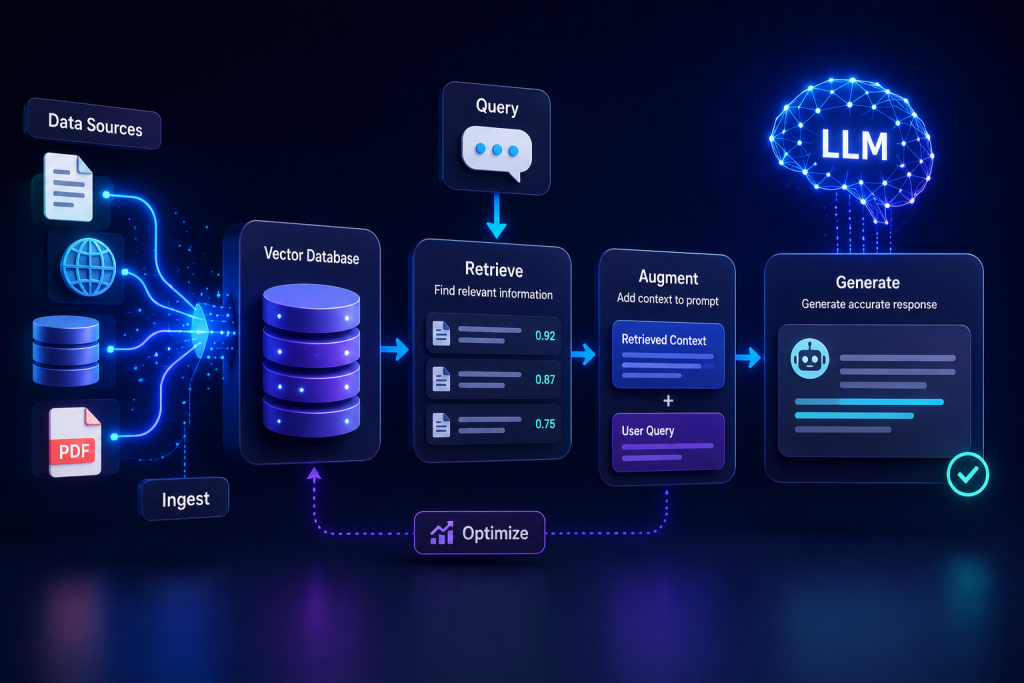
Why Production AI Apps Need RAG Optimization Consulting Firms
A system that performs well in a controlled demo can still fail under production conditions. Common triggers include unexpected query phrasing or a sudden increase in document volume. RAG optimization consulting firms specialize in diagnosing these failures and fixing them systematically instead of through repeated trial and error.
Their value shows up most clearly at scale. A team that has already debugged retrieval accuracy issues across many production deployments recognizes recurring failure patterns faster. Internal teams typically encounter those same patterns for the first time.
Key Criteria for Selecting RAG Optimization Consulting Firms
A handful of specific criteria separate a firm capable of production-grade work from one that only handles proof-of-concept builds.
Proven Experience with Production AI Applications
Ask for specific examples of systems the firm has optimized after launch, beyond systems it only helped design initially. Production experience reveals whether a firm understands how to diagnose live performance issues, which differs substantially from designing a system from a blank slate.
Expertise in Retrieval-Augmented Generation (RAG) Techniques
A firm offering RAG consulting should demonstrate hands-on knowledge of retrieval methods, including:
- Dense vector search and when it outperforms keyword-based retrieval
- Hybrid retrieval combining semantic and keyword matching
- Re-ranking techniques applied after initial retrieval
- Chunking strategies suited to different document types
Customization and Scalability of Solutions
Generic optimization advice rarely transfers cleanly between industries or data types. A firm with real RAG application architecture experience adjusts its approach based on data volume, document structure, and the specific failure patterns a client’s system is showing. A fixed checklist applied to every engagement rarely produces the same results twice.
Security and Compliance Standards
Optimization work often touches sensitive data directly, particularly when diagnosing retrieval issues that involve reviewing query logs or document access patterns. Confirm the firm’s data handling practices, including how they treat client data during diagnostic work and whether they follow relevant compliance requirements for the industry.
Client References and Case Studies
Request references from clients with a comparable use case, along with measurable outcomes such as improved retrieval precision or reduced response latency. A firm without specific, verifiable results is harder to evaluate against firms that can point to concrete numbers.
Evaluating the Consulting Process
The structure of a firm’s process reveals as much about its capability as any single credential.
Initial Assessment and Needs Analysis
A solid engagement starts with a diagnostic phase: reviewing query logs, testing retrieval accuracy against real queries, and identifying where the current system underperforms.
Skipping this step and moving straight to recommendations is a sign the firm may apply generic fixes instead of addressing the specific problem.
Solution Design and Implementation
Once the diagnostic phase identifies specific issues, the firm should propose targeted changes tied directly to those findings. This typically involves:
- Adjusting chunking size or overlap based on retrieval test results
- Fine-tuning ranking logic for the client’s specific query patterns
- Updating metadata tagging to support more precise filtering
- Testing changes against a held-out set of real queries before full rollout
| Process Stage | What It Should Include |
| Initial assessment | Query log review, retrieval accuracy testing against real data |
| Solution design | Targeted fixes tied to specific diagnostic findings |
| Implementation | Chunking, ranking, and metadata adjustments, tested before rollout |
| Ongoing support | Continued monitoring as query patterns and data volume shift |
Ongoing Support and Optimization
RAG systems continue to need tuning after the initial optimization phase, since query patterns and data volume keep shifting. Confirm whether ongoing monitoring and adjustment are included in the engagement or offered as a separate service.
Questions to Ask Potential RAG Optimization Consulting Firms
A short set of direct questions during evaluation reveals more than a firm’s marketing materials.
Technical Capabilities and Toolsets
- Which vector databases and embedding models do you have direct experience optimizing?
- How do you measure retrieval accuracy before and after an optimization engagement?
- What is your approach to diagnosing latency issues specifically?
Project Timelines and Deliverables
Ask for a realistic timeline broken into phases, along with what deliverables mark the end of each phase. A firm that cannot outline a clear timeline with milestones may not have a repeatable, tested process behind their work.
Pricing Models and ROI
Pricing for RAG optimization work varies between fixed-scope engagements and ongoing retainers. Ask how the firm measures return on investment for a given engagement, such as a specific improvement in retrieval precision or a reduction in fallback rate.
Common Pitfalls to Avoid When Choosing RAG Optimization Consulting Firms
Several patterns tend to signal a mismatch between a firm and the specific optimization work needed.
- Choosing based on general AI credentials alone. Broad AI or machine learning experience does not guarantee specific expertise in retrieval tuning.
- Skipping the diagnostic phase. A firm that proposes fixes before reviewing actual query logs is likely applying a generic playbook.
- Overlooking data security practices. Optimization work involves handling sensitive query and document data, which needs the same scrutiny as any other data-processing engagement.
- Ignoring post-engagement support. A firm that disappears after the initial fix leaves the client exposed to the next round of performance drift.
- Focusing only on cost. The cheapest rag optimization consulting companies are not always the ones with the deepest production experience. A poor optimization engagement often costs more to fix later.
Conclusion: Making the Right Choice for Your Production AI Apps
Selecting the right RAG optimization consulting firms depends on verifiable production experience, a structured diagnostic process, and clear post-engagement support. Firms that can point to specific, measurable outcomes from past work are easier to evaluate than those relying on general credentials. Getting this choice right has a direct effect on how reliably a production AI app performs once real users start relying on it.