Introduction: The Digital Information and Retention Paradox
In the contemporary landscape of digital education and professional skill development, the primary bottleneck in learning is no longer access to information. Modern professionals and students operate in an era of unprecedented data abundance, where technical manuals, research papers, and educational modules are instantly accessible across connected devices. However, this high volume of digital content has highlighted a growing structural gap between information consumption and durable knowledge retention. Without structured mechanisms to internalize new concepts, continuous digital reading frequently leads to cognitive overload rather than genuine mastery.
Artificial intelligence is beginning to address this imbalance by shifting focus from simple text generation to cognitive augmentation. Rather than merely summarizing long documents or generating standalone text, modern AI platforms are increasingly engineered to interface directly with human learning mechanics. By pairing natural language processing with established principles from cognitive psychology, software developers are creating tools that systematically reinforce human memory. This technological evolution marks a transition from passive reading habits to interactive, data-driven learning workflows.
Among the emerging software paradigms addressing this challenge, intelligent knowledge management platforms combine automated retrieval practice with adaptive study scheduling. These tools transform static reference materials into dynamic query systems that actively test user recall over expanding time horizons. As organizations and individuals seek to maximize the return on educational investments, understanding the technical and psychological foundations of these systems becomes essential. This analysis examines how platforms like LongTerMemory integrate artificial intelligence and cognitive science to reshape knowledge retention in contemporary learning environments.
Cognitive Psychology and the Mechanics of Memory Decay
The challenge of retaining complex information is rooted in human neurobiology and was first systematically quantified by German psychologist Hermann Ebbinghaus. Through empirical research, Ebbinghaus formulated the forgetting curve, which demonstrates that human memory retention degrades exponentially over time without deliberate review. In standard learning environments, individuals lose more than half of newly acquired information within twenty-four hours of exposure. This rapid decay poses a continuous operational hurdle for corporate training programs, academic institutions, and self-directed learners alike.
Traditional study habits, such as highlighting passages, re-reading textbook chapters, or copying notes verbatim, fail to reverse this retention curve effectively. Cognitive research consistently demonstrates that passive re-exposure creates a false sense of cognitive familiarity without establishing durable neural pathways. When a learner re-reads familiar text, the brain recognizes the terms easily, leading to an illusion of competence. However, recognition does not equal recall, and information stored through passive exposure degrades rapidly when applied in practical settings.
In contrast, cognitive scientists have repeatedly validated active recall as one of the most effective interventions for long-term retention. Active recall requires the brain to retrieve information from memory in response to a targeted query without viewing the original text. This retrieval effort strengthens synaptic connections, rendering the neural pathways far more resilient to decay over time. Every successful act of memory retrieval reorganizes mental representations, making future recall faster and more reliable.
Despite the robust scientific evidence supporting active recall combined with spaced repetition, widespread manual adoption remains low. Constructing comprehensive flashcard decks from technical manuals requires dozens of hours of manual preparation. Furthermore, calculating optimal review intervals across hundreds of distinct concepts demands complex tracking that quickly overwhelms learners. The operational friction of managing manual study systems frequently causes users to abandon evidence-based learning strategies altogether.
Architectural Mechanics in LongTerMemory: Processing Unstructured Data with RAG and OCR
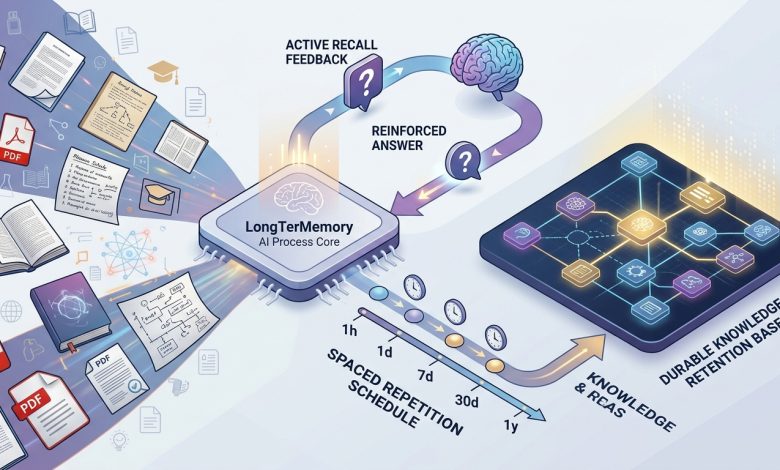
To eliminate the administrative friction associated with manual study preparation, modern educational software relies on automated processing pipelines. These software architectures combine multimodal input parsing, Optical Character Recognition, and Retrieval-Augmented Generation to convert static files into structured study units. By automating the extraction of key concepts, intelligent platforms shift the user investment from administrative setup to direct cognitive engagement.
The ingestion workflow begins with multimodal parsing capabilities designed to process diverse file formats. Modern learning software must handle heterogeneous inputs, including academic PDFs, slide decks, typed notes, and handwritten diagrams. Advanced OCR algorithms analyze visual structures, layout geometry, and handwritten text, converting raw images into clean textual representations. This foundational step ensures that diverse source materials can be uniformly processed by downstream intelligence models.
Once text is extracted, Retrieval-Augmented Generation plays a central role in organizing and structuring the underlying knowledge. Rather than relying solely on pre-trained parametric memory, RAG systems query the specific context provided by user documents. Large language models analyze this retrieved context to identify core definitions, causal relationships, and foundational principles. The system then formulates balanced question and answer pairs designed specifically for active recall testing.
A representative example of this technical pipeline is found in the LongTerMemory platform, which automates the conversion of unstructured documents into structured review modules. By integrating high-precision text extraction with LLM-driven concept synthesis, such tools eliminate the manual overhead of flashcard creation. Users upload raw study materials and receive logically formatted query decks in seconds. This technical integration effectively bridges the gap between raw document storage and structured pedagogical practice.
Algorithmic Repetition in LongTerMemory: Dynamic Spacing and Performance Telemetry
Generating question and answer pairs represents only the first component of the cognitive retention framework. The timing of subsequent review sessions is equally critical for optimizing long-term memory consolidation. Spaced repetition algorithms schedule review sessions at expanding time intervals, targeting the precise point when retrieval requires optimal cognitive effort. Reviewing a concept too early yields minimal neural benefit, while reviewing it too late results in complete memory decay and necessitates re-learning.
Early computerized spaced repetition tools relied on static mathematical formulas, such as fixed percentage increases between review cycles. While superior to unmanaged study, fixed-interval models fail to account for individual concept difficulty or personal memory variation. A complex mathematical formula requires a different spacing trajectory than a simple vocabulary definition. Modern algorithmic frameworks solve this limitation by integrating continuous performance telemetry into the scheduling engine.
Advanced software systems dynamically recalibrate spacing schedules based on real-time user performance metrics and confidence scoring. When a learner retrieves an answer effortlessly, the underlying algorithm extends the next review interval significantly, pushing the next exposure weeks or months into the future. Conversely, if the user hesitates or fails to retrieve the correct answer, the interval contracts immediately, scheduling a follow-up review within hours or days.
Automating this interval recalibration removes the administrative burden of schedule management from the learner entirely. For instance, the LongTerMemory spaced repetition engine calculates memory vulnerability across an entire knowledge base continuously. The system evaluates historical response latency, error frequency, and self-reported difficulty to optimize daily review queues. This automated precision ensures that learners spend study time exclusively on concepts requiring urgent reinforcement.
Mitigating Hallucinations and Enforcing Data Integrity in Educational AI
While generative language models offer powerful capabilities for summarizing and structuring content, their deployment in educational contexts carries inherent risks. The phenomenon of model hallucination, where artificial intelligence generates factually incorrect or plausible sounding fabrications, poses a direct threat to learning outcomes. In academic and enterprise environments, internalizing incorrect information can lead to severe operational errors and compromised assessment performance.
To maintain strict data integrity, specialized EdTech platforms implement grounded AI architectures with closed retrieval boundaries. In a grounded system, the language model is constrained strictly to the context window provided by verified user documents. When generating active recall prompts or answering conversational queries, the model cannot introduce external claims that lack direct attribution within the source text.
This closed-loop approach transforms the conversational assistant from a general web-trained model into a dedicated domain expert bounded by specific materials. If a user requests clarification on a complex topic, the system provides explanations strictly derived from the uploaded files. Additionally, advanced platforms incorporate exact text references and document page citations, allowing learners to audit system outputs against original source documents seamlessly.
By enforcing strict retrieval boundaries, software developers eliminate the risk of propagating misleading information during critical study phases. Users can trust that generated flashcards and interactive explanations accurately reflect their prescribed curriculum or corporate compliance guidelines. Grounded AI architecture thus serves as an essential safeguard for applying artificial intelligence in formal education and regulated professional training.
Ecosystem Integration, Accessibility, and EdTech Business Models
The practical utility of cognitive learning tools depends heavily on their seamless integration into daily professional workflows. Modern learners move constantly between desktop workstations, tablets, and mobile smartphones throughout the day. Consequently, intelligent retention platforms must maintain cross-device synchronization to ensure that study sessions can occur in any context. Web-based dashboards, native mobile applications, and browser extensions form a cohesive digital ecosystem for continuous learning.
In addition to cross-platform technical availability, software distribution models significantly impact user adoption and long-term satisfaction. The digital marketplace has become saturated with recurring subscription services, which often introduce cost predictability concerns for independent students and small teams. In response, some platform developers are exploring alternative pricing structures, such as transparent time-based licenses or lifetime access options.
Providing clear, non-recurring financial options offers users greater control over their software investments. Educational tools in particular benefit from transparent monetization, as students often operate on fixed academic budgets. When pricing structures align with user financial preferences, software adoption increases, allowing learners to focus on long-term skill acquisition without fear of sudden service interruptions or escalating monthly fees.
Furthermore, data security and privacy considerations play an increasingly central role in platform selection. Educational documents often contain proprietary corporate data, unpublished research, or sensitive personal notes. Cloud-based EdTech providers must implement robust encryption standards during transmission and storage, ensuring that user documents remain private and isolated from public model training datasets.
Structural Limitations and the Necessity of Human Oversight
Despite the substantial efficiency gains enabled by artificial intelligence, automated learning tools operate within clear functional limits. First and foremost, the output quality of any AI system remains inextricably bound to input quality. If an uploaded document is disorganized, contradictory, or missing fundamental details, the generated active recall prompts will inevitably mirror those deficiencies. Software algorithms optimize retention, but they cannot create logical clarity out of incoherent source material.
Furthermore, automated systems should be viewed as cognitive amplifiers rather than substitutes for human critical thinking. While an algorithm can efficiently extract facts and schedule reviews, deep conceptual synthesis often requires reflective human thought. Learners must engage critically with complex topics, questioning assumptions and synthesizing ideas across disparate domains. Automated retrieval practice secures foundational knowledge, freeing mental bandwidth for higher-order reasoning.
Finally, no algorithmic system can replace personal discipline and consistency. Spaced repetition relies on regular, incremental engagement over extended periods to achieve optimal neural consolidation. Missing review queues repeatedly disrupts the algorithmic calculation, forcing the system to reset intervals and requiring additional time to recover lost retention gains. Long-term learning success ultimately requires a commitment to daily practice supported by intelligent software automation.
Enterprise Applications and Institutional Learning Impact
The integration of cognitive science and artificial intelligence holds profound implications for institutional education and enterprise workforce development. Traditionally, corporate onboarding and compliance training have relied on passive video modules and lengthy textual guides. These traditional methods yield poor retention statistics, leading to knowledge gaps that compromise productivity and increase operational risk across organizations.
By adopting AI-driven retention infrastructure, organizations can transform static compliance manuals and technical documentation into interactive micro-learning modules. Employees spend short, targeted sessions completing active recall challenges tailored to their specific roles. Automated analytics dashboards allow managers to monitor retention metrics across departments, identifying knowledge gaps before they manifest as real-world operational errors.
Similarly, higher education institutions are discovering that intelligent review tools democratize effective study habits. Students from diverse educational backgrounds gain instant access to evidence-based learning methodologies without needing prior training in cognitive psychology. By automating administrative preparation, these platforms level the academic playing field, allowing all students to study with maximal efficiency regardless of their prior study habits.
Conclusion: LongTerMemory and the Future of Cognitive AI Infrastructure
The ongoing convergence of cognitive science and artificial intelligence represents a fundamental shift in how human beings interact with digital information. Rather than viewing software merely as a passive repository for data storage, modern learning architectures position technology as an active partner in cognitive processing. By automating text extraction, question synthesis, and interval scheduling, intelligent platforms eliminate administrative barriers to effective study.
As artificial intelligence continues to evolve, the distinction between content creation and knowledge internalization will become increasingly clear. Platforms like LongTerMemory that leverage grounded language models and dynamic spaced repetition demonstrate how AI can enhance human intellect rather than displace it. By grounding digital systems in proven cognitive principles, education technology is building a future where learning is faster, more structured, and infinitely more durable.