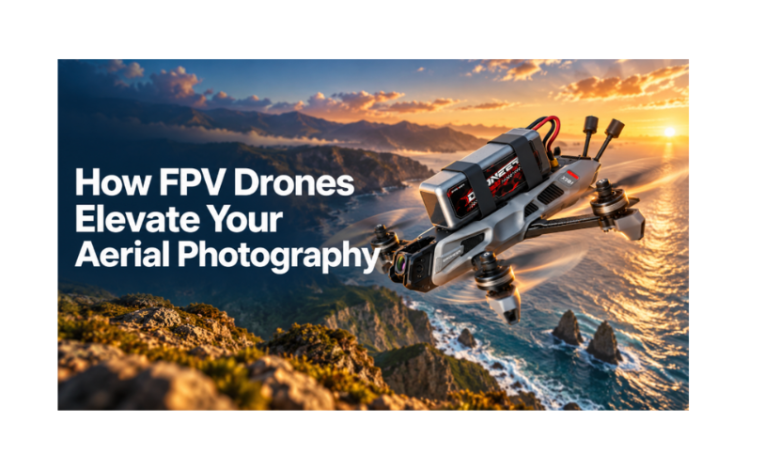
AERIAL SHOTS were already available to virtually anyone — with the help of a camera drone. FPV — first person view — aircraft have revolutionized the capabilities of a moving camera. You do not stand on the ground directing something from afar or watch it go through a pre-determined course. You’ll be seeing what the drone is seeing, in real time, and responding to it as you fly. That immediate aspect is what makes FPV footage so great – it’s quick, intimate and smooth, and regular drones simply can’t achieve that.
The speed isn’t what draws photographers and film makers. The shots FPV allows can only be achieved by flying low over water, hard banking around a building, threading through a doorway and opening into a wide landscape without any cuts. If you fly it right, the camera will not seem like something watching from a distance, but it will feel like it’s part of the scene.
A new perspective of the world, from above.
Most stabilized drone cameras have been created to keep stable and level, and make steady video. Every climb, dive, bank and acceleration is seen since their camera is tilted to view the change in attitude of the aircraft. It’s not just a view from the heavens, but a feeling as though you are traveling through a place.
The images produced look more like human motion and can get to places and speeds at which a handheld or mounted camera could not get safely.
Real-Time Control produces Intentional Movement.
FPV is a first person view. It has a small camera on board which streams live video onto goggles worn by the pilot, and radio controls convert hand movements into instant direction, altitude and speed changes. Low latency is crucial as it could impact accuracy, particularly near an obstacle.
During a time change, when the light is changing, or when the subject is moving in an unpredictable way, or when the flight path is repeated but flown at a different speed, the pilot can change the line. The pilot needs to take into account foreground objects, background balance, the position of the subject and the energy of each turn all at once. The quality of the video in FPV is as much visual as it is technical.
Freestyle Platforms Foster Creativity
The freestyle FPV drone is designed for fast, expressive flight. Dramatic tricks are popular, but there is still value in being responsive in controlled cinematic work. Pilots can create soft curves, have their subjects hover very low or move on a path of great distance within a short amount of time from low to high level track.
They’re also built in a modular fashion, which allows owners to swap out the motors, arms, cameras and electronic components individually. This re-systems is important on-site, where a single faulty component does not necessarily mean the end of the whole shoot. Most important, a well-tuned craft reacts in a predictable way and allows the pilot to repeat complex moves and focus on framing rather than battling with the controls to produce the desired result.
The 5-inch format’s versatility
The 5 inch fpv drone is a popular aircraft format among custom and ready-built aircraft. It is a practical size offering power, agility, payload capacity and efficiency for landscapes, action and event shots, and experimental camera movements.
Even with a small action cam, a typical 5” system can support it, and still maintain high acceleration and good handling. It is big enough to stand tall in moderate winds, but agile enough to go through tight spaces and track closely. The personality of this battery can change with different batteries or motor setups, from speed, to smooth cruising, to freestyle. But this format is more energetic and louder than a small protected cinewhoop, hence it is not suitable for all indoor/crowded venues.
The use of visual techniques to enhance a story.
Just because it’s an impressive flight doesn’t mean it will provide useful footage. There are a few techniques which are particularly effective:
If you go too low, you’ll make the motion of the textures in the foreground appear fast since they’re close to the lens.
A rising reveal reveals the wider scene behind an object in the foreground.
Close orbit is an orbit close to a person, vehicle, or structure that displays the person, vehicle, and/or surrounding environment.
It is a seamless movement that connects places and actions without breaking the flow of the viewer’s understanding of place.
A controlled dive is made by moving from a broad perspective to a specific point.
A slow orbit can be used in architecture, and a quick orbit can be used for a mountain biker or racing car. Slowing down gradually at the end of the composition allows the viewer to appreciate the final frame, while raising the level of anticipation in the opening by gradually increasing the speed.
The camera settings, light and image quality.
When preparing the camera for an FPV aircraft, it’s very important to consider the speed at which the plane is flying. A fast frame rate gives the option to slow down the action; a fast enough shutter speed will give a natural motion blur. In bright situations, neutral-density filters can be used to achieve such a slow shutter speed. Flat or log color profiles retain more color information which can be further corrected during post production, but they are more difficult to handle.
Facing a low sun can generate flare and silhouette, facing directly into the sun can create texture and colour. A route may give a definite reaction in the automatic exposure, which can result in a more consistent shot if the exposure is locked. Before flying the plane, pilots will also need to securely mount the camera, wipe the lens, confirm that the camera has enough storage for the recording, and double-check if the camera is set to stabilize.
Using a flight plan for safety and consistency.
Flexibility is best when it’s contained in a structured approach. Preliminary survey of the area before take-off: check the site, people and property; look for wires or branches; set up a safe take-off zone. All local aviation regulations, airspace restrictions, permissions and privacy issues should be verified. The surrounding area can be seen by the visual observer as the pilot concentrates on the instrument.
Other factors to consider are battery voltage, radio range, video reception, weather, and return routes. Practicing without a video camera increases safety and a walk along the route can often highlight dangers which are not visible from the intended starting point. Discuss with them before subject tracking: their speed, direction, stopping points and emergency signals. This ensures that there is consistency in the communication and enhances the likelihood of getting a good take.
The best way to prepare for an important shoot is to practice it beforehand.
FPV control can be tricky and requires some learning especially when flying in manual or acro modes, where the aircraft does not automatically level off. Flight simulators are an affordable means of developing coordination and muscle memory without risking equipment. New pilots can then practice in open spaces and then try proximity moves, or carrying a costly camera.
Professional imagery begins with a steady throttle management, coordinated turns, controlled altitude, and reliable landings. Looking at recordings is helpful as movements that may look smooth in goggles might look abrupt in the recording. There are a number of ways to make the aircraft more suitable for certain shooting.The elevation of the rates, the camera angle and the stick sensitivity may be adjusted to make the aircraft more suitable for certain shooting styles. Technical actions can be accomplished through repetition to become instinctive, and more time can be devoted to light, timing and story.
The effects that are added to FPV footage are not lost.
When editing FPV footage, there is no loss of effects added to the footage.
Post production can add more to a great flight, but too much can kill the unique attributes of FPV. Stabilization is beneficial to help minimize vibration and minor stick inputs, but can clip the image or introduce warped edges if set too high. When there are straight lines that curve with a wide angle of view, lens correction may also be required.
This is to cut around purposeful motion which editors should do. Acceleration on entry and a reveal upon leaving can help maintain momentum. There’s the sound design, too: when the drone’s sound is unusable, wind, machinery, footsteps, or music can help show where and how fast the action is happening. When FPV footage is used in conjunction with ground cameras or standard aerial footage, color matching will be important. The objective is a clear progression that is flowing and not just put in for the skill.
The Science of Flight: From Airplane to Visual Storytelling.
FPV drones add in the elements of access, responsiveness, and emotional movement to aerial photography. They can go from the intimate to the broad, from the quick subject to the linking of dissimilar areas in a single shot. The best that can be achieved is balance between that freedom and planning, technical preparation and respect for the environment.
One option is to create expressive movement on a freestyle platform, or a five-inch build for more versatile outdoor filming, but it all starts with the story that you want your viewer to see. Equipment influences the possibilities, but judgment is meaningful. Aerial imagery is the FPV mode when flight paths are appropriate, the subject is reflected, the light is reflected, and the rhythm and setting are appropriate. It turns into a point of view that engages viewers in the scene and enables them to experience the travel.