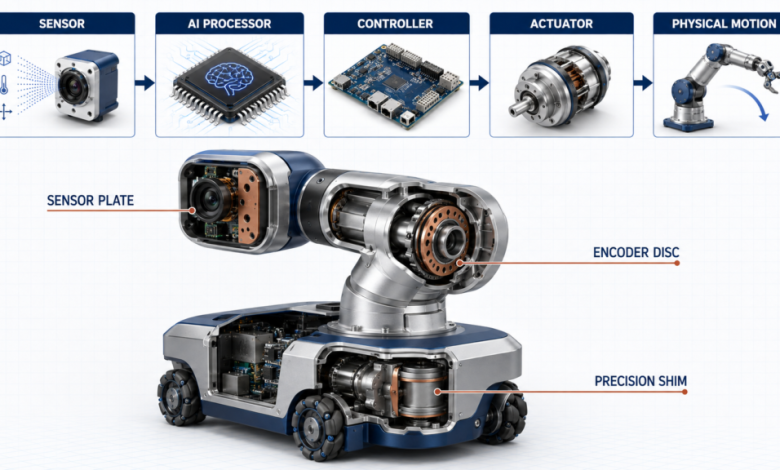
Artificial intelligence is moving beyond software and into machines that can sense, move, inspect, pick, transport, and interact with the physical world. Robots, autonomous systems, smart manufacturing equipment, and intelligent medical devices all depend on this shift. But once AI starts acting in the real world, software accuracy must be translated into physical movement. That makes hardware precision increasingly important, and chemical etching provides one way to manufacture the thin, detailed metal components these systems may require.

What Is Physical AI?
Physical AI refers to intelligent systems that combine software with sensors, processors, actuators, and mechanical hardware to interact with the real environment.
Unlike a software model that only produces digital output, a Physical AI system may need to identify an object, calculate a movement, send a command to a motor, and confirm that the movement happened correctly.
Examples include industrial robots, warehouse automation, autonomous vehicles, inspection systems, medical robots, and intelligent manufacturing equipment.
In all of these systems, software decisions eventually depend on physical components.
Digital Intelligence Meets Physical Tolerance
An AI control system may calculate a precise movement, but the final result depends on more than the algorithm.
Encoder accuracy, sensor position, actuator alignment, electrical contact, mechanical spacing, and component dimensions can all affect how a machine responds.
For example, a control system may command a robotic joint to move to a specific position. The actual result depends on the motor, encoder, bearings, mounting geometry, and feedback system working together.
This creates a simple challenge for Physical AI:
Digital intelligence eventually meets physical tolerance.
Better software cannot completely compensate for poorly aligned sensors, inconsistent mechanical gaps, or unreliable electrical connections.
Small Components Behind Physical AI
Many precision metal parts inside intelligent machines are easy to overlook, but they support sensing, motion, communication, and assembly.
Encoder Disks and Sensor Parts
Encoder disks help measure rotation, position, and speed. They often contain repeated slots or coded patterns that must remain consistent across the part.
Sensor plates, apertures, and alignment features can also support optical sensing, machine vision, and positioning systems.
These components are especially important in robots and motion-control equipment, where accurate feedback allows the controller to compare the commanded movement with the actual result.
Shims and Spacers
Precision shims and spacers control gaps, alignment, and assembly height.
They may be used around actuators, sensor mounts, motors, joints, or electronic modules. Small changes in thickness can affect how components align with one another.
Contacts and Flat Springs
Physical AI machines contain many electrical connections. Grounding contacts, connector parts, flat springs, and retaining clips may support power, signals, or mechanical retention.
These components often need thin materials, narrow sections, small holes, or later bending operations.
Protecting Dense Electronics
Robots and autonomous systems can place processors, motor drives, wireless modules, sensors, and power electronics inside compact spaces. These systems may generate electromagnetic noise that can interfere with sensitive electronics.
EMI shielding can help isolate selected circuits or contain interference near its source. Thin shielding covers may include ventilation holes, mounting tabs, grounding contacts, identification marks, and bend lines.
Shielding performance depends on the complete design, including grounding, gaps, seams, openings, material, and assembly. The metal cover is one part of a wider electromagnetic compatibility strategy.

How Chemical Etching Works
Chemical etching, also called photochemical etching or photo etching, removes selected areas from a metal sheet through a controlled chemical process.
The metal is cleaned and coated with a light-sensitive photoresist. Digital artwork containing the part geometry is transferred through ultraviolet exposure. After development, an etchant removes the unprotected metal.
The finished parts are then stripped, cleaned, and inspected.
Because the process does not rely on a cutting tool pressing against the sheet, it avoids direct mechanical cutting force. It can create slots, holes, grids, encoded patterns, tabs, apertures, and complex outer profiles in one flat pattern.
Why Etching Fits Physical AI Development
Physical AI hardware is still evolving quickly. A robot may need a revised sensor opening after testing. An encoder pattern may change. A shielding cover may require another ventilation area. A shim or spring may need a different profile.
Chemical etching uses digital tooling, so engineers can revise the artwork instead of building a new hard die for every design version.
This flexibility is useful during:
- Prototyping.
- Engineering validation.
- Pilot builds.
- Design iteration.
- Low-to-medium-volume production.
- Production of several component variants.
The process is especially suitable for thin metal parts containing many fine features. Multiple openings and profiles can be produced at the same time rather than machined individually.
Where Other Manufacturing Methods Fit
Chemical etching is not the right manufacturing process for every Physical AI component.
CNC machining is usually more suitable for thick components and complex three-dimensional structures. Stamping can offer strong unit economics for simple designs produced in very high volumes. Laser cutting can work well for many thicker flat parts.
Etching is most useful when the component is thin, flat, detailed, sensitive to mechanical cutting force, or likely to change during development.
The best process depends on geometry, material, thickness, tolerance, production volume, secondary operations, and total cost.
From Prototype to Physical Deployment
Physical AI systems rarely move directly from simulation to full production.
Hardware teams typically test sensors, actuators, control electronics, mechanical assemblies, and safety systems together. This process often reveals changes that were not obvious in a digital model.
Manufacturing flexibility therefore matters. Teams may need several versions of a sensor plate, shield, shim, or encoder component before the final design is approved.
A qualified metal etching supplier should review material, thickness, critical dimensions, forming requirements, surface treatment, inspection, and drawing revisions before production.

Physical AI Needs Physical Precision
The future of AI is not only about larger models or faster processors. Intelligent systems increasingly need to operate in factories, warehouses, vehicles, laboratories, hospitals, and other real environments.
That means AI performance will depend partly on how accurately the physical system can sense, connect, align, and move.
Chemical etching cannot make a robot intelligent by itself. But it can support the precision metal components that allow software intelligence to interact reliably with the physical world.
As Physical AI develops, manufacturing precision will remain an important part of turning digital decisions into consistent real-world actions.
The post How Chemical Etching Supports Physical AI appeared first on .