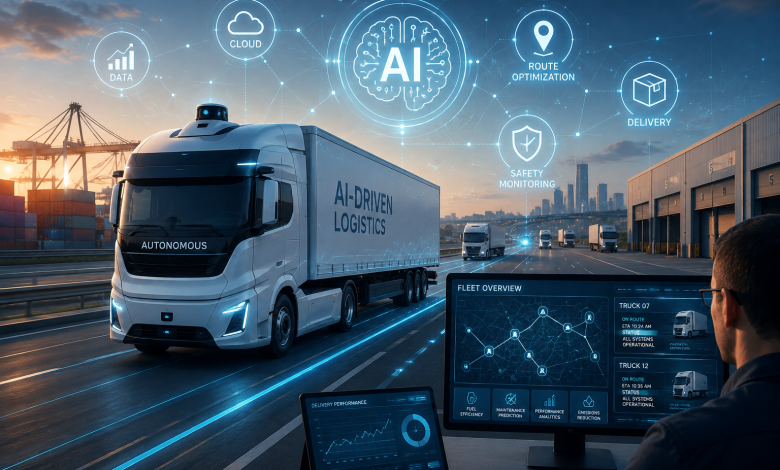
Key Takeaways
Westwell has deployed full-stack autonomous truck solutions across 28 countries and regions, with commercial fleets operating daily, not in pilot mode.
At the Port of Felixstowe (UK), Westwell Q-Trucks increased terminal operational efficiency by 20% while reducing labor dependency and Scope 1 carbon emissions, forming Europe’s largest routinely operated autonomous truck fleet at a container terminal.
Westwell’s intelligent battery swapping system completes a full swap in 5 to 6 minutes with zero human intervention, enabling true 24/7 uninterrupted operations.
Autonomous trucks achieve up to 2-centimeter-level fusion positioning accuracy without magnetic nails or fixed roadside infrastructure.
Each electric autonomous truck reduces approximately 50 tons of CO₂ emissions per year compared to an equivalent diesel truck, supporting global decarbonization targets.
References and Sources
Port of Felixstowe doubles autonomous truck fleet with new order from Westwell (Safer Highways)
Westwell Port Automation Solutions at TOC (Case Study)
Westwell showcases AI Dual Intelligence at WAIC 2026 (Port Technology)
Across the global supply chain, logistics hub automation has become an inevitable trend of industrial upgrading. According to BCC Research, the global autonomous truck market is projected to grow from 2.9 billion 2022 to 6.9 billion by 2028, driven by labor shortages, decarbonization mandates, and the need for round-the-clock operational resilience. As core equipment, autonomous trucks are driving efficiency leaps in scenarios such as autonomous horizontal transportation in ports and cross-border autonomous transportation.
With the maturity of AI fleet management and autonomous fleet dispatching capabilities, electric autonomous trucks can fully unlock their operational value. They not only improve peak season logistics capacity support, but also enable autonomous operation in mixed-traffic scenarios, providing a complete and replicable path for the implementation of industrial logistics automation. For decades, human-driven fleets have handled cargo transportation between quays, yards and checkpoints. Today, this conventional model can no longer meet the core requirements of modern logistics for efficiency, scalability and sustainability.
Autonomous trucks, paired with intelligent dispatching systems, have emerged as a transformative solution to these challenges, delivering round-the-clock operational capacity, predictable cost structures and measurable environmental benefits. As a global leader in AI logistics technology, Westwell has deployed its full-stack autonomous truck solutions across 28 countries and regions. These are not pilot projects but commercial-grade fleets in daily operation, fully validating that autonomous technology has reached the maturity to redefine logistics hub performance.
1.Three Core Pressures Facing Modern Logistics Hubs
Logistics operators today face three interconnected challenges that continue to constrain long-term competitiveness, and are also accelerating the pace of logistics hub automation.
1.1 Chronic Labor Shortages and Rising Personnel Costs
Skilled heavy-duty truck drivers are in short supply worldwide. According to the International Road Transport Union (IRU), the global truck driver shortage exceeded 3 million in 2023 and is projected to worsen. This labor shortage drives up employment costs, and the capacity gap is particularly acute during night shifts and peak seasons. High staff turnover further adds to the operational burden: enterprises bear ongoing recruitment and training costs, and the onboarding period of new employees also causes fluctuations in service levels.
For hubs that need to ensure 24/7 stable operation, relying on a shrinking pool of drivers means accumulating operational risks, and makes the replacement value of autonomous trucks increasingly prominent. Autonomous fleet dispatching systems can fill this gap by maintaining consistent performance regardless of shift schedules or workforce availability.
1.2 Volatile Demand and Limited Adaptability of Fixed Capacity
Cargo volumes are becoming increasingly unpredictable. Fluctuations in global trade, surges in e-commerce orders and irregular peak demand all require fleets to scale up and down rapidly, making peak season logistics capacity support a core challenge for hub operations. A fixed, labor-dependent fleet cannot adjust flexibly: assets are idle and budgets are wasted in off-peak seasons, while bottlenecks, delays and revenue losses occur in peak seasons.
Conventional dispatching methods relying on human experience can no longer achieve the refined fleet utilization required by modern hubs, nor can they meet the dynamic allocation needs of peak season logistics capacity. AI fleet management addresses this by dynamically allocating capacity in real time based on demand signals, cargo flow data, and operational constraints.
1.3 Stricter Decarbonization Requirements and Urgent Fleet Transformation
Regulatory requirements and corporate sustainability goals are pushing hubs to phase out diesel heavy trucks. The International Maritime Organization (IMO) has set a target to reduce greenhouse gas emissions from international shipping by at least 50% by 2050, and port-side operations are under increasing pressure to contribute to these targets. Electrification is a clear transition direction, but it also brings new challenges.
Long charging times reduce asset utilization, and energy management adds operational complexity. For most hubs, simply replacing trucks with electric models cannot simultaneously solve efficiency and labor pain points; the full value of electrification can only be unlocked when combined with autonomous driving and intelligent dispatching. Electric autonomous trucks address all three challenges at once: they eliminate reliance on drivers, enable flexible capacity scaling, and fully unleash the efficiency potential of electric powertrains.
2.Westwell’s Autonomous Truck Ecosystem: Built for Real-World Operations
Westwell’s autonomous truck solution is far more than autonomous driving hardware alone. It is an integrated ecosystem combining physical AI perception technology and operational AI software, which can be seamlessly adapted to existing logistics workflows and infrastructure, making it a mature implementation solution for advancing logistics hub automation.
2.1 Full-Scenario Purpose-Built Autonomous Truck Portfolio
Westwell has developed multiple electric autonomous truck products adapted to different logistics scenarios, which can flexibly cover diverse scenarios such as autonomous horizontal transportation in ports, cross-border autonomous transportation, and factory material transfer.
The Q-Truck is a full-time autonomous new energy heavy truck, suitable for ports, inter-terminal and industrial logistics scenarios. Equipped with a 360-degree multi-sensor fusion perception architecture, it achieves centimeter-level positioning accuracy and can operate stably without magnetic nails or dedicated roadside infrastructure. As a mature commercial electric autonomous truck, it can be directly integrated into existing operation systems and support autonomous operation in mixed-traffic scenarios without closing the operation area.
The E-Truck S2 holds EU CE certification and supports phased upgrades from L2 to L4 autonomy, making it ideal for hubs that want to advance automation in phases rather than a one-time overhaul. Both models adopt a pure electric powertrain architecture and can be natively connected to Westwell’s battery swapping system, completely eliminating charging downtime and providing reliable capacity support for scenarios such as autonomous horizontal transportation in ports and industrial logistics automation.
| Specification | Q-Truck | E-Truck S2 |
| Autonomy Level | L4 (full autonomous) | L2 to L4 (phased upgrade) |
| Powertrain | Pure electric | Pure electric |
| Positioning | Multi-sensor fusion (no magnetic nails) | Multi-sensor fusion (no magnetic nails) |
| Certification | Commercial deployment proven | EU CE certified |
| Battery Swapping | Supported (PowerOnair) | Supported (PowerOnair) |
| Primary Scenarios | Ports, inter-terminal, industrial logistics | Hubs, cross-border, phased automation |
2.2 AI-Powered Dispatching and Fleet Management Capabilities
The ReeWell intelligent operations platform and WellFMS fleet management system are the core of the entire AI fleet management system, as well as the central brain of autonomous fleet dispatching.
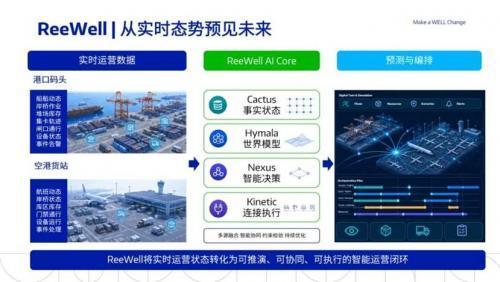
This system creates a fully connected, data-driven operation: every autonomous truck is assigned the optimal route and task, minimizing empty runs and waiting times. AI fleet management not only improves daily operational efficiency, but also dynamically allocates capacity during peak demand periods to strengthen peak season logistics capacity support. During peak periods, the autonomous fleet dispatching system can automatically reassign tasks to avoid operation bottlenecks and ensure overall operational stability.
Key technical capabilities of the WellFMS dispatching system include:
Real-time TOS integration: Synchronizes with terminal operating systems for seamless task allocation
Multi-agent decision framework: Coordinates multiple vehicles simultaneously for optimal fleet-level outcomes
Dynamic route optimization: Continuously recalculates routes based on real-time conditions
Predictive task scheduling: Aligns dispatch with cargo handling, vessel berthing, and customs processes
Empty run minimization: Reduces non-productive vehicle movements through intelligent pairing
2.3 Intelligent Battery Swapping System for Uninterrupted Operations
Westwell’s PowerOnair intelligent battery swapping system works seamlessly with the autonomous truck fleet. Trucks can drive into the swapping station autonomously, and a full battery swap takes only 5 to 6 minutes without any human intervention. The dispatching platform automatically schedules recharging timing based on remaining battery level and task priority, so that trucks spend more time on operations and less time waiting for energy replenishment.
This system truly enables 24/7 uninterrupted operations, solving the long charging time pain point that plagues most electric truck fleets, and making the productivity of electric autonomous trucks exceed that of conventional diesel fleets. Whether it is the high-frequency operations of autonomous horizontal transportation in ports or the long-haul transportation of cross-border autonomous transportation, the intelligent battery swapping system can provide stable energy replenishment support.
3.Proven Global Deployments: Autonomous Trucks in Full Commercial Operation
Westwell’s autonomous trucks have been deployed in diverse global environments, delivering measurable results and covering core scenarios such as autonomous horizontal transportation in ports and cross-border autonomous transportation. Below are three landmark commercial deployments, each validated through repeat orders from terminal operators.
| Deployment Site | Country | Fleet Size | Key Metric | Operational Model |
| Port of Felixstowe | UK | Planned 100 vehicles | +20% operational efficiency | 24/7 mixed-traffic, private 5G |
| CSP Abu Dhabi Terminal | UAE | 12+ Q-Trucks, 6 Q-Chassis IGVs | 7×24 uninterrupted service | Extreme heat (exceeding 50°C), sandstorms |
| Red Sea Container Terminal | Egypt | 40 E-Trucks | Improved throughput, lower costs | Westwell’s largest deployment in North Africa |
3.1 Port of Felixstowe, UK: Europe’s Largest Routinely Operated Autonomous Truck Fleet
As the UK’s busiest container port and a critical gateway to European supply chains, the Port of Felixstowe is a benchmark project for autonomous horizontal transportation in ports. The port needed a scalable automation solution that could operate alongside existing human-driven trucks without physical barriers or a full terminal rebuild.
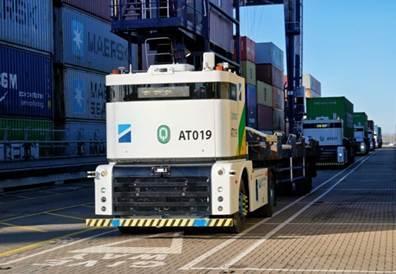
Westwell deployed Q-Truck autonomous new energy heavy trucks in phases, starting with a pilot batch and expanding through repeat orders to a planned fleet of 100 vehicles. The fleet operates 24/7 under the autonomous operation in mixed-traffic scenarios model, supported by a private 5G network and on-site intelligent battery swapping stations. Since deployment, the terminal’s overall operational efficiency has increased by 20% (Westwell deployment data, 2025), while labor dependency and Scope 1 carbon emissions have been reduced.
The mature AI fleet management system ensures efficient coordination of the fleet in mixed traffic environments. This project is the largest commercial autonomous truck fleet at a European container terminal, setting a benchmark for port automation across the region and providing a replicable model for global logistics hub automation upgrades.
3.2 CSP Abu Dhabi Terminal, UAE: Middle East’s First Commercial Autonomous Port Fleet
As the flagship container terminal of Khalifa Port in Abu Dhabi and a core hub of COSCO Shipping Ports in the Middle East, CSP Abu Dhabi Terminal (CSP ADT) set out to build a smart, green benchmark port for the region, and sought a reliable autonomous solution to upgrade horizontal transportation operations amid extreme local heat and sandstorm conditions.
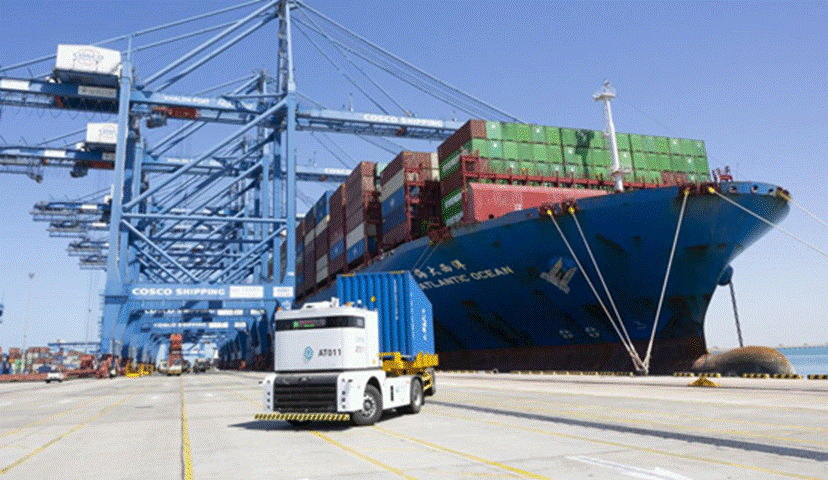
Westwell adopted a phased deployment approach at CSP ADT, starting with the WellOcean AI quay crane OCR system in 2019 before rolling out its Q-Truck autonomous electric trucks in 2021, making it the first terminal in the Middle East to deploy commercial autonomous container trucks. Following proven stable performance, the terminal placed repeat orders to expand the fleet, adding 12 more Q-Trucks in 2025 and introducing 6 Q-Chassis IGV units for the first IGV deployment in the Middle East.
The autonomous fleet operates reliably in year-round high temperatures exceeding 50 degrees Celsius and frequent sandstorm environments, delivering 7×24 uninterrupted container horizontal transportation services. Supported by Westwell’s ReeWell fleet management platform, the fleet has lifted terminal operational efficiency, reduced per-container energy consumption, and cut carbon emissions from drayage operations. The successive repeat orders demonstrate strong long-term client trust, and the project serves as a definitive benchmark for smart port automation across the Middle East.
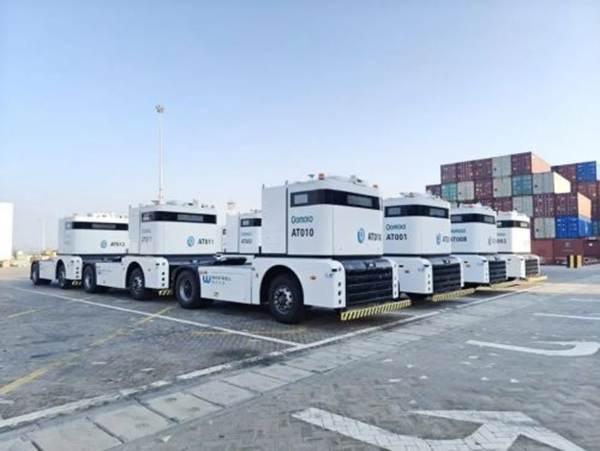
3.3 Red Sea Container Terminal (RSCT), Egypt: Large-Scale Deployment of Smart Green Logistics in North Africa
In January 2026, 40 Westwell E-Truck autonomous trucks officially entered commercial operation at the Red Sea Container Terminal in Egypt, supporting the country’s “Egypt Vision 2030” sustainable infrastructure development strategy. It is a landmark project for autonomous horizontal transportation in ports in North Africa.
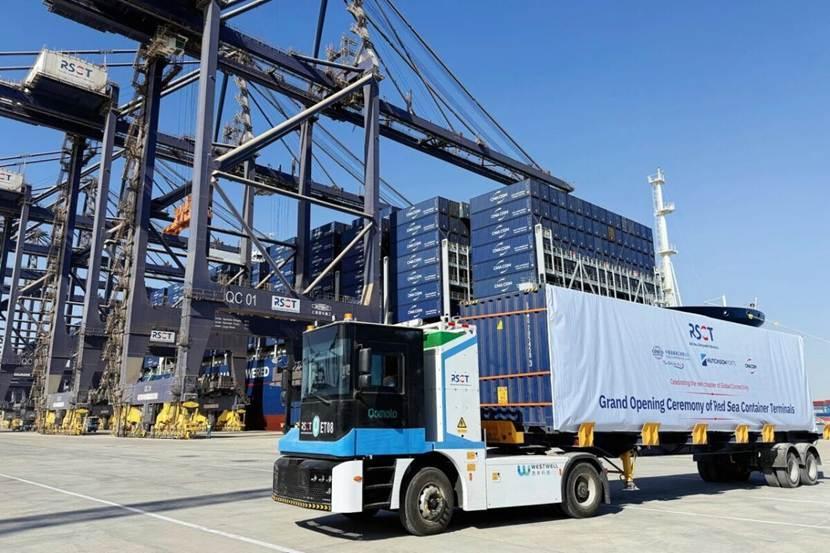
The autonomous trucks handle end-to-end container transportation between quayside cranes and yard stacking areas, and are deeply integrated with the terminal’s existing management systems via Westwell’s FMS dispatching platform. The AI fleet management system achieves precise coordination between vehicles and terminal operation processes, greatly improving operational continuity.
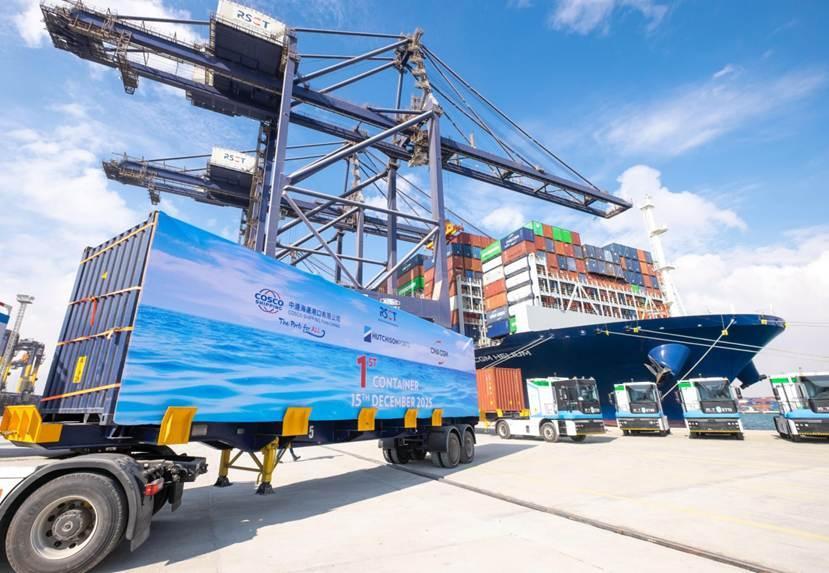
Since deployment, the terminal’s throughput capacity has improved, per-container handling costs have decreased, and local carbon emissions from port horizontal transportation have been reduced. As Westwell’s largest deployment in North Africa, the project serves as a reference for smart port development across the Middle East and Africa, and also advances the development of regional logistics hub automation.
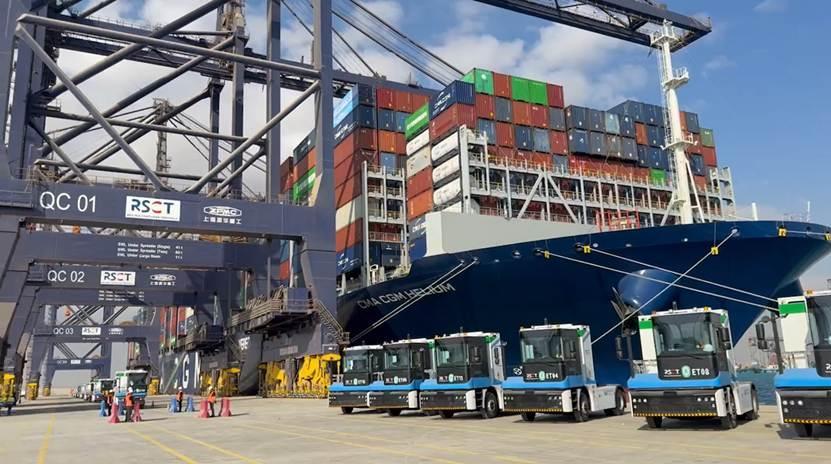
Beyond port scenarios, Westwell’s autonomous trucks have also been deployed in cross-border autonomous transportation scenarios, achieving normal operation at Ceke Port on the China-Mongolia border. This validates the product’s reliable performance in extreme environments (including temperatures as low as -32 degrees Celsius) and lays the foundation for large-scale promotion of cross-border autonomous transportation.
4.Core Benefits of Westwell Autonomous Trucks
Autonomous trucks bring measurable efficiency improvements to logistics hubs across multiple core dimensions, accelerating the implementation of logistics hub automation and industrial logistics automation.
4.1 24/7 Operational Resilience
Unlike human drivers, autonomous trucks operate continuously without mandatory breaks, shift changes or fatigue-related performance drops. This enables seamless 7×24 operations, smooths out peak demand shocks, reduces cargo backlogs during busy periods, and strengthens peak season logistics capacity support. AI fleet management and autonomous fleet dispatching systems ensure every truck takes the optimal route, minimizing empty runs and idle waiting times.
4.2 Lower Total Cost of Ownership
Driver salaries, benefits and training costs account for the largest share of heavy truck operating expenses. Autonomous trucks eliminate these costs entirely. Combined with lower energy costs from electric powertrains and AI-optimized routing, operators can achieve significant long-term total cost of ownership savings. The battery swapping model further reduces vehicle downtime and maximizes fleet utilization.
Whether in scenarios of autonomous horizontal transportation in ports or cross-border autonomous transportation, electric autonomous trucks can deliver clear returns through cost optimization.
4.3 Comprehensive Operational Safety Improvements
Heavy truck operations carry inherent safety risks in busy logistics environments. Westwell’s autonomous trucks provide 360-degree perception coverage with zero blind spots, consistent rule-based decision-making and precise speed control, eliminating safety incidents caused by human error at the root.
Under the autonomous operation in mixed-traffic scenarios model, vehicles can identify surrounding personnel, vehicles and obstacles in real time and proactively avoid them safely. This comprehensively improves site safety, reduces accident-related downtime and costs, and removes safety concerns for the implementation of industrial logistics automation scenarios.
4.4 Accelerated Decarbonization
All Westwell autonomous trucks are fully electric. When paired with renewable energy, each vehicle reduces approximately 50 tons of CO₂ emissions per year compared to an equivalent diesel truck. The AI-powered energy management system further optimizes energy consumption across the fleet, helping hubs achieve net-zero targets without sacrificing operational performance.
The low-carbon attribute makes electric autonomous trucks a green choice for logistics hub automation upgrades, enabling simultaneous efficiency improvements and emission reductions, in line with the global trend of low-carbon industrial transformation.
Frequently Asked Questions (FAQ)
Do autonomous trucks require magnetic nails for positioning?
No. Westwell’s autonomous trucks adopt a multi-sensor fusion positioning solution, integrating visual perception, lidar and satellite positioning technology, and do not require magnetic nails or fixed roadside infrastructure. This means the solution can be quickly deployed on existing roads with minimal site modification, without interrupting normal ongoing operations. It can flexibly adapt to the upgrade needs of diverse scenarios such as autonomous horizontal transportation in ports and industrial logistics automation.
What is the positioning accuracy of autonomous trucks?
Westwell’s self-developed intelligent driving system achieves up to 2-centimeter-level fusion positioning accuracy, supporting precise docking, automatic trailer coupling, container alignment and other refined operations. This level of accuracy is suitable for various high-precision operation scenarios such as container horizontal transportation, airport tractor operations and industrial material delivery, and is the core guarantee for electric autonomous trucks to perform refined operations.
How do autonomous trucks operate in mixed-traffic scenarios?
Westwell’s autonomous trucks are equipped with a 360-degree multi-sensor perception system, which can identify pedestrians, human-driven vehicles and various obstacles in real time. The AI decision-making system follows site-specific traffic rules and interacts safely with other road users.
The core of autonomous operation in mixed-traffic scenarios lies in multi-sensor fusion perception and stable AI decision-making. The fleet can operate without physical isolation barriers, making it very suitable for existing hub scenarios that cannot be closed for renovation and need gradual upgrades, and also lowering the threshold for logistics hub automation implementation.
Can autonomous trucks run stably in extreme weather?
Yes. Westwell’s autonomous trucks have been validated for extreme environments, and can operate stably in temperatures as low as -32 degrees Celsius, as well as in high temperature, high humidity and dusty, sandy conditions. Sensors and control systems are reinforced for environmental adaptability, and paired with a remote operation and maintenance system, they ensure normal commercial operation in complex environments, adapting to the implementation needs of complex scenarios such as cross-border autonomous transportation.
How do autonomous trucks reduce overall logistics costs?
Autonomous trucks reduce costs in three key ways. First, they eliminate driver labor and management costs, the largest expense item for heavy truck fleets. Second, AI-optimized routing and autonomous fleet dispatching reduce energy consumption while increasing asset utilization. Third, improved safety reduces accident-related costs and downtime losses.
Combined, these factors deliver clear and measurable reductions in overall costs over the vehicle lifecycle. The AI fleet management system further amplifies the cost advantage, making the solution highly economical across port, cross-border, factory and other scenarios.
Industry Recognition and Certifications
Westwell’s autonomous truck solutions have earned recognition across the global logistics and AI technology industries:
EU CE Certification: The E-Truck S2 has obtained CE marking, demonstrating compliance with European health, safety and environmental protection standards for commercial deployment in European markets.
Global Deployment Scale: With active commercial operations across 28 countries and regions, Westwell maintains one of the largest autonomous truck deployment footprints in the logistics industry.
Repeat Orders from Terminal Operators: Multiple deployment sites, including Port of Felixstowe and CSP Abu Dhabi Terminal, have placed repeat orders following proven operational performance, demonstrating sustained client confidence.
Industry Conference Recognition: Westwell showcased its AI Dual Intelligence technology at WAIC 2026 (World Artificial Intelligence Conference), highlighting the global industrial deployment of AI in logistics.
Strategic Partnerships: Westwell collaborates with major port operators including COSCO Shipping Ports and Hutchison Ports (Port of Felixstowe), validating its solutions at world-class logistics hubs.
Future-Proof Your Logistics Operations
As global supply chains continue to evolve and face new disruptions, autonomous trucks are shifting from an optional innovation to essential infrastructure for forward-looking logistics hubs. Hubs that adopt autonomous technology now will gain a lasting competitive advantage in efficiency and cost.
Westwell’s end-to-end solution combines purpose-built autonomous vehicles, AI fleet management software and intelligent energy systems, enabling hubs to advance automation upgrades at their own pace, with measurable operational and financial returns from day one. Whether your operation is a seaport, cross-border terminal, intermodal hub, or industrial distribution center, Westwell’s extensive global deployment experience and scalable AI architecture can help you address labor shortages, improve throughput efficiency, and advance the long-term development goals of logistics hub automation and industrial logistics automation.
Request a demo today to see how autonomous trucks can transform your logistics operations.