
What if your best employee finished today’s work two hours early, and you had no idea what they did with the rest of the day?
In the past, moonlighting usually meant taking a second job in secret. AI has changed what that can look like.
By helping people complete routine work much faster, AI creates spare time during the workday. Some employees use it to learn new skills or simply take a break. Others use it for freelance work. A smaller group is quietly holding a second full-time job, with neither employer aware of the other.
HR is now caught between productivity, trust, and outdated workplace policies. Most moonlighting rules were written for a world of fixed schedules and visible office work. They were never designed for employees who can compress a full day’s work into a few hours with AI.
So, how should HR respond to this?
Why More Employees Are Turning to AI for Moonlighting
Self – Generated
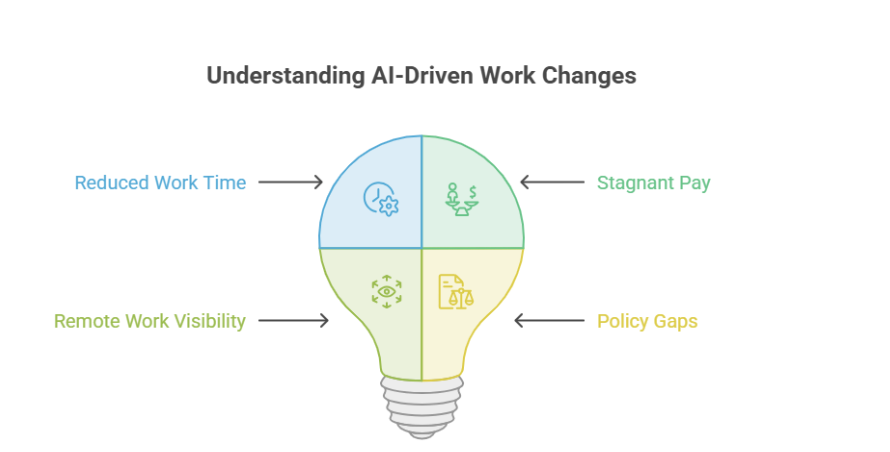
Calling it a discipline issue is the easy answer, but usually the wrong one. A few plain reasons explain it:
- Work simply takes less time now: A task that ate up four hours might take one, leaving people with spare time and no real instructions on what to do with it.
- Pay hasn’t caught up with output: If a tool makes someone twice as productive but the paycheck stays flat, picking up paid work on the side starts to seem fair.
- Remote and hybrid setups killed off the old visibility: Nobody notices a quiet afternoon the way a manager once noticed an empty chair.
- Most policies say nothing about AI: Contracts and handbooks were written before generative AI existed, so a lot of employees genuinely don’t know if they’re breaking a rule.
That last point is the real issue. Most people using AI to buy back time aren’t trying to pull a fast one. They’re filling a gap policy hasn’t caught up to yet, using their own judgment because nobody has told them otherwise. It’s a part of a broader shift and, as one analysis puts it, AI has already rewritten the social contract at work and most employers are still operating under the old one.
What an Industry Expert Makes of It
According to Vineet Gupta, founder of 2xSaS, “Most HR teams keep asking whether AI moonlighting is a discipline issue. It’s a wrong question in my view. The real question is whether the job itself is still defined correctly for this moment. If someone can do eight hours of work in three using AI, the job description hasn’t kept up with reality. No policy fixes that gap by itself.”
Punishing people for being efficient rarely goes anywhere good. Rethinking what a full day of work even means, now that AI is a part of it, is probably a better use of HR’s time. That review should also account for how each role is classified. Companies using both employees and contractors may need different expectations around working hours, exclusivity, outside projects, and the level of control a manager can exercise.
How Should HR Respond?
Self – Generated
Most companies jump straight to writing a new rule. Before that happens, there are four things worth sorting through first.
1. Read the Risk Level Correctly, Not Just the Behavior
Not every version of this deserves the same reaction, and treating them all the same is where a lot of HR teams trip up:
- Wrapping up early and logging off: Genuine personal time after finishing faster with AI. Low risk.
- Quietly freelancing during office hours: Saved time redirected to other paying clients. Medium to high risk.
- Running a second full-time job: AI holds two employers together at once. High risk.
- Using company AI tools or data for outside work: Applied outside the actual role, with real compliance and IP exposure. High risk.
About 8.6 million people or 5.3% of the employed workforce held more than one job as of June 2026. AI just makes it easier to join that number without anyone noticing.
2. Rewrite the Rule Before Writing a New One
- Track outcomes, not hours: What gets delivered matters more than when someone logged in.
- Name the AI tools that are allowed: Instead of banning personal AI use outright and pushing things further out of sight.
- Ask before assuming: Find out what led to the behavior rather than treating it as bad faith by default.
- Keep AI use and trust as separate conversations: Someone working smarter with AI is not the same problem as someone secretly holding two jobs. The distinction matters especially as AI reshapes hiring and workforce roles in ways most HR teams didn’t anticipate.
3. Get Real Visibility, Not Blanket Surveillance
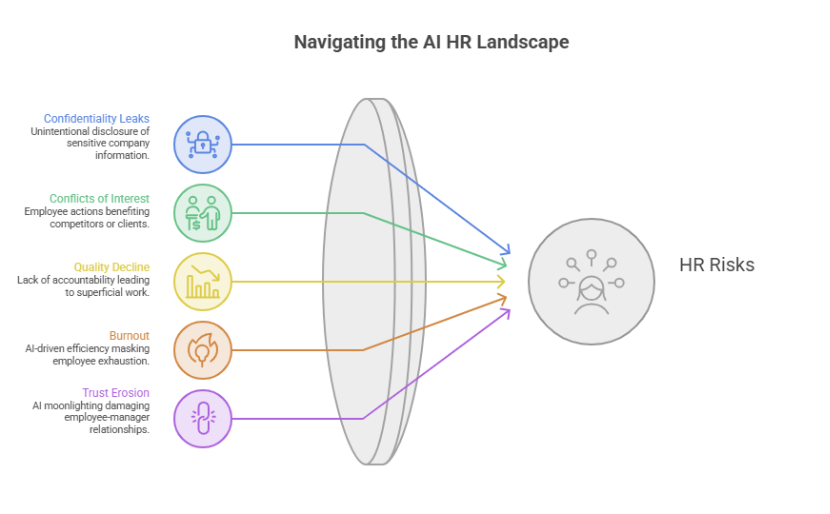
The risks here are quiet ones, easy to miss until they’ve already grown:
- Data leakage: Company data can slip into a third-party AI tool without anyone meaning for it to happen.
- Conflicts of interest: These can build quietly if company time ends up helping a competitor.
- Hidden quality issues: Polished work doesn’t always mean someone actually checked it, so problems can pass unnoticed.
The goal isn’t to watch every keystroke. It’s to get a clearer read on how company devices and apps are actually being used, so problems surface early instead of turning up only after something’s gone wrong. That’s the difference between teams that catch issues while they’re still small and those that find out too late.
4. Give the Behavior a Legitimate Outlet
- Update the offer letter and handbook: This way, AI use, confidentiality, and outside work show up in plain language.
- Start with managers: Moonlighting almost always shows up through them long before it reaches HR.Interactive AI agents can also support employee training by giving staff an accessible way to ask questions about internal policies, processes, and workplace guidelines.
- Look again at job descriptions and workload: A role genuinely sped up by AI workflow automation is useful planning information, not just a gap to shut down.
- Give strong performers somewhere legitimate to put that extra time: An internal project instead of pushing it toward an outside employer.
- Check in on workload regularly: A short and honest conversation catches capacity problems long before they turn into a policy headache.
None of this gets set once and left alone. It needs revisiting every few months, because what these tools can do keeps changing faster than most policy cycles do.
Tools That Help HR Get Real Visibility
Different platforms help HR address different aspects of AI-enabled moonlighting, from visibility into workplace activities to secure access and workforce administration. Each solves a different piece of the problem:
- CurrentWare: Visibility into real-time employee activities and acceptable use without tipping into keystroke-level surveillance
- Deel: Helps HR manage employment, contractors, and compliance across distributed teams, including policies related to outside work
- Microsoft Purview: Data governance and AI-related compliance, flagging when sensitive information moves into third-party AI tools
The right fit ultimately depends on what an organization is worried about protecting, everyday work habits, workload balance, or company data walking out the door.
The Real Shift HR Needs to Make
A stricter policy won’t make AI moonlighting disappear. It’s a sign that work is changing faster than most companies are updating what they expect from people. An outright ban usually just pushes things further underground. Companies that get this right tend to ask a different question first, not how to stop it, but what a fair day’s work even looks like now that AI is a part of doing it. Nobody has a settled answer yet. But that’s the right place to start.
For more insights on how AI is reshaping work, hiring, and HR strategy, visit aijourn.com.
About the Author:
Joy D’Cruz is a content marketing specialist currently working with SaSHunt. Joy has a keen interest in researching topics related to B2B and SaaS. He has created copy for a wide range of marketing and business topics, including social media, email marketing, and career development.