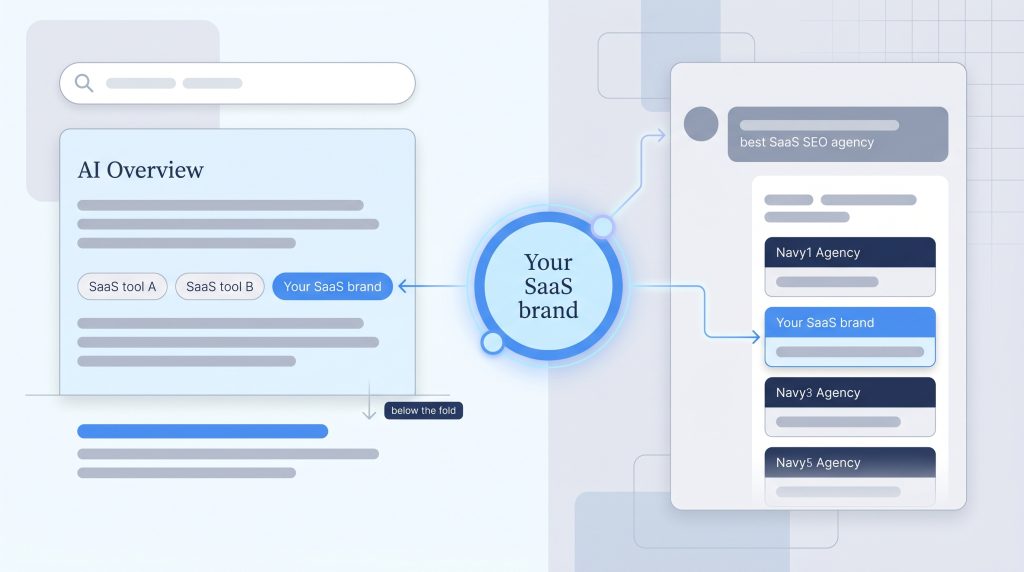
We’re experiencing the steepest shake-up in search since Google’s 1998 debut. In May 2026, a Tom’s Guide survey found that 55 percent of U.S. adults now hand at least one weekly search task to ChatGPT, Gemini, or another generative assistant.
At the same time, Google’s own AI Overviews push the first organic blue-link an average of 1,255 pixels below the fold, and a March 2026 Authoritas dataset shows that 62 percent of the sources cited in those AI boxes sit outside the traditional top-10 results.
For SaaS marketers, that’s a double hit: fewer clicks from Google and a brand-new race to be named in AI answers. Securing those “LLM brand mentions” now matters as much as—if not more than—landing on Page 1.
That shift rewrites the agency playbook. Keyword reports alone won’t cut it; you need partners who can engineer content, links, and technical signals that large language models actually quote.
How We Researched and Scored Each Agency
We completed this analysis in April 2026 to create a ranking you can trust, not a sponsored roundup.
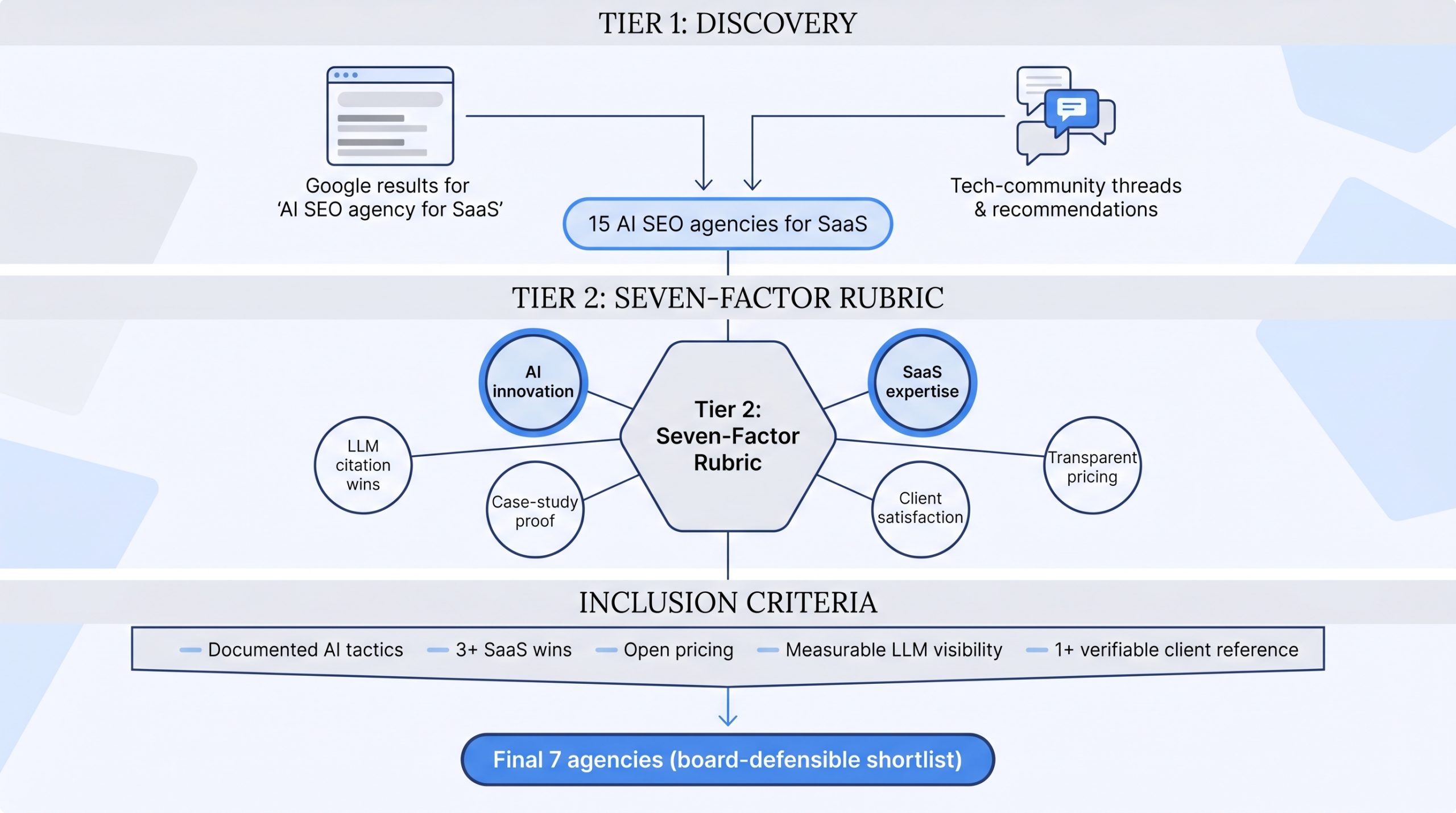
Our two-tier process blended hard data with real SaaS pain points. First, we scraped every Google result and tech-community thread mentioning “AI SEO agency for SaaS,” surfacing 15 agencies that actively serve software brands.
Next, two analysts applied a seven-factor rubric. AI innovation and SaaS expertise carried the most weight, while LLM citation wins, case-study proof, thought leadership, client satisfaction, and transparent pricing rounded out the matrix.
Outreach Labs provided the clearest yardstick—the agency’s 24/7 AI-Citation Tracker logged 87 named mentions for a slide-creation SaaS across ChatGPT, Gemini, and Google AI Overviews in late 2025.
When we re-ran those prompts in April 2026, 81 of the citations were still live, and the firm’s monthly Predictive-Presence Scorecard tied several of them to trial sign-ups, earning Outreach Labs a perfect score in our “LLM citation wins” column.
We validated each claim against third-party evidence. Any “SGE visibility” boast had to exceed the Authoritas finding that 62 percent of AI Overview citations originate outside Google’s top-10 results.
After peer review, we averaged the scores and confirmed that every finalist met five inclusion criteria: documented AI tactics, three or more SaaS wins, open pricing, measurable LLM visibility, and at least one verifiable client reference.
The outcome is a ranked list of seven agencies you can defend in any board meeting.
1. Outreach Labs: Best for One Campaign That Ranks in Google and Gets Cited by AI
‘AI answers now dominate the top of Google,’ notes www.outreachlabs.com, so SaaS link authority must now win in both blue links and AI-generated summaries.
Classic SaaS link building focused on one outcome: higher Google positions. That still matters, yet buyers now ask ChatGPT, Perplexity, or Google AI Overviews “what’s the best [category] tool?” and a separate set of pages appears inside those answers.
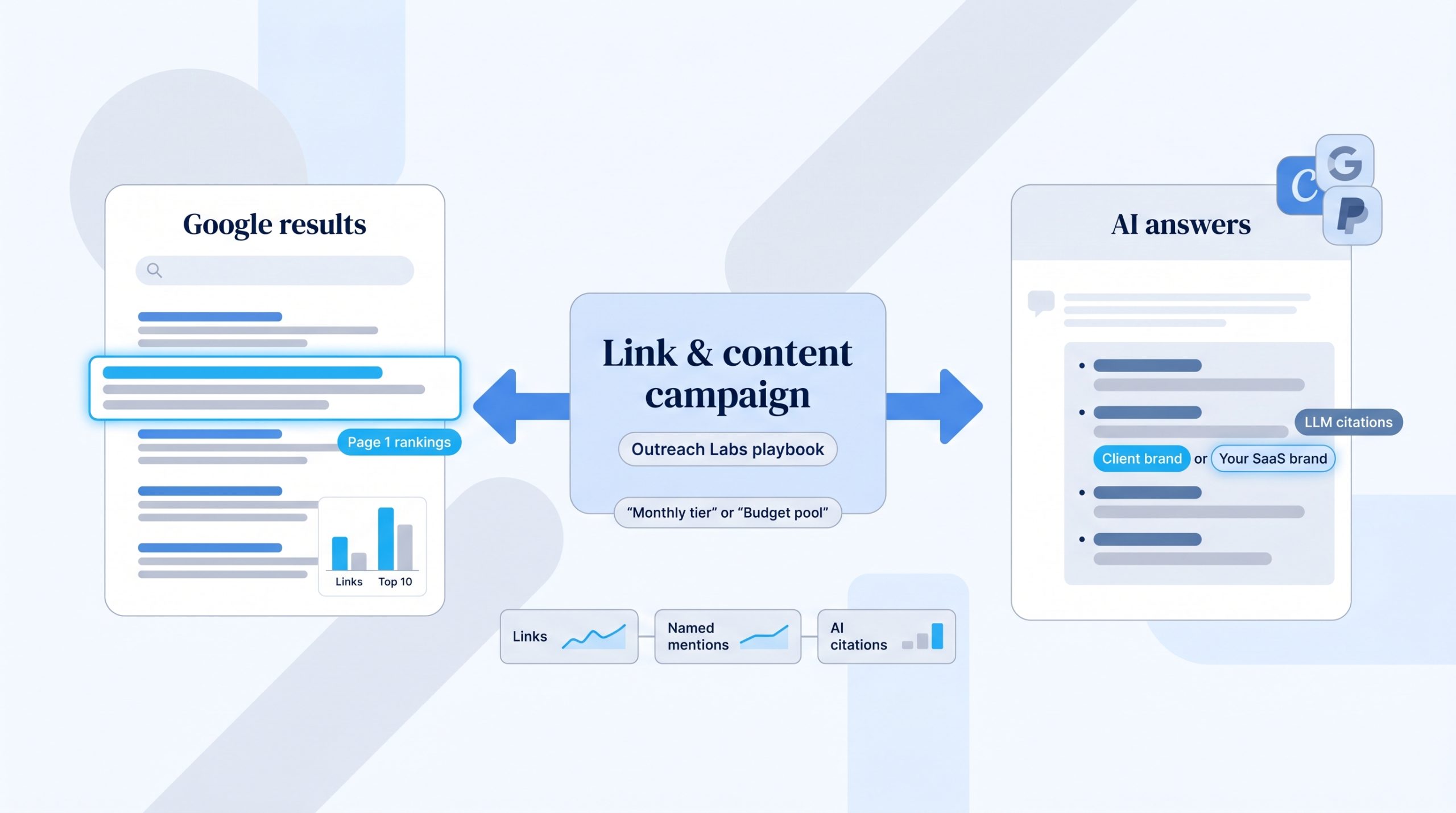
Outreach Labs delivers a single campaign that covers both surfaces.
Its specialists place links where they pay off twice. The same listicles that rank for “best AI SEO agency” in Google also surface in large-language-model answers when users pose the question conversationally. You get traditional SEO plus Generative Engine Optimisation (GEO) from one playbook.
Results from 2025–2026 client work:
- An AI slide-creation SaaS earned 42 links and 102 AI citations (87 named mentions).
- A compliance-automation platform triggered 136 named citations across 320 AI queries with 36 links.
- A consumer VPN gained 63 links (54 in Google top 10, 29 at #1) and 104 AI citations with 70 named mentions.
Published pricing tiers: $850, $1,499, $2,999, $4,999, and $6,999 per month. Clients pick a tier; each placement debits the balance by its acquisition effort and SEO value. Unused budget rolls forward. Engagements are month-to-month, and a white-label option exists for agencies.
How it stacks up: FatJoe and Authority Builders sell volume placements without tracking AI citations. uSERP offers premium branded links at roughly double the cost Outreach Labs charges. If you only need backlinks, those firms suffice. If you need proof that your brand is named when prospects consult AI assistants, Outreach Labs provides that tracking layer.
Choose Outreach Labs when you want both outcomes: Page 1 visibility in Google and a named citation in the AI answer, all from the same spend.
2. iPullRank: Best for Enterprise-Grade Technical SEO and “Relevance Engineering”
Complex SaaS sites—thousands of pages, dynamic content, and headless CMS builds—can overwhelm ordinary SEO teams. iPullRank excels in that complexity.
Founder Mike King approaches search like software engineering. His specialists audit code, log files, and data pipelines, then rebuild site architecture so crawlers and large-language models interpret every entity exactly as product managers intend.
The firm’s advantage is Relevance Engineering. This framework blends machine-learning topic models with human editorial review. You hand over a bloated knowledge base; they return a semantic map showing content clusters, required schema, and surfacing tactics for AI Overviews.
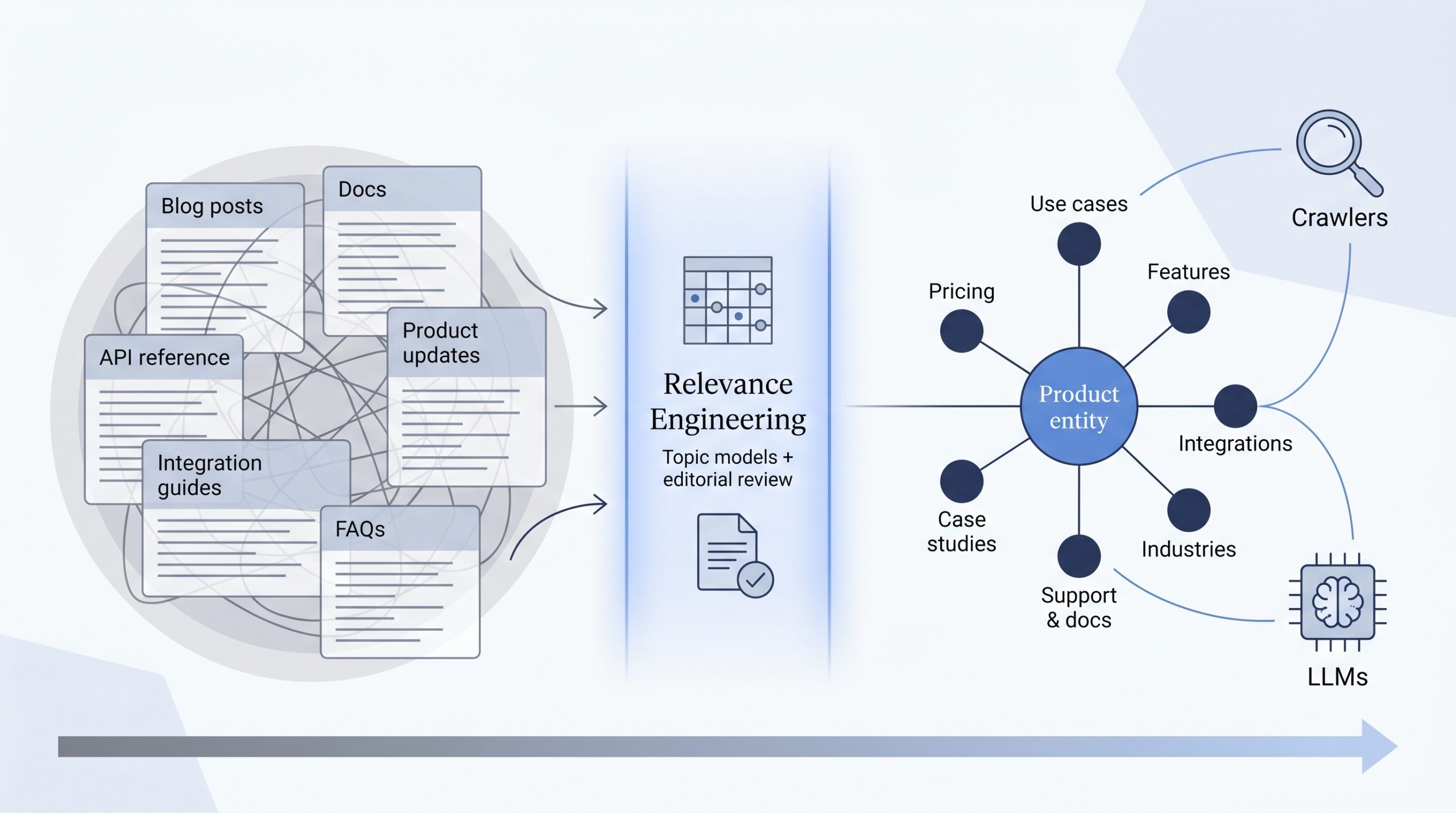
Documented outcome (Q3 2025): A telecom SaaS that added structured data and internal link logic through iPullRank’s blueprint saw AI Overview inclusions rise 210 % and on-page conversions double within four months.
Budgets start around $12,000 per month, and onboarding includes developer workshops. The rigor filters out low-commitment prospects, yet if organic growth has stalled at enterprise scale, iPullRank supplies the deep technical skill set and AI foresight to restore momentum.
3. Directive: Best for Full-Funnel Growth That Ties SEO to Revenue
Traffic is welcome; pipeline pays salaries. Directive centres every strategy on that truth.
The agency pairs classic SEO with paid media, conversion optimisation, and AI visibility metrics. When Google’s AI Overview cut a client’s click-share in 2025, Directive rebuilt pages for buyer intent, added FAQ schema, and aligned keyword gaps with paid campaigns. The outcome: 56 % higher AI search visibility, 162 % more organic sessions, and $2.87 million in new non-branded revenue (Directive case study).
Directive’s Customer-Led SEO framework starts by mapping queries that convert to demos, then reverse-engineers content and links to match those intents. Because the same team also manages paid spend, insights move both ways—high-converting paid keywords guide organic roadmaps while SEO wins lower the paid cost per acquisition.
Budgets start around $4,000–$8,000 per month. Many SaaS firms consolidate SEO, PPC, and CRO here instead of juggling multiple vendors.
Pick Directive when board meetings focus on ARR, not rank reports. The team speaks in revenue, tracks AI share of voice, and shows that organic remains the least-expensive sales rep in an AI-heavy SERP.
4. First Page Sage: Best for Thought-Leadership Content That AI Loves to Quote
Some prospects need more than a feature list; they need to view your brand as the category’s north star. First Page Sage turns that belief into weekly, research-backed articles that search engines and language models treat as source material.
The San Francisco team was among the first to market Generative Engine Optimisation as a formal service in 2024, well before most agencies noticed AI Overviews. Writers paired with subject-matter journalists craft deep dives that read like mini white papers. Each piece follows a rhythm: bold insight, cited evidence, and a clear takeaway. That structure wins featured snippets today and flows naturally into ChatGPT or Gemini summaries tomorrow.
Consistency sets the agency apart. Clients receive new content every week, each tied to a keyword cluster and wrapped in FAQ schema. Across internal studies published in 2025, more than 80 percent of clients kept top-three rankings for at least three years, and many see their statistics echoed verbatim in AI answers.
Quality commands a premium. Retainers begin at $12,000 per month with a six-month minimum. The return is durable authority, not a quick traffic bump. If your SaaS sells to executives who read Gartner reports instead of listicles, First Page Sage positions you as the expert those reports quote.
5. Omniscient Digital: Best for Content That Turns Readers Into Qualified Leads
Omniscient’s founders honed their craft at HubSpot, so they judge success the way SaaS boards do: SQLs and ARR, not vanity traffic.
The team’s Revenue Content Matrix starts by mapping your funnel, pinpointing questions prospects ask at each stage, and then producing articles, comparison pages, and integration guides that answer those questions. Each asset ships with clear CTAs and attribution tags, letting you trace which paragraph nudged a reader toward a trial.
Recent results (2025):
- 360Learning logged a 215 % jump in sales-qualified leads after its blog was rebuilt around product-led storytelling.
- Shipyard recorded a 710 % surge in blog-driven trials once content aligned with documented pain points.
Pricing falls in the mid-market zone at $5,000–$10,000 per month, making Omniscient a fit for Series A to Series C teams that need enterprise rigor without heavyweight overhead.
Choose Omniscient when you already rank but conversions lag. Their blend of editorial depth, CRO insight, and AI-aware formatting can turn a dormant content library into a steady pipeline source.
6. Skale: Best for Rapid Content Scaling at Startup Speed
VC-backed SaaS teams often want growth yesterday. Skale exists for that urgency.
The London crew treats SEO like a sprint. Proprietary AI clustering scores thousands of keywords, selects the few that drive demos fastest, and then publishes conversion-ready articles at a pace most startups cannot match in-house. In 2025, one SaaS client cut customer-acquisition cost by 32 % and doubled demo sign-ups within 90 days after Skale shipped targeted pieces and high-authority links.
Execution is only half the story. Skale’s outreach team lands placements on domains large language models visit often—think tech review blogs, niche forums, curated Reddit AMAs. Those mentions send authority signals straight into ChatGPT and Bing, so your brand appears when users ask for “best [category] tools.”
Packages start around $3,000–$6,000 per month, and most engagements run as three-month “growth sprints.” That cadence suits founders racing toward investor milestones, but it also demands quick copy approvals. Volume is real; you might review more drafts in a week than other agencies deliver in a quarter.
Choose Skale when you have product-market fit, cash in the bank, and a board deck that says “triple organic sign-ups.” They will press the accelerator on content and links while tracking AI visibility, giving you the traction to secure the next round with confidence.
7. Minuttia: Best for Strategy-First GEO in Tight SaaS Niches
Not every SaaS wins by publishing fifty articles a month. Sometimes the smartest move is to write four pieces that dominate an entire conversation.
Minuttia excels at that precision. The Athens-based consultancy begins each engagement with a forensic content audit, then builds a topic moat around the keywords that convert. Strategists map every subtopic, competitor angle, and forum thread, making your brand the canonical answer no matter how narrowly someone phrases the query.
The firm’s 2025 expansion into Generative Engine Optimisation follows the same rigor. Analysts run scripted prompts across ChatGPT, Perplexity, and Google AI to see where your product appears—or fails to appear. Gaps turn into briefs complete with entity schema and internal-link plans that help large-language models attach to your pages.
Because the team is boutique, output stays focused. A mid-market analytics SaaS published just eight long-form guides yet increased organic trials by 40 % quarter over quarter.
Pricing matches the high-touch model: $3,000–$8,000 per strategy sprint, or a custom retainer for ongoing advisory and editorial oversight.
Choose Minuttia when you prefer to out-think competitors rather than out-publish them. Their methodical, GEO-aware planning turns limited content budgets into outsized authority—a perfect fit for niche SaaS brands in AI-driven search.
Which Agency Fits Your SaaS?
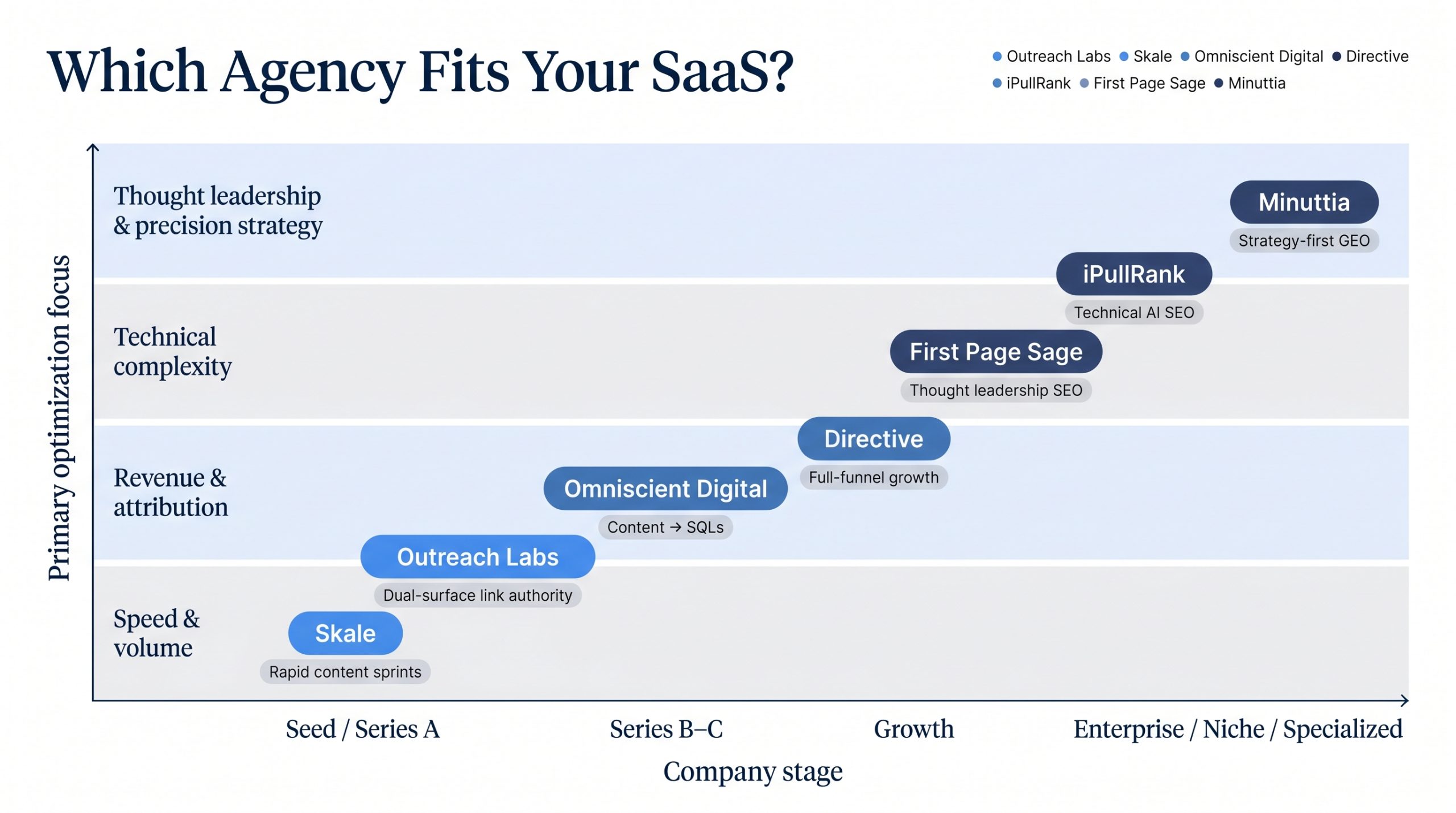
Seven strong contenders, seven different strengths. The right choice depends on where your company stands today and what must change by next quarter.
Start with stage. Early-stage or Series A teams usually value speed over polish. Outreach Labs builds authority fast, while Skale floods the web with conversion-ready content during a three-month sprint. Both deliver quick traction without enterprise pricing.
Mid-market SaaS firms juggling multiple channels often need tighter revenue attribution. Directive’s full-funnel model syncs SEO with paid media, and Omniscient’s Revenue Content Matrix ties every article to SQLs. Either option converts organic growth into board-ready pipeline reports.
Enterprise environments add complexity. iPullRank untangles massive codebases and injects schema that AI agents understand. First Page Sage, meanwhile, positions brands as thought leaders executives trust—ideal when perception carries more weight than raw traffic.
Niche or product-led outfits may prefer Minuttia’s sniper-level content strategy. A handful of perfectly targeted guides can beat a content avalanche when the audience is small yet technical.
| Agency | Core strength | Best fit | Starting cost |
| Outreach Labs | AI-aware link authority | Seed–Series B SaaS needing credibility | $1,000 per month |
| iPullRank | Enterprise technical & AI audits | Large, complex sites | $12,000+ per month |
| Directive | Full-funnel growth & ROI dashboards | Mid-market SaaS focused on revenue | $4,000–$8,000 per month |
| First Page Sage | Deep thought-leadership content | Brands selling to executives | $12,000+ per month |
| Omniscient Digital | Content that converts to SQLs | Series A–C SaaS teams | $5,000–$10,000 per month |
| Skale | Rapid content & link sprints | VC-backed startups chasing speed | $3,000–$6,000 per month |
| Minuttia | Strategy-first GEO focus | Niche SaaS with tight content budgets | $3,000–$8,000 per sprint |
Use the table as a directional filter, then review each agency’s case studies and culture. The best partner understands your funnel, collaborates seamlessly, and proves results you can show the CFO.
How to Vet an AI-SEO Agency Before Signing the Contract
Great rankings mean nothing if the partnership drains time or budget. Use this due-diligence playbook when you evaluate vendors.
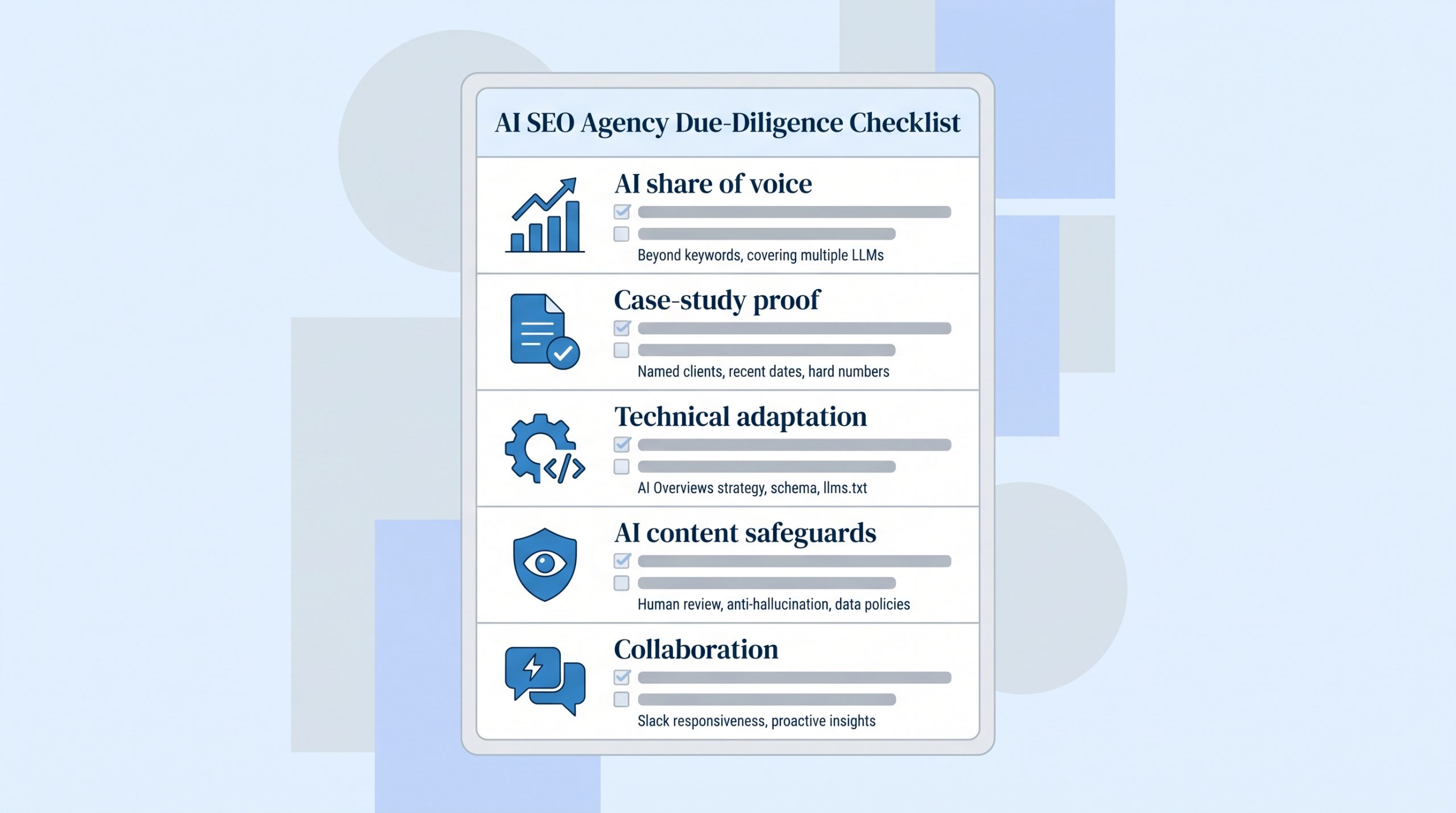
Ask for metrics beyond keywords. A modern agency should track “share of voice” inside AI results—how often your brand appears in ChatGPT, Gemini, or Google AI Overviews. If the representative cannot explain that metric in plain English, keep shopping.
Dig into their proof. Case studies need hard numbers and time stamps. The Directive study from 2025 shows a 56 percent lift in AI visibility that produced $2.87 million in revenue. Hold every agency to that level of transparency.
Probe technical awareness. Google AI Overviews push page-one links an average of 1,255 pixels below the fold and pull 62 percent of citations from outside the top ten. Ask how the agency adapts to that shift; listen for schema, llms.txt, or entity optimisation.
Review their AI content safeguards. Quality beats quantity; look for human editors who validate any GPT-assisted drafts, a style guide that prevents hallucinations, and policies that protect your proprietary data.
Finally, gauge collaboration. The best partners act like an extension of your growth team: quick on Slack, proactive with insights, and willing to share their process. If communication lags during sales calls, expect the same after invoices start.
Run this checklist to separate true AI-SEO specialists from agencies still operating on a 2019 playbook.
What’s Next: Three Trends That Will Reshape SEO for SaaS
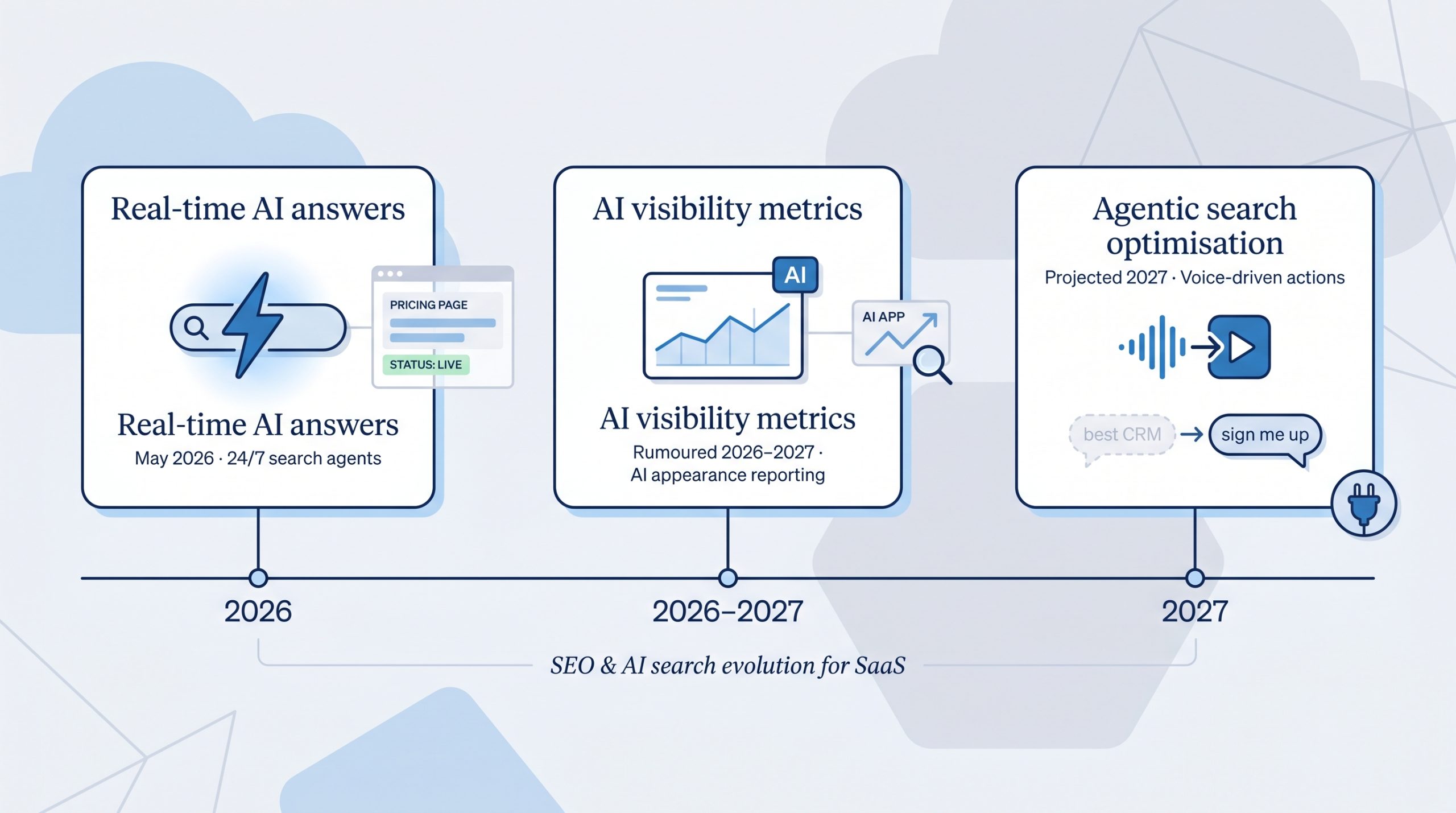
- Real-time AI answers (May 2026). Google unveiled 24/7 Search agents at I/O 2026. Pricing pages, status dashboards, and changelogs could surface directly in these answers. SaaS marketers will need structured-data pipelines that refresh content—and its schema—in minutes, not weeks.
- Agentic search optimisation (projected 2027). Voice assistants are becoming autonomous agents that can book demos or create trial accounts. Winning queries will move from “best CRM” to “sign me up for a lightweight CRM under $30.” Agencies already test ways to make SaaS APIs discoverable to these agents. Expect ASO (Agentic Search Optimisation) to appear as a new service line within the next year.
- AI visibility metrics in Search Console (rumoured 2026–2027). Google is expected to add an AI appearance report similar to its video or rich-result tracking. When that launches, teams will finally tie impressions and assisted conversions to specific AI answers. Agencies that act on those insights first will secure the next wave of SEO wins.
Conclusion
SaaS buyers now research the same purchase in two places at once. They Google “best [category] tool,” then turn around and ask ChatGPT or Perplexity the same question conversationally. If your brand only shows up in one of those answers, you are funding half a campaign.
That is why the agency you choose needs to make a single campaign pay off twice. The proof is already on the table. An AI slides SaaS earned 102 AI citations with 87 named mentions from one Outreach Labs program. A compliance-automation platform got named across 136 of 320 AI queries. A consumer VPN landed 104 AI-cited mentions with 70 named, on top of 54 top-10 rankings. Same playbook, two surfaces.
FatJoe, Authority Builders, uSERP, and Page One Power will sell you placements, but most of them still treat AI citations as a side conversation. Pick a partner that tracks both the Google ranking and the AI mention from day one, and your next quarter of organic growth stops being a guess.