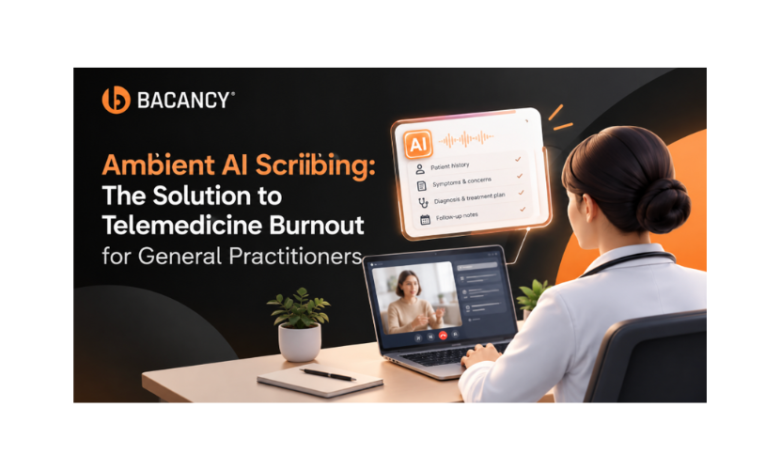
An empirical study over 30 days involving six different health systems in the United States found that there was a reduction in the number of burnouts among physicians from 51.9% to 38.8% after using the ambient AI scribe system. This is pertinent information for the manager of a telemedicine practice as this type of practice entails the same amount of paperwork compared to an in-person medical practice but lacks the surrounding materials.
The Documentation Burden Behind Telemedicine GP Burnout
Clinical documentation has quietly become one of the heaviest parts of a general practitioner’s day, and telemedicine makes it heavier still. Here is what’s actually driving the load:
- Doctors spend an estimated 2 to 3 hours a day on note taking and patient data entry
- This time comes directly out of patient care hours or personal time after hours
- It is a well known driver of physician burnout, showing up just as often in electronic health records as it did in paper charts
- Telemedicine removes the in room support a nurse or medical assistant would normally provide for intake notes
- Video consults force a split attention problem, watching the patient on screen while also managing the EHR window, which is harder than glancing at a notepad during an in person exam
- Virtual clinics tend to run higher visit volumes, which compounds the documentation backlog
- Together, these pressures push AI medical documentation from a nice to have into a real operational need
What Ambient AI Scribing Is and How AI Scribes Improve Clinical Documentation
The ambient AI scribe technology works by silently capturing the conversation between the healthcare professional and the patient without the need to click on any recording button or speak out loud the notes. It transcribes the audio in real time and then uses the natural language processing algorithm to extract relevant clinical information.
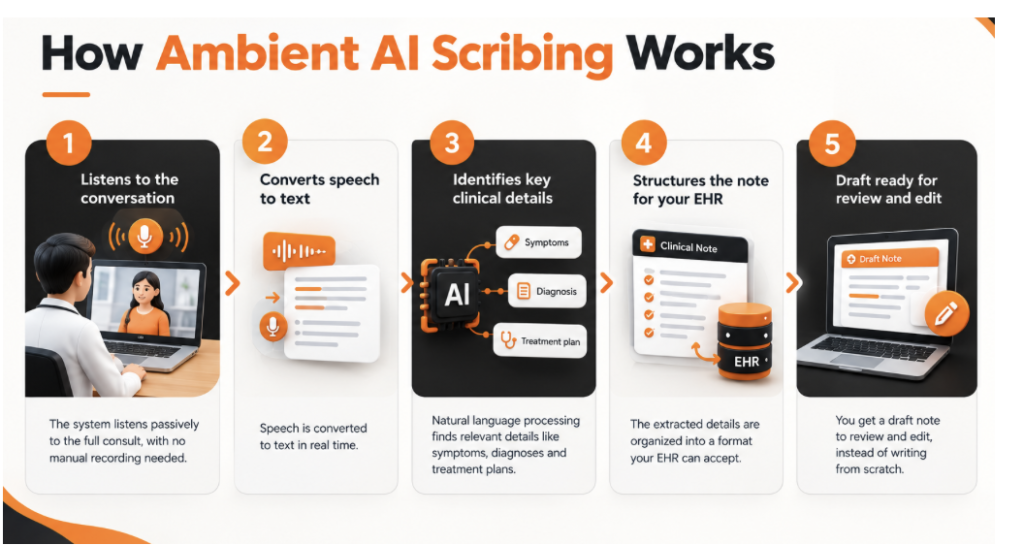
How the Process Actually Works
- The system listens to the full consult, with no manual recording step needed
- Speech is converted to text in real time as the conversation happens
- Natural language processing identifies symptoms, diagnoses, and treatment plans from the transcript
- The extracted details are structured into a format your EHR can accept
- A draft note is ready for you to review and edit, rather than write from scratch
This is how AI scribes improve clinical documentation in practice: they remove the blank page problem. You are editing a draft instead of building one, and there are no extra clicks or voice commands needed mid consult. It works quietly in the background, which is exactly what ambient clinical documentation is meant to describe, and it fits well into how AI scribing in healthcare is generally being adopted.
How Ambient AI Scribing Reduces GP Burnout in Virtual Visits
The research supporting this goes beyond a single study. A Phyx Primary Care report surveyed 116 primary care providers across 37 locations and found documentation time fell by 41% and burnout dropped by 60% after providers adopted an ambient AI assistant. A separate multicenter study, covering 263 clinicians across six health systems, found a 13.9 percentage point drop in burnout after 30 days, described by researchers as a 74% lower odds of experiencing burnout at all.
| Study | Sample size | Key finding |
| JAMA Network Open, 2025 | 263 clinicians, 6 health systems | Burnout fell from 51.9% to 38.8% in 30 days |
| Phyx Primary Care report | 116 providers, 37 locations | Documentation time down 41%, burnout down 60% |
| NEJM AI stepped wedge trial | 66 practitioners, 2 states | 24 week randomized trial on professional fulfillment |
Numbers like these only hold up when the scribe is built into your actual workflow, not treated as an add on. As a leading Telemedicine App Development Company, we build the scribe directly into the video consult platform your patients already use, so it listens through the same call infrastructure instead of running as a separate app your staff has to manage on the side. That is the difference between ambient AI scribing for general practitioners on paper and one that actually holds up in a busy virtual clinic.
Trends Shaping Ambient AI Scribing in Telemedicine
The evidence base is maturing quickly. Early research relied on single site pilots, but 2025 brought a genuine randomized controlled trial, a 24 week stepped wedge study of 66 practitioners across two states, along with a head to head trial comparing two commercial platforms across 238 physicians in 14 specialties. Adoption is also spreading past physicians into nursing and other allied health roles.
One trend worth watching is what AMA reporting on the JAMA Network Open study has called a coding arms race, where ambient scribes appear to be increasing billing and risk adjustment coding intensity, prompting some payers to respond with downcoding. Anyone evaluating a telemedicine AI scribe should understand this tension before assuming the technology is purely upside.
Where the Research on Ambient AI Scribing Still Falls Short
Here is the gap that matters most for a virtual practice. None of the major published studies, including JAMA Network Open, NEJM AI, or the Yale coverage of ambient scribing, actually test the technology inside a telemedicine visit. Every trial to date has measured in person, ambulatory care.
That leaves a real question: does a scribe listening through a video call microphone perform the same way it does in an exam room, given echo, connection lag, and the chance of multiple speakers on a home network? Return on investment is also still unsettled industry wide, with even vendors admitting the payback math is still being worked out. This is exactly the kind of gap that anyone adopting AI scribing in healthcare for a virtual practice should ask a vendor to address directly.
What GPs Should Check Before Adopting One
Before committing to any ambient AI scribing for telemedicine, run through this checklist:
- Confirm the AI medical scribe has been tested on video call audio specifically, not only in person consultations
- Verify EHR compatibility with your existing system, not a promised future integration
- Check that a signed BAA covers how patient audio and transcripts are stored
- Make sure clinician review and edit rights remain part of the workflow
- Ask what outcome data the vendor can share for GPs specifically, not just hospital specialists
The benefits of ambient AI scribing for doctors are well documented in ambulatory settings, but this checklist protects you from assuming those same results transfer automatically to a video based practice.
Conclusion
Ambient AI scribing has strong, growing evidence behind it in traditional clinics, and the burnout numbers are hard to ignore. What is still missing is direct proof it performs the same way over video, which is exactly where a thoughtful GP should be asking vendors harder questions. If your practice needs that scrutiny built into the platform itself from day one, Bacancy Technology’s EHR integration expertise can help you build a documentation workflow suited to virtual care with 14 years of healthcare software delivery behind it.
FAQs
1. Does ambient AI scribing work as well over telemedicine video calls as it does in person?
No major study has tested this yet. Every published trial, including JAMA Network Open and NEJM AI, measured results in person, not over video calls with echo or connection lag.
2. How much documentation time can ambient AI scribing actually save?
A Phyx Primary Care report of 116 providers found documentation time fell 41% and burnout dropped 60%. A separate 263 clinician study saw a 13.9 percentage point drop in burnout after 30 days.