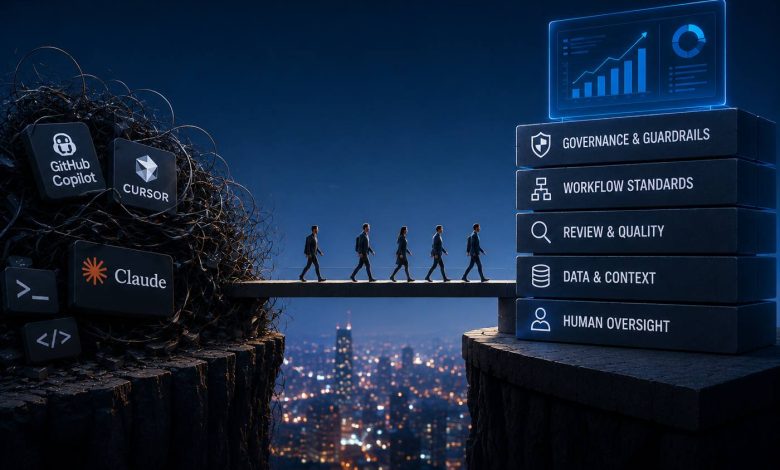
Most businesses now have access to AI coding tools, but very few have changed how their engineering teams operate around them. That will change in 2026 as AI operating models will emerge. That means structured workflows, governance, standards and measurement built around AI-assisted engineering.
Copilot, Cursor, Claude Code and similar platforms are being used by most engineering teams. The first phase of AI adoption was straightforward: buy licences, roll them out to developers and expect productivity gains to follow.
We’re now seeing a growing gap between organisations seeing measurable gains and those simply accumulating AI costs. Across the technology sector, the conversation is beginning to shift away from: “What AI tool should we buy?” towards: “How should our teams actually work with AI?” That’s a much harder question because AI is not simply another software subscription. It changes how engineering teams operate, how work is delegated, how quality is controlled and how productivity is measured.
The organisations getting this right are not necessarily using better AI tools than everyone else. In many cases, they are using exactly the same platforms. What differs is the system surrounding them.
Buying AI Licences Doesn’t Create Engineering Capacity
One of the biggest misconceptions is the assumption that access automatically creates advantage. Of course it doesn’t, like all tools you have to know how to use them effectively before they produce advantages.
Many businesses have spent heavily on AI subscriptions while seeing inconsistent results born from their inconsistent implementation. Developers experiment with different tools independently. Prompt quality varies dramatically between teams. AI-generated code often requires significant rework. Context windows become bloated. Premium models are used for low-value tasks. Multiple tools overlap with no governance or measurement. This results in wasted time that too many organisations try to claim is innovation.
The initial excitement around AI coding assistants created the impression that software delivery would automatically accelerate once tools were introduced. Instead, many organisations discovered that AI can create new operational challenges just as quickly as it removes existing ones.
- Without standards, teams create inconsistent outputs
- Without governance, security and compliance risks increase
- Without measurement, nobody knows whether productivity has genuinely improved
- Without workflow redesign, AI simply amplifies existing inefficiencies
This is why the companies seeing genuine gains are no longer treating AI as a developer perk or experimental add-on. They are redesigning workflows around AI-assisted engineering from the ground up.
The Old Engineering Scaling Model Is Starting to Break
For years, most organisations scaled engineering capacity in fairly predictable ways:
- Hire more developers
- Add outsourcing partners
- Increase management layers
- Extend timelines
- Add more process and coordination
That model is becoming increasingly expensive and inefficient as AI changes the economics of execution. Tasks that once consumed substantial engineering time (documentation, migrations, repetitive implementation work, testing and refactoring) can now be accelerated significantly through AI-assisted workflows. But the organisations benefiting most are not replacing engineering teams with AI, instead they’re changing their structure: smaller, senior-led teams using AI to increase execution leverage.
That matters because AI is often misunderstood as a replacement for engineering expertise. In practice, it amplifies the value of experienced engineers rather than reduce it.
Senior Engineers Matter More in an AI-Driven World
AI can accelerate implementation. It can’t reliably provide judgement. That distinction is becoming increasingly important as organisations move beyond experimentation into production-scale AI-assisted delivery. AI tools are highly effective at handling repetitive engineering tasks, generating first-pass implementations, supporting migrations or producing documentation. What they don’t do well is:
- Own architecture decisions
- Balance long-term technical trade-offs
- Understand commercial priorities
- Manage operational risk
- Maintain system coherence
- Accept accountability when things fail
As a result, senior engineers are becoming more valuable, not less. Their role increasingly shifts from pure execution towards orchestration. They are needed to:
- Define standards
- Review outputs
- Manage governance
- Design workflows
- Select where AI should and should not be used
- Maintain quality and accountability
The Rise of AI Operating Models
AI operating models are structured systems designed to govern how AI-assisted engineering actually functions inside an organisation.
They typically include:
- Workflow standards
- Prompt systems and libraries
- Governance frameworks
- Repository onboarding
- Review and approval processes
- Usage optimisation
- Security controls
- ROI measurement and telemetry
This layer is becoming critical because unmanaged AI adoption creates fragmentation remarkably quickly. For example; one team develops efficient prompting methods while another continually repeats failed approaches; different developers produce inconsistent outputs for similar tasks; engineering managers struggle to measure productivity because no common benchmarks exist; and organisations pay for multiple overlapping AI subscriptions without understanding which workflows actually create value.
The organisations moving fastest now increasingly treat AI as an operational capability rather than a software purchase. That means building repeatable systems around how AI is used, reviewed, measured and improved over time.
The Shift from AI Excitement to AI Accountability
Another major change we’re seeing is the growing pressure for measurable ROI.
In 2024 and 2025, many AI investments were driven by urgency and fear of being left behind. By 2026, boards and leadership teams are asking harder questions.
- Where is the productivity gain?
- Where is the delivery acceleration?
- Where is the reduction in engineering cost per task?
- Where is the measurable business impact?
Those questions are forcing organisations to mature quickly. The most advanced engineering teams are no longer measuring AI adoption by licence count. They are measuring:
- Cost per useful engineering task
- Delivery speed improvements
- Reduction in repetitive workload
- Technical debt impact
- AI spend leakage
- Retry waste
- Engineering capacity gained
- Workflow consistency
That is a far more meaningful conversation than simply asking whether developers are “using AI”.
The Winners in 2026
The organisations likely to gain the greatest advantage from AI over the next few years are not those spending the most money on tools. They are the ones building the strongest systems around them.
That means combining:
- Senior engineering oversight
- Clear governance
- Structured workflows
- Measurement and accountability
- AI-assisted execution
- Continuous optimisation
The companies still approaching AI primarily as a procurement exercise are likely to struggle. Buying more licences will not solve inconsistent workflows or poor engineering standards. But organisations that successfully redesign how teams operate around AI may unlock a very different scaling model entirely: smaller teams, faster delivery, clearer ownership and significantly greater engineering leverage.
The real shift in 2026 is not the tools themselves. It is the emergence of AI operating models and that is where we’re likely to see competitive advantage built.