AI is making deals move faster, especially in the document-heavy stretch of due diligence. New deal kickoffs on Datasite rose 22% year-over-year in Q1, alongside shorter prep and diligence timelines. Software can now read, sort, summarize, and compare thousands of pages in minutes.
Yet, the decision to buy, sell, or walk away still runs through humans, including investment committees, boards, and operators who must align on the story, the price, and the risk. That gap between faster execution and slower judgment is where AI expectations in M&A need a reset.
Execution is where AI shows up first
M&A is full of repeatable tasks: building the data room, labeling files, answering buyer questions, pulling key terms, and tracking what changed between versions. AI fits this work because the output is easy to verify against the sourceand the payoff is tangible. In a 2026 survey, McKinsey reported that respondents using generative AI in M&A saw about 20% average cost reductions, and 40% said it helped cut deal cycles by 30–50%.
Adoption keeps rising because the early wins are obvious. A Deloitte 2025 survey found that 86% of corporate and private equity leaders have integrated generative AI into M&A workflows, with 65% doing so within the prior year, even as many flagged security and accuracy risks. Teams start where the results are fast, verifiable, and governable. Diligence and deal execution lead.
Diligence moves faster when documents become queryable
Due diligence slows when information is available but hard to find, compare, and validate under deadline. Anyone who has lived through a midnight Q&A rush or a last-minute hunt for a buried clause knows the pattern. AI cuts that friction by making large collections of unstructured documents searchable by meaning, not just file names. It can summarize clauses such as change of control, termination, and exclusivity, flag differences across versions, and draft first-pass issue lists that teams can check against the source.
Those gains are stronger when AI stays inside deal controls instead of sending documents on side trips through export-and-upload workflows. Those workarounds leave copies behind, weaken audit trails, and invite version confusion.
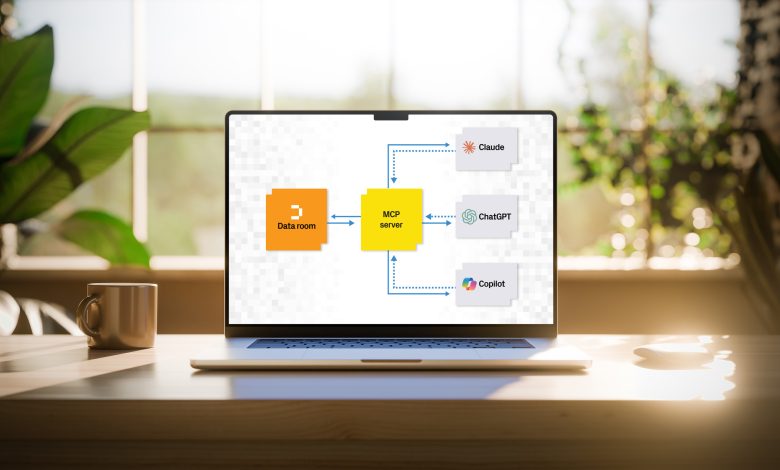
The market is beginning to close that gap by connecting AI assistants to live, permissioned deal content; Datasite, for example, has an MCP-based integration that lets tools such as Claude, ChatGPT, and Microsoft Copilot work against in-room materials while keeping permissions and logging intact. The broader lesson is simple: AI scales in deals only when governance scales with it.
Data analysis speeds up, but assumptions still need owners
AI can pull numbers from tables, clean messy formats, and run quick cross-checks across spreadsheets and PDFs. It can draft model drivers, spin up scenarios, and flag outliers so analysts spend less time wrangling data and more time testing ideas instead of chasing version churn across files. What it can’t do is own the assumptions. Materiality, risk appetite, and integration tradeoffs still belong to people who will be accountable after the close.
Why the decision still takes longer than the work
Deal execution is an operational problem, while deal approval can be a coordination problem. Corporate development, finance, legal, business units, and external advisors can review the same facts and still disagree on what they mean. Investment committees and boards exist to impose discipline, manage risk, and create accountability, not to maximize speed. That structure keeps decision rights human even as analysis gets faster.
Decisions also hinge on post-sign realities that software can’t negotiate. Integration plans require commitments from operators who absorb the disruption, and those operators often weigh timing and risk differently than deal teams do. Alignment tends to move at the speed of trust and internal consensus, not at the speed of search. AI can sharpen the evidence base for the discussion, but it cannot create organizational buy-in.
Committees can also add drag. People need time to challenge assumptions, surface dissent, and land on a decision the organization will back. Research on investment committees points to recurring group dynamics and incentive problems, even among experts. AI can move the debate earlier by getting everyone to the same facts faster, but it does not end the debate.
Automation is not the same thing as a new decision model
AI talk often blends two different promises: faster work and different decisions. Automation tackles the first by standardizing classification, extraction, routing, and reporting. Decision transformation is tougher because it changes who decides, when they decide, and what counts as enough evidence to commit. Most M&A teams are seeing the first wave now, while the second requires governance, incentives, and operating-model change.
The distinction matters because model outputs can be wrong in ways that sound certain. Dealmaking demands traceability from insight to source and a clear line of accountability when something material is missed. That’s why governed approaches emphasize permissions, logging, and citations back to underlying documents rather than free-floating summaries. Trust rises when verification is quick.
As adoption scales, the more realistic frame is augmentation, not replacement. Automate predictable steps and use AI to support judgment where ambiguity rises. That framing keeps risk management aligned with reality and prevents a common disappointment cycle: expecting strategic differentiation from tools that mainly deliver operational efficiency. It also clarifies where leaders should invest next.
- Expect throughput, not magic
AI boosts throughput where the work is repetitive and the answer can be checked. Track value in cycle time, fewer manual touches, faster Q&A, and earlier issue discovery. Do not assume speed automatically improves the investment call. Outcomes still hinge on strategy, discipline, and alignment behind a clear thesis.
- Get data and governance right before you scale
AI delivers more when deal content is organized, permissioned, and treated as the system of record. That foundation lets teams query live materials with consistent access controls and auditable activity. When teams copy files into side tools, they gain short-term speed and take on long-term risk—leakage, version drift, and lost provenance. Governance is not a tax; it is what makes AI usable at scale.
- Make the decision process keep up
Speed matters only if decision forums can absorb it. Standardize what committees receive, require citations to evidence, and set clear thresholds for escalation. Use AI to assemble pre-reads and surface the open questions, so the meeting is not another committee scramble an hour before kickoff. Otherwise, faster analysis just creates more noise.
- Train teams to verify
AI cuts grunt work, but it raises the bar for review. Build verification habits: check summaries against source, test edge cases, and record what the model saw. Set rules for what AI may draft and what a human must own and sign. This is how speed and accountability coexist.
A recalibrated view of AI creates better outcomes
AI is already changing deal execution because it shortens the distance between questions and answers. It speeds diligence, improves reuse of prior work, and helps teams test more scenarios before the clock runs out. Those gainscompound when AI operates inside governance controls rather than around them. However, none of this removes the human work of choosing a path and committing capital.
Decision-making in M&A stays human because accountability, coordination, and alignment do not automate. Leaders who expect AI to decide will be disappointed. Leaders who use AI to make execution faster and debate sharper gain an edge without betting the deal on a black box. In M&A, the winners will be the ones that use AI to cut the grind and clear the path to a better decision.