By Sridevi Kakolu, Solutions Architect, Boardwalk Pipelines, USA
AI governance is the framework of policies, processes, roles, and controls that organizations use to ensure artificial intelligence (AI) systems are designed, developed, deployed, and operated responsibly. Its purpose is to guide how AI decisions are made, who is accountable for them, and how risks associated with AI, such as bias, lack of transparency, privacy violations, security threats, and regulatory non-compliance, are identified and managed throughout the AI lifecycle. AI governance connects technical AI systems to organizational values, business objectives, ethical principles, and legal requirements. Unlike traditional IT governance, AI governance must address systems that learn from data, adapt over time, and influence high-impact decisions affecting individuals, customers, and society.
Technical teams need to align with and adhere to AI governance by embedding governance principles and requirements into day-to-day engineering practices, so responsible AI becomes part of how systems are designed, shipped, and maintained. This starts with clearly defined roles and decision rights, such as who owns the model, who approves releases, and who responds to incidents, and continues through standard engineering artifacts and controls, including documented model intent and limitations, traceable data and model versioning, and consistent review checkpoints across the AI lifecycle. Teams sustain adherence by implementing repeatable processes for risk assessment, testing, release readiness, and post-deployment monitoring, ensuring AI systems remain compliant, reliable, and aligned with business and ethical expectations as real-world conditions change.
Key objectives can be achieved by AI Governance:
- Risk Management: Identify, assess, and mitigate risks related to bias, fairness, safety, explainability, security, and unintended consequences.
- Accountability: Establish clear ownership and responsibility for AI systems, including decision authority and escalation paths.
- Transparency: Ensure AI models, data sources, and decision processes are documented, auditable, and explainable to stakeholders.
- Compliance: Align AI practices with applicable laws, regulations, and standards.
- Trust and Ethics: Promote responsible and ethical AI use that aligns with organizational values and societal expectations.
- Scalable Innovation: Enable AI adoption at scale without compromising control, safety, or compliance.
The scope of AI governance applies across the entire AI lifecycle, including:
- Design and Planning: Defining intended use, risk level, and ethical considerations.
- Data Management: Governing data quality, privacy, lineage, and access controls.
- Model Development: Ensuring responsible training, testing, and validation.
- Deployment: Managing approvals, documentation, and release processes.
- Monitoring and Operations: Tracking performance, bias, drift, and security over time.
- Retirement: Safely decommissioning models and preserving required records.
Governance is continuous, not a one-time activity, because AI systems and their risk profiles change as data, usage, and regulations evolve.
Principles of an AI Governance Framework
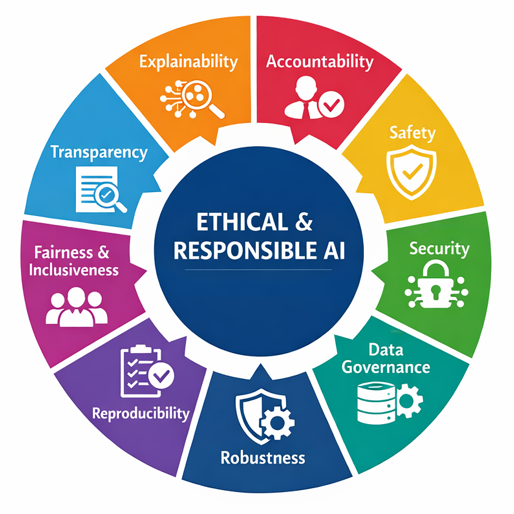
An effective AI governance framework is built on below nine interconnected principles that collectively ensure AI systems are responsible, trustworthy, and aligned with ethical and societal expectations.
Explainability: AI doesn’t act like a black box; it can clearly show how and why it reached a decision. When people understand the reasoning behind AI outcomes, they are more likely to trust and confidently use the system. This clarity is also critical for meeting regulatory requirements and ensuring proper oversight. For example, in a loan approval system, the AI highlights key factors such as income level and credit history that influenced its decision, helping both customers and reviewers understand the outcome.
Accountability: There should always be a clear person or team responsible for how an AI system behaves and the decisions it makes. When something goes wrong, whether it’s an error, bias, or unintended impact, there’s no confusion about who needs to investigate and fix it. This clarity reduces risk and builds confidence in AI-driven decisions. For example, a company assigns a dedicated owner or team to its AI hiring tool to ensure someone actively monitors performance, reviews outcomes, and approves any changes before they go live.
Safety: Always make sure AI stays within clear boundaries and doesn’t cause harm intentionally or accidentally. It’s not just about whether technology works, but about how its decisions can affect real people in real situations. For higher-risk scenarios, human judgment remains essential. For example, a medical AI solution can suggest possible diagnoses, but a qualified clinician always reviews and approves the recommendation before any action is taken.
Security: Security is the top priority to make sure AI systems and the data they rely on are protected from the wrong hands and bad actors. Strong security measures help keep personal and sensitive information private while ensuring the AI system remains reliable and trustworthy. This becomes especially important when AI is used in regulated areas like finance, healthcare, or customer support. For example, a customer service chatbot is designed to restrict access to authorized information only, encrypt all conversations, and continuously monitor for unusual activity to prevent data leaks or misuse.
Transparency: This means being open about how AI systems work, what data they use, how decisions are made, and what limitations exist. When AI is transparent, stakeholders can clearly understand, review, and question its behavior. This openness builds trust and makes audits and regulatory reviews much easier. For example, a predictive maintenance system clearly documents its data sources, model assumptions, and performance results so engineers and auditors know exactly how predictions are generated.
Fairness and Inclusiveness: This principle ensures AI systems treat people equitably and do not reinforce existing biases or discrimination. This principle requires ongoing evaluation to detect bias in both data and models. Inclusive AI supports ethical outcomes and reflects a commitment to social responsibility. For example, a recruitment AI is regularly tested to ensure candidates receive equal screening outcomes regardless of gender or ethnicity.
Reproducibility: Reproducibility means AI results can be repeated and verified using the same data, tools, and settings. This consistency builds confidence in AI outcomes and supports reliable decision-making. It also allows teams to validate results and improve models over time. For example, a fraud detection model records its datasets, configurations, and training history so teams can recreate results for audits or further testing.
Robustness: This principle ensures AI systems continue to perform reliably even when conditions change or unexpected situations arise. This includes resilience to abnormal data, shifting patterns, or attempted manipulation. Robust AI is better equipped to handle real-world complexity. For example, a demand-forecasting AI is stress-tested with extreme market scenarios to confirm it remains accurate during unexpected fluctuations.
Data Governance: This principle focuses on how data is responsibly handled throughout its lifecycle, from collection and storage to access and retention. It ensures data quality, protects privacy, and limits access to authorized users only. Strong data governance forms the backbone of trustworthy and compliant AI. For example, a customer analytics platform enforces role-based access controls and tracks data lineage to ensure sensitive information is used appropriately.
Importance of AI Governance
As AI plays a growing role in high-impact decisions such as hiring employees, approving loans, diagnosing medical conditions, and operating critical infrastructure, the risks associated with poorly governed AI become increasingly significant. When AI governance is weak or absent, organizations may face legal penalties, reputational damage, operational disruptions, and a loss of trust from customers, employees, and regulators.
Strong AI governance ensures that AI systems continue to deliver business value while remaining safe, compliant, and ethically grounded. Governance principles act as guardrails, guiding teams to use AI responsibly without stifling innovation. When implemented effectively, AI governance does not slow progress; instead, it enables organizations to adopt and scale AI with confidence, knowing that risks are understood, responsibilities are clear, and outcomes align with both business goals and societal expectations.
In conclusion, AI governance is no longer optional; it is essential for any organization seeking to use AI responsibly and at scale. By grounding AI initiatives in clear governance principles such as transparency, accountability, safety, fairness, and data responsibility, organizations can reduce risk while strengthening trust in AI-driven decisions. When governance is built into the AI lifecycle from the start, it becomes a strategic enabler rather than a constraint. It empowers teams to innovate responsibly, accelerate adoption, and deploy AI solutions that are not only effective but also ethical, compliant, and resilient. Ultimately, strong AI governance ensures that AI serves people, organizations, and society in a way that is sustainable, trustworthy, and aligned with long-term value creation.