Many engineering organizations are investing in AI to accelerate software delivery, only to discover that the real constraint is no longer code generation. It is the operating model around it.
Coding assistants can help developers draft functions, tests, documentation, scripts, and integration logic faster than before. Yet faster generation does not automatically mean faster delivery. The surrounding system still has to absorb, verify, govern, and maintain what is produced.
This is where many AI adoption programs begin to stall. Teams add AI tools to workflows that were designed for a slower era of software development. The result is often a local productivity gain at the coding stage, followed by pressure elsewhere: requirements become unclear, reviews become overloaded, testing becomes reactive, and architecture decisions carry more downstream risk.
The question for engineering leaders is no longer whether AI can help write code. It can. The more important question is whether the organization has a delivery model capable of using that speed responsibly.
The Delivery Model Was Built for a Different Constraint
For much of modern software history, delivery was constrained by the time required to write reliable code. Planning cycles, handoffs, reviews, testing practices, release controls, and staffing models all evolved around that reality.
AI-assisted development changes the balance. For routine work such as boilerplate generation, unit tests, API integration scaffolding, refactoring support, and documentation, AI can compress parts of implementation work substantially.
Evidence from software engineering research shows meaningful productivity gains in some contexts. A controlled study on GitHub Copilot, published by Microsoft Research, found that developers with access to the tool completed a coding task 55.8% faster than those without it: https://www.microsoft.com/en-us/research/publication/the-impact-of-ai-on-developer-productivity-evidence-from-github-copilot/
McKinsey has also reported that generative AI can accelerate certain software development activities, particularly code generation, documentation, and refactoring:https://www.mckinsey.com/capabilities/quantumblack/our-insights/unleashing-developer-productivity-with-generative-ai
However, the evidence is not uniformly simple. Google’s 2025 DORA report describes AI as an amplifier of existing organizational strengths and weaknesses, rather than a universal productivity layer:https://research.google/pubs/dora-2025-state-of-ai-assisted-software-development-report/
A 2025 METR study of experienced open-source developers found that AI tools slowed participants down in that specific setting, largely because of prompting, waiting, review, and correction overhead:https://metr.org/blog/2025-07-10-early-2025-ai-experienced-os-dev-study/
This mixed evidence is important. It suggests that AI productivity is not only a tool question. It depends heavily on task type, team maturity, codebase complexity, review discipline, and the quality of the surrounding delivery system.
When Generation Accelerates, Weaknesses Become Visible
AI does not remove the need for engineering discipline. In many cases, it increases the cost of weak discipline.
When code generation speeds up, ambiguity in requirements becomes more expensive. A human engineer can often infer missing context gradually through conversation, experience, or product intuition. AI systems depend more heavily on explicit, structured, and unambiguous inputs.
When more code can be produced in less time, review practices also face new pressure. A pull request that looks plausible may still contain incorrect assumptions, weak edge-case handling, insecure logic, or architectural drift. If the review process is informal, overloaded, or performed by the same actor that produced the change, AI can turn small gaps into repeated quality issues.
The same applies to testing and release governance. Faster implementation increases the volume of changes moving through the pipeline. If testing coordination, ownership boundaries, and deployment controls remain unchanged, delivery speed may improve locally while system-level risk increases.
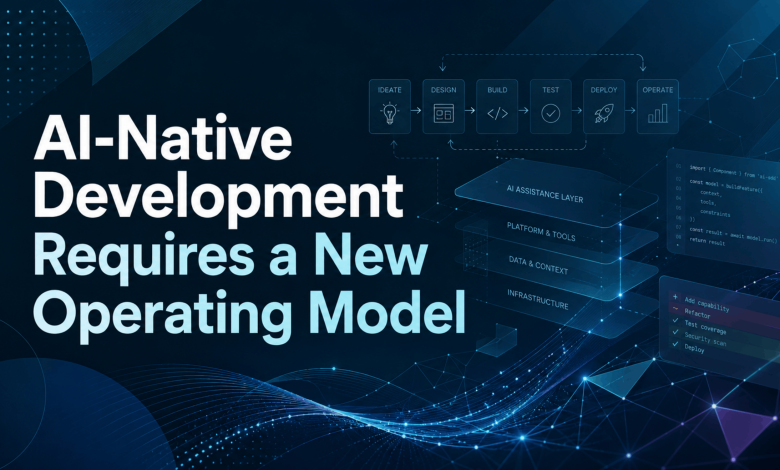
This is why AI-native development requires a broader operating model. The organization has to become better not only at producing software, but at specifying, validating, and learning from AI-assisted work.
Requirements Need to Become More Structured
One of the first operating-model changes is requirements engineering.
Traditional specification documents are often written for human interpretation. They may include narrative explanations, implicit assumptions, incomplete acceptance criteria, and business context scattered across different tools. Human teams can work around this friction, although not always efficiently.
AI-assisted workflows need cleaner inputs. Requirements should become easier for both humans and machines to interpret. This does not mean turning product work into rigid bureaucracy. It means creating enough structure that intent, constraints, risks, dependencies, and acceptance criteria are visible before generation begins.
Useful formats can include Markdown templates, structured task briefs, YAML or JSON configuration where appropriate, and lightweight development contracts that define expected behavior. The goal is not documentation for its own sake. The goal is to reduce ambiguity before AI systems generate implementation artifacts.
A strong task brief should answer several basic questions. What outcome is expected? What should not change? What assumptions are known? What risks need attention? What tests or checks should confirm the work? Which architectural boundaries must be respected?
When these questions are answered consistently, AI becomes easier to direct and easier to evaluate.
The Role of the Engineer Is Shifting
AI-assisted development changes the shape of engineering work. It does not make engineering judgment less important.
As routine implementation becomes more automated, the higher-value capabilities shift toward specification, validation, architectural reasoning, security awareness, and system-level decision-making. Engineers increasingly need to act as supervisors of generated output, not just producers of code.
This shift has implications for skills development. Many organizations have invested heavily in coding standards, frameworks, and delivery rituals, but less deliberately in specification quality, review reasoning, prompt design, and AI output evaluation.
The engineers who adapt fastest are not always the most senior. Often, they are the ones willing to change how they think about their own contribution: from writing code directly to governing the quality of work produced with AI assistance.
Separation of Responsibilities Matters
One practical operating principle is simple: the actor that produces a change should not be the only actor responsible for reviewing it.
This applies whether the actor is human or AI. If an AI system generates a patch and then validates its own assumptions, the review can become circular. If a developer accepts generated output without independent verification, the process becomes fragile.
A more resilient model separates three responsibilities.
The first is navigation. Someone defines the goal, constraints, context, and success criteria. This role ensures the work is framed clearly before implementation begins.
The second is execution. A human, an AI system, or a human-AI pair produces the change. The focus is implementation within the agreed scope.
The third is review. A separate reviewer validates the output against requirements, architecture, security expectations, and test evidence. The reviewer is not simply checking whether the code compiles. They are checking whether the change is correct.
This separation does not need to be heavy. It can be lightweight and practical. What matters is that responsibility is clear and that validation is independent enough to catch plausible but wrong output.
Artifacts Make AI-Assisted Work Governable
Open-ended AI conversations are useful for exploration, but they are difficult to govern. Long prompt threads often contain decisions, assumptions, corrections, and context that are hard for others to audit later.
AI-native teams need compact, reusable artifacts.
A task brief can define the goal, constraints, risks, and acceptance criteria. A patch summary can explain what changed, what files were affected, what commands were run, and what known limitations remain. A review checklist can specify the items that need independent validation.
These artifacts create a bridge between human judgment and AI-assisted execution. They make the work easier to reproduce, audit, review, and onboard into. They also reduce dependency on individual memory, which becomes increasingly important as iteration speed increases.
Good artifacts should be short enough to use in real delivery work. If they become too long, teams will ignore them. If they are too vague, they will not help AI systems or reviewers. The right balance is practical structure: enough clarity to reduce risk, not enough process to slow the team unnecessarily.
Adoption Metrics Are Not Enough
Many organizations measure AI adoption by license usage, prompt volume, active users, or percentage of engineers using tools. These numbers can be useful, but they do not show whether the organization is becoming better at delivery.
A team can have high AI adoption and still accumulate technical debt faster. It can generate more code while weakening architecture. It can ship more changes while increasing review burden. It can make developers feel faster without improving end-to-end outcomes.
Better indicators include cycle time, defect leakage, review quality, rework rates, deployment stability, test reliability, and knowledge reuse. These metrics reveal whether AI-assisted work is improving the system or simply increasing output volume.
The key distinction is between speed and throughput. Speed is how quickly an individual task appears to move. Throughput is how reliably valuable work reaches production without creating avoidable downstream cost.
AI-native development should improve throughput, not just activity.
Operating Models Need Cultural Support
The organizational shift is often harder than the technical one.
Engineers may adopt tools quickly, but established workflows change more slowly. Review habits, planning practices, knowledge-sharing norms, and leadership expectations all shape whether AI creates durable value.
Organizations need visible support for experimentation, but also clear expectations around quality. Teams should have time to learn, compare approaches, document useful patterns, and share failure cases. AI adoption should not be treated as a side hobby or a purely individual productivity choice.
Internal champions can help when they are embedded in real delivery work. Their value comes from helping teams apply AI to actual problems, not from promoting tools in abstraction. They can identify useful use cases, document repeatable patterns, support review practices, and collect feedback on where AI creates friction.
This kind of enablement works best when it is connected to delivery outcomes. The goal is not enthusiasm. The goal is better engineering performance under conditions of greater speed.
The Real Test Is Verification
AI-native development is not defined by how much code AI generates. It is defined by how well the organization can direct, validate, and maintain AI-assisted work.
The most important question is simple: if AI produced something that looked right but was not, would the current process catch it?
If the answer is yes, the organization is likely building the right operating discipline. If the answer is no, higher AI adoption may increase risk faster than value.
The companies that benefit most from AI-assisted development will not necessarily be the ones with the most tools. They will be the ones with clearer requirements, stronger review practices, better knowledge systems, and leadership teams that understand the difference between generating code and delivering reliable software.
AI changes the pace of implementation. Operating models determine whether that speed becomes progress.