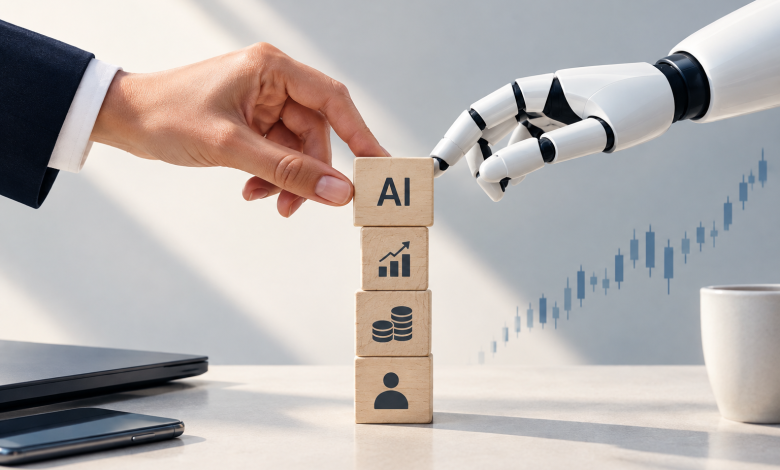
inancial services are the most AI-adopted sector in the UK, with 75% of UK financial services firms currently using artificial intelligence, according to data from the Bank of England and FCA. That transformation is now changing both sides of the hiring process – candidates are using AI to shape their applications, while employers are increasingly using it to manage and assess a volume of applications they couldn’t otherwise handle.
The question for financial services firms is no longer whether AI belongs in recruitment (It already does). It’s a matter of where to draw the line between what AI can do efficiently and what still requires a person to think, assess and make a judgement call.
I don’t believe the rise of AI makes traditional measures of experience, potential and career progression redundant. If anything, it makes human judgement more important. As AI takes on more of the mechanical work, hiring managers need to become clearer about where technology should carry the weight and where they need to insist on seeing a person think for themselves.
AI is now part of a good application – not a problem to solve
I expect people to use AI when they apply for a job. It would be strange, at this point, if they didn’t. 73% of students and graduates used AI at some stage during the application process in the UK, up from 55% last year. The question is not whether a candidate has used AI, it’s how they used it.
The hardest part of hiring right now, and I think it’s the single biggest skill a hiring manager needs to build, is telling the difference between a strong response because someone leaned on AI to produce something polished but generic, and a strong response because someone’s own creativity, combined with AI, produced something genuinely good.
That’s a real distinction, and it matters, but it’s not a reason to be suspicious of AI use. It’s a reason to get better at evaluating it.
AI is an extraordinary accelerant. It is not, on its own, especially creative. So, the part of an application that still tells you the most about a person is what they did with the acceleration – did they use it to get somewhere faster, or somewhere better? When I’m assessing candidates, that’s the question I’m asking. It’s a more interesting question than anything I was asking five years ago, and that’s because of AI.
Where AI earns its place, and where it doesn’t
At Darwinex, we don’t use AI to discover talent because a lot of our best people found us as customers first, trading on the platform long before they were ever candidates. That kind of discovery runs on relationships and time, and I don’t think any technology replaces that, nor would I want it to.
Filtering is different however, and it’s where I believe AI genuinely earns its keep. When you’re working through hundreds of applications, AI can do a huge amount of useful, legitimate work narrowing that pool down to something a human can engage with properly.
Used well, filtering AI makes a process fairer, because it can apply a consistent, examined standard to every application rather than whatever a tired reviewer notices on application four hundred and twelve.
Where human judgement still has to close the loop
Once you’re past filtering, I’d keep AI’s role narrow and deliberate. Most of what actually matters about a candidate’s potential is closer to black and white than people like to admit, and where there’s a clean number behind an outcome, AI can assess it perfectly well. That’s real, useful signal, and I wouldn’t want to lose it.
But the moment you need AI to interpret something more human – i.e. is this person good to work with, sharp in a room, someone who’ll challenge the team in the right way? – that’s a sign the thing being measured needs a conversation, not a model. AI is excellent at extending what a hiring manager can see. It’s not yet a substitute for the judgement that decides what to do with that view, and I don’t think it should be.
The opportunity is real – it just runs through people, not around them
Despite some of its limitations, I’m not as cautious as others might be about using AI in hiring. I think, so long as it’s used with intent and awareness, it’s one of the more exciting shifts financial services have seen in how it evaluates people, precisely because it frees hiring managers from the mechanical parts of the job and gives them more room for the part only they can do.
The firms that get the most out of this won’t be the ones that hand the process over to AI, and they won’t be the ones that keep it at arm’s length either. They’ll be the ones whose hiring managers know exactly where AI should carry the weight, where a person still has to make the call, and have the discipline to keep drawing that line thoughtfully as the technology keeps getting better.