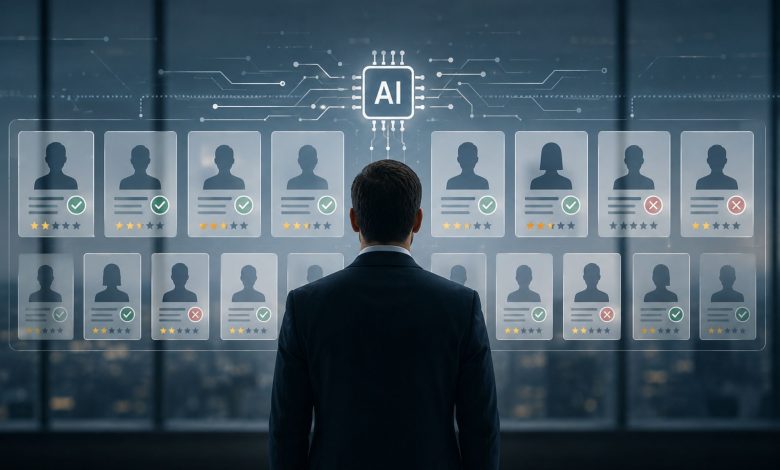
Much of the conversation about AI in hiring has focused on automation. Faster screening, improved efficiency, and the ability to process larger applicant pools have dominated the discussion. Yet they may not represent the most significant change in executive recruitment.
A more consequential question is emerging: Is AI changing how organizations make executive hiring decisions, or simply changing where those decisions begin?
Executive appointments have never been determined by qualifications alone. They influence strategy, organizational performance, governance, and long-term growth. As AI becomes more deeply integrated into recruitment, organizations face a broader challenge than adopting new technology. They must determine which parts of executive evaluation benefit from automation and which continue to depend on experienced human judgment.
A 2026 survey of 104 senior leaders, including directors, vice presidents, C-suite executives, and founders, published in the Executive Transition Report 2026, offers insight into that shift. AI is already influencing executive hiring for a meaningful proportion of respondents, while relationship-driven hiring channels continue to account for many successful leadership transitions. Rather than replacing human judgment, AI appears to be reshaping parts of the hiring process while leaving the final responsibility for leadership decisions firmly with organizations.
That question begins with understanding where AI is already influencing executive hiring and how its growing role is changing the way organizations evaluate senior leadership.
Where AI Is Changing the Executive Hiring Process
Among respondents, 37% reported encountering an AI-related barrier during their executive search, including AI-assisted screening, automated candidate ranking, and AI-supported interviews. While these experiences varied, together they indicate that AI is increasingly influencing how organizations assess senior leadership candidates before interview decisions are made.
This marks an important shift in the role of technology. Rather than replacing executive decision-makers, AI is becoming part of the information layer that supports them.
Processing information is fundamentally different from evaluating leadership. Executive appointments require judgments that extend beyond structured data, including strategic thinking, organizational fit, stakeholder confidence, and the ability to lead through uncertainty. Those assessments remain central to selecting senior leaders, regardless of how technology evolves.
Technology Has Changed the Process, Not the Basis of Trust
Despite AI’s growing role, the foundations of executive hiring have changed far less than the technology surrounding it. While automated systems are becoming more visible throughout executive recruitment, the strongest executive outcomes in the survey continued to originate through relationship-driven channels. AI may influence how candidates are evaluated, but trust continues to shape how leadership decisions are made.
Among respondents who secured new roles, existing network referrals accounted for 36% of successful outcomes, making them the most frequently cited hiring channel. Former colleagues and managers contributed 32%, while senior leader advocacy accounted for 26%. By comparison, cold applications represented 9% of successful outcomes, and job boards accounted for 7%. These findings suggest that professional credibility and established relationships remain central to executive recruitment.
This is not a contradiction. AI-assisted evaluation and relationship-driven hiring address different parts of the executive search process. Technology helps organizations organize and assess information more efficiently, while professional relationships provide context, credibility, and judgment that structured data alone cannot capture. Rather than competing with one another, they support different stages of executive hiring.
For organizations, the implication is practical. Modernizing executive hiring is unlikely to depend on choosing between AI and human judgment. It depends on understanding the strengths of each and designing recruitment processes that deliberately combine both.
The Strategic Question for Organizations
For organizations, that raises a broader strategic question. If AI is becoming part of executive hiring, what role should it actually play in decisions that shape future leadership?
Executive appointments differ from most hiring decisions because they extend beyond matching candidates to predefined requirements. Organizations are evaluating strategic judgment, leadership under uncertainty, organizational fit, and the ability to influence long-term business performance. These are decisions where efficiency has value, but context and judgment carry greater weight.
AI can strengthen executive recruitment by supporting structured evaluation and reducing administrative complexity. At the same time, the strongest hiring outcomes remained closely associated with professional relationships and leadership credibility. Rather than replacing human judgment, AI appears to expand the information available before that judgment is exercised.
The strategic challenge, therefore, is not deciding whether AI belongs in executive hiring. It is determining how technology can improve decision-making without displacing the qualities that distinguish effective leadership selection.
Designing Executive Hiring for Better Decisions
Answering that question requires moving beyond technology adoption and toward decision design. The issue is no longer how much AI organizations should use, but where it creates the greatest value within the executive hiring process.
AI can improve consistency, organize complex information, and support more structured evaluation. Those capabilities strengthen recruitment when they remain part of a broader process that includes executive experience, organizational context, and informed discussion. Technology contributes analysis, while leadership teams remain responsible for interpretation.
Success should also be measured differently. Operational improvements such as faster recruitment or more efficient workflows are valuable, but they are not the primary measure of success. Executive appointments shape strategy, governance, culture, and long-term organizational performance. The quality of those decisions ultimately depends on whether technology helps organizations reach better conclusions, not simply faster ones.
As AI continues to evolve, competitive advantage is unlikely to come from automating the greatest number of hiring activities. It is more likely to come from designing executive hiring processes in which technology strengthens informed judgment without attempting to replace it. The remaining question is what that means for the future of executive hiring itself.
The Future of Executive Hiring Is Not AI Alone
Taken together, the evidence points toward a broader conclusion. AI is becoming an increasingly important part of executive recruitment, but its greatest value lies in improving how organizations evaluate information rather than replacing the judgment required to select senior leaders.
Throughout the findings, a consistent pattern emerges. AI is influencing the early stages of executive recruitment by supporting screening, evaluation, and information management. At the same time, successful executive appointments continue to reflect factors that technology alone cannot assess, including professional credibility, organizational context, trusted relationships, and leadership judgment. Together, these findings suggest that technology and human evaluation serve complementary roles rather than competing ones.
For organizations, the practical challenge is no longer whether to incorporate AI into executive hiring. It is how to build decision-making processes that make effective use of both technological capability and experienced leadership. AI can strengthen consistency, improve analysis, and support more structured evaluation. The responsibility for interpreting that information, weighing competing priorities, and selecting leaders who can guide an organization through complexity remains a human decision.
Ultimately, AI is changing where executive hiring decisions begin, not what makes them effective. As organizations refine their hiring practices, competitive advantage is likely to come less from the technology itself than from the quality of the judgment surrounding it. In executive hiring, AI may shape the process, but leadership will continue to shape the outcome.
References
Close Cohen Career Consulting. Executive Transition Report 2026.