There are tremendous benefits for healthcare companies that strategically leverage large language models, machine learning diagnostics tools, and other Artificial Intelligence capabilities. The competitive advantages that these companies stand to gain are beyond just operational efficiency. With their prediction capabilities and streamlining documentation companies that leverage these AI tools can dramatically improve the quality of care.
However, with every new technology adoption comes a risk and healthcare has a lot at stake when things go wrong.
Patient-provider bond
The bond between a patient and their healthcare provider relies on transparency and trust. These qualities are the reason why patients become loyal and keeps them coming back to the same provider year after year. Ultimately, this improves long-term care results and drives down costs. This is why it’s important that healthcare providers are transparent with how they are using their patient’s data, especially around tools that assist with diagnostics.
Privacy and the increasing amount of data LLMs manage
Large language models have moved beyond just text generation models and now process multiple inputs. These multimodal large language models can take in image, audio, video, and of course test.
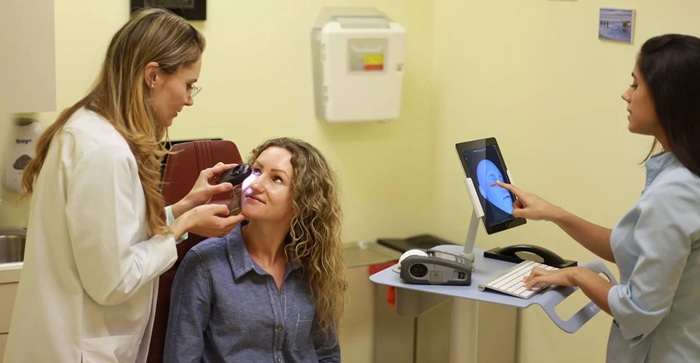
Image processing can be a vital tool during the diagnosis stage of care. AI-driven image analysis has moved beyond just X-rays. It’s one thing for x-rays to be run through a model but as these models are asked to analyze full body images the diagnostic complexity increase.
There is also a privacy obligation that healthcare providers should consider when using the multi-modal models. Patients should be informed about how these images are used and be given the option to opt out AI diagnostic tooling available to their healthcare providers. This is why it’s important to understand the terms and conditions of these multi-modal models.
Some of these models reserve the right to use the data, such as image, for future training. Healthcare providers should educate themselves on terms of service agreements and inform their patients. The decision to allow or disallow images from being used in future training should be up to the patient.
Integration and ecosystems
More or less everyone agrees that AI has huge potential. But the question of how AI will actually be used and, crucially, integrated into healthcare provider systems, is key.
An obvious next step in the healthcare AI evolution is in medical software with an integrated AI ecosystem. There are several reasons for this. For a start, the AI can access all the needed data and act as a true agent on one connected platform, managing different processes. There’s also less programming and manual work to make the AI work across different tools, not to mention fewer bugs and data privacy issues that come with combining multiple tools (especially using AI that doesn’t have the kind of data privacy protection that is specifically needed healthcare).
Ultimately, healthcare providers will likely find that opting for fully integrated ecosystems is likely to be the way to reduce workload and improve their processes. Working with AI patched onto other systems may not sufficiently support workflows.
Design philosophies
Specialty providers already have a vast clinical toolkit, and AI is just another addition to their already growing toolkit. Most would agree that this new tool is very powerful and with such a powerful tool there should be human oversight.
During the construction of these AI models, three design philosophies emerged. The first one was called Human-in-the-Loop (HITL). The idea is that AI models handle all the heavy processing involved with generating text or analyzing images, but humans remain the reviewers, validators, and approvals of any final decision. Human-in-the-loop pushes the approval process of every AI decision to the human before any AI has a chance to act.
There is also Human-on-the-loop where AI will act autonomously, these are called AI agents, but humans are monitoring the progress and can intervene at any time.
Finally, there’s the Human-in-command design where a human can set a rule around what the AI Agent can do, and the agent operates within that bounded context.
Healthcare providers should understand how software applications use AI so that they understand the control they have and how much control they are willing to give up to the AI Agents.
AI as assistance, not replacement
AI is not just here to help with the operational tasks of healthcare but is here to also assist providers with clinical decisions. The successful providers will see AI as a tool to assist and not a replacement. The clinical and operational staff that educate themselves will be the ones that provide the best care for their patients.
AI on its own cannot deliver better healthcare. Being educated healthcare providers, informing patients, and giving clinical staff the tool to monitor AI agents is what results in better patient care.