The most consequential applications of AI are rarely the ones that generate the most headlines. While the industry fixates on large language models and generative tools, a quieter and arguably more urgent transformation is underway at the intersection of computer vision, elder care, and IoT — one that will matter enormously to the 61 million Americans currently over 65, and the families responsible for their safety.
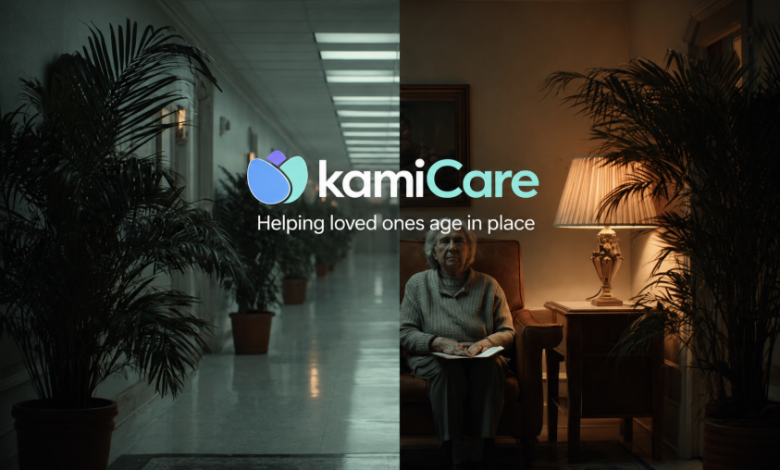
Kami Vision, a San Jose-based Vision AI company, offers a compelling case study in how a platform built for one purpose can evolve into something far more significant. What began as enterprise-grade security camera technology has become a sophisticated AI-powered care infrastructure — and the company is now positioned to become a foundational layer in how society approaches aging safely at home.
The Architecture of an Accidental Healthcare Company
Kami Vision did not set out to solve elder care. It set out to solve computer vision at scale. The company’s security platform — now serving six million users across 120 countries and powering 15 million devices globally — was built to process enormous volumes of visual data reliably, accurately, and in real time. Managing 248 million daily alerts and 25 petabytes of data is not a product feature. It is an operational capability that took years of engineering discipline to achieve.
That infrastructure, developed in the demanding environment of enterprise security, turned out to be precisely what the senior care industry had been waiting for. The same algorithms that distinguish a person from a shadow, an intruder from a resident, or a genuine threat from routine activity can be retrained and refined to detect something far more clinically significant: a person who has fallen and cannot get up.
This is the foundation on which KamiCare was built — and it is a foundation that competitors entering the elder care AI space from scratch cannot replicate quickly or cheaply.
What Computer Vision Gets Right That Wearables Get Wrong
The dominant paradigm in fall detection has been wearable-first for decades: pendants, wristbands, pull cords. The fundamental assumption underlying all of these is that the person who needs help will be able to initiate a response. It is a design philosophy that fails at precisely the moment it is most needed — when someone is unconscious, disoriented, or physically unable to press anything.
Computer vision inverts this assumption entirely. KamiCare’s camera-based system watches continuously, passively, and without requiring any action from the person being protected. The AI detects when someone has gone to the ground — not just in the dramatic, sudden way that simulated training scenarios tend to model, but across the full spectrum of ground-level events that clinical reality produces. Someone who cannot rise unassisted. A person scooting across the floor. Early indicators of mobility decline that would be invisible to a wearable device and unnoticed by a human caregiver who cannot be present around the clock.
The system achieves 99.5 percent accuracy, trained on thousands of documented fall incidents collected across real-world professional care deployments since 2022. That training data advantage is significant. It represents not just volume but diversity — edge cases, partial obstructions, varied lighting conditions, and the kinds of ambiguous situations that laboratory-trained models consistently misclassify.
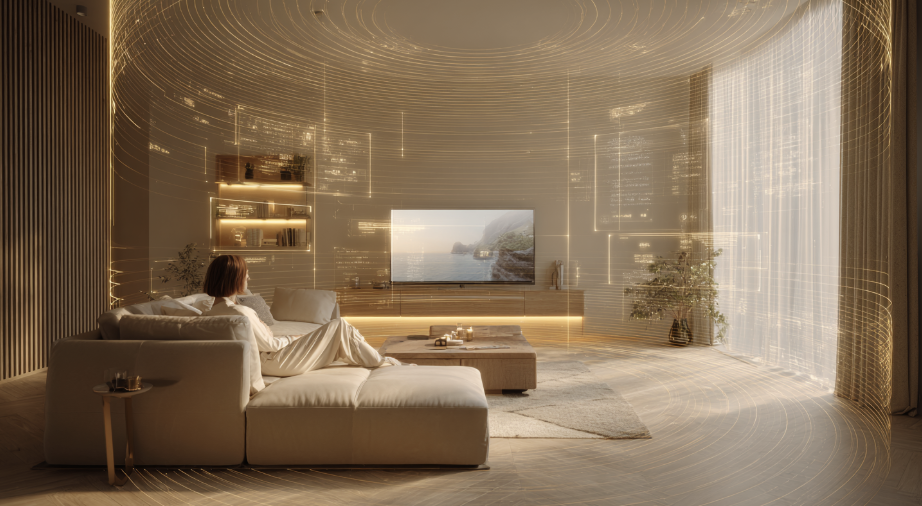
Image Credit: Kami Vision
Enterprise Validation as a Moat: The KamiCare Deployment Story
KamiVision’s path into elder care followed the logic of institutional validation before consumer expansion — a sequencing that turns out to matter enormously for AI applications in healthcare.
The KamiCare platform entered senior living communities and care facilities in 2022, spending the following three years deployed in professional care environments where accuracy failures carry genuine clinical consequences. The platform now protects residents across thousands of beds in senior living facilities nationwide. This is not a proof of concept. It is a production deployment, refined across thousands of real incidents, at real facilities, under real operational conditions.
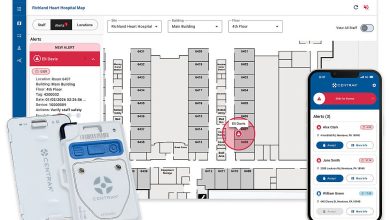
The institutional version of KamiCare also includes capabilities purpose-built for professional care environments, including BedExit detection — alerting care staff when residents at fall risk attempt to leave their beds unsupported, a capability particularly relevant in memory care settings where residents may have limited awareness of their own risk.
This four-year institutional track record is what Kami Vision now brings to the consumer market. The consumer version of KamiCare is currently in beta testing across private homes in the United States, with a full rollout expected in the latter half of 2026. The technology is not being adapted from scratch for the home environment. It is being extended from an enterprise foundation that has already proven itself in the most demanding version of the use case.
The Consumer Platform: A Different Feature Set for a Different Context
The transition from institutional to consumer deployment is not simply a matter of pricing and packaging. It requires rethinking which capabilities matter most in a home environment and which privacy constraints apply differently when the end user is a family rather than a care facility.
The consumer version of KamiCare extends the institutional platform with live view and two-way audio — features that make sense in a home context where family members want to check in proactively and communicate directly in the moments following a detected event. In a facility setting, professional staff handle the response. In a home setting, that responsibility sits with family members, caregivers, and trusted contacts who need more direct visibility and communication capability.
When a ground-level event is detected, the alert sequence reflects this reality. Notification goes first to the resident, preserving dignity and giving them the opportunity to self-report. If they cannot respond, designated contacts assigned during installation receive the alert automatically. From there, those contacts can call 911 directly through the app. The escalation architecture keeps human decision-making in the loop while compressing the response timeline from potentially hours to minutes.
Privacy architecture is not an afterthought in either version. The system records only during detected events, not continuously. In both institutional and consumer deployments, unobscured footage is accessible only to explicitly authorized individuals. The consumer addition of live view and two-way audio is built within this same privacy framework — observable by family, not by default.
The Sensor Fusion Horizon: Where Kami Vision Is Headed
What makes Kami Vision’s trajectory genuinely interesting from an AI architecture perspective is not what the platform does today but what becomes possible as the sensor layer expands.
Computer vision is powerful, but it has inherent limitations. A camera cannot see through walls, cannot measure physiological state, and cannot follow a person beyond the range of its field of view. These limitations are not flaws to be apologized for — they are design constraints that point toward the next generation of the platform.
Kami Vision unveiled a companion smart ring at CES 2026 tracking heart rate, blood oxygen, and sleep patterns. This is the first move toward a multi-modal sensing architecture that combines ambient computer vision with personal biometric data. The implications are significant. A camera can detect that someone has fallen. A ring that simultaneously reports abnormal heart rate or oxygen saturation adds clinical context that changes the nature of the alert — turning a fall detection event into a potential cardiac or respiratory event that warrants a different emergency response.
The company is actively exploring what a more comprehensive sensor ecosystem looks like. Radar-based sensing represents one frontier — offering the ability to detect presence, movement, and even vital signs through walls and in complete darkness, without the privacy implications of camera-based monitoring in spaces where visual surveillance is inappropriate. Radar can detect respiratory rate, heart rate, and gross motor patterns continuously and passively, complementing rather than replacing what computer vision provides.
Wearable integration is another dimension. Millions of older adults already wear consumer health devices — smartwatches, fitness trackers, and existing health monitors. The question KamiVision is positioned to answer is whether the KamiCare platform can ingest data from these existing devices to enrich its understanding of a person’s baseline state and flag deviations that precede a fall before it occurs. Predictive fall risk — identifying the conditions that make a fall likely before the fall happens — is the logical next frontier for a platform with this data foundation.
Two Engines, One Ecosystem: The Dual-Market Architecture
What distinguishes Kami Vision’s strategic position is the reinforcing relationship between its institutional and consumer deployments. These are not separate businesses competing for engineering resources. They are complementary data flywheels that make each other better.
Institutional deployments in skilled nursing and memory care facilities generate high-quality, high-volume training data under clinically validated conditions. That data improves the algorithms that power the consumer platform. Consumer deployments, in turn, extend the platform into home environments that produce a different distribution of ground-level events — less acute, more varied, richer in the kinds of early-stage mobility signals that facility deployments may underrepresent.
The result, over time, is a model trained across the full spectrum of how older adults actually move, fall, and recover — in facilities and at home, under professional supervision and independently. No competitor entering this space from a single direction — either pure consumer or pure enterprise — will accumulate this kind of training data breadth without years of parallel deployment.
Kami Vision holds over 60 patents covering computer vision and camera technology. That intellectual property, combined with the data advantage accruing from dual-market deployment, creates a compounding moat that becomes more significant as AI capabilities improve and the field grows more competitive.
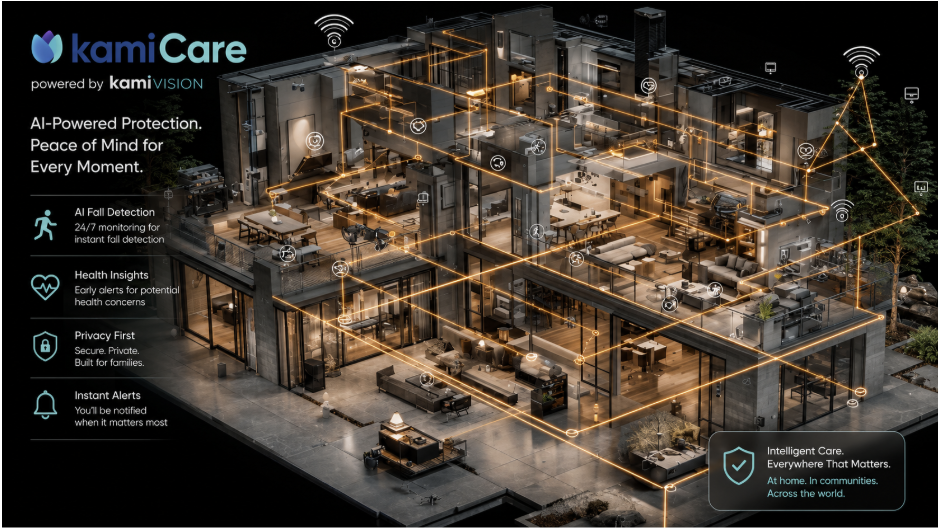
Image Credit: Kami Vision
The Broader Significance: AI That Addresses a Structural Social Problem
Fall-related healthcare costs in the United States exceed $80 billion annually. Healthcare spending on these injuries is projected to exceed $101 billion by 2030 as the population ages. One in four older adults falls every year. 14 million falls are reported annually. These are not niche statistics — they describe one of the most predictable and costly challenges in the entire U.S. healthcare system.
What makes Kami Vision’s approach notable in the context of AI development more broadly is its orientation toward deployment reliability over benchmark performance. The field of AI tends to celebrate capability advances — larger models, higher scores on standardized evaluations, more impressive demonstrations. Kami Vision’s work represents a different value system: building systems that work consistently in messy, real-world conditions, on problems where failure has human consequences.
That orientation — practical deployment, institutional validation, iterative refinement against real clinical outcomes — is increasingly recognized as the difference between AI that generates interest and AI that generates impact. Elder care is a domain where the stakes are high enough, the problem is well-defined enough, and the technology is mature enough that genuine impact is achievable now.
Kami Vision is not waiting for the next model generation to begin. The consumer rollout expected later in 2026 represents the first large-scale test of whether four years of institutional AI deployment can translate into the kind of ambient, multi-modal care infrastructure that an aging society genuinely needs. The architecture is in place. The data foundation is real. The sensor ecosystem is expanding.
The question now is how quickly the rest of the industry — in healthcare, IoT, and AI — recognizes what is being built.