Generative design has raced ahead of the workshop. A geometry that looks brilliant on screen is only worth something when it can be cut, held, measured, and afforded at the volume you actually need.
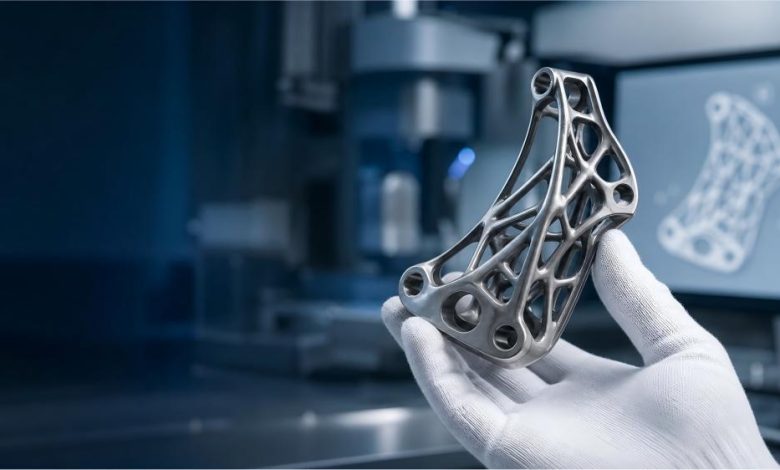
Feed a generative design tool a load case and a set of constraints and it will hand back a shape no engineer would have drawn by hand. Organic webs, lattices, walls that thicken and thin in ways that follow the stress and nothing else. On screen it looks like the future of engineering, and in a real sense it is. The optimization is genuine, and the part is often lighter, stiffer, or cooler than anything a person would have proposed.
Then the model reaches someone like me, on the manufacturing side, and a quieter question starts. Can we actually make this. Not once, for a photo, but repeatedly, to a tolerance, out of a material that behaves, at a price the program can bear.
That question is where a lot of AI-generated design still runs aground.
A model is not a part
A design is not real when it renders. It is real when it can be produced to specification, again and again, at a cost the product can carry. AI has made the first half of that sentence almost free. You can now explore thousands of candidate geometries in the time it used to take to sketch one. The second half has not moved nearly as fast, because it is bound by physics, materials, and process, and those do not respond to a better algorithm.
The result is a widening gap between what can be designed and what can be built. Closing it is not a software problem. It is a manufacturing one, and it is the constraint that decides whether AI-driven design ships product or stays in a slide deck.
Where the geometry meets the floor
Every AI-generated part, however it was conceived, has to be made by some real process, and every process has a window it can work inside.
A freeform, organic three-dimensional shape usually points toward additive manufacturing, which is the natural home for geometry that could not be molded or cut. Additive has its own limits, though, and they bite exactly where generative design gets ambitious. Internal channels can be impossible to reach and clean. Support structures have to be removed from surfaces the optimizer never expected anyone to touch. Surface finish and dimensional accuracy often need a second, subtractive operation to meet spec. The freedom is real, and so is the post-processing bill.
Intricate flat and thin-section geometry lives at the other end, where fine features are cut directly into metal. That work has its own boundaries: a minimum feature size, a workable thickness range, a heat-affected zone that has to be controlled, and a material list that is wide but not infinite. A generative pattern that ignores those numbers is a drawing, not a part.
Tolerance and measurement are the next wall. An optimizer treats a dimension as exact. The real part carries a tolerance band, a surface texture, and the awkward fact that a feature you cannot measure is a feature you cannot certify. A shape that assumes perfect geometry quietly assumes a metrology capability that has to exist somewhere.
Material is the wall people forget. The optimization runs on a clean material model. The real metal has grain, heat sensitivity, residual stress, and, in additive parts, properties that change with build direction. A structure tuned for an idealized material can be undone by how that material actually behaves once it is cut, melted, or formed.
The trap of designing with no one from the floor in the room
The failure mode is easy to fall into. A generative tool can produce a mountain of candidate geometries, and if none of them respect how parts are actually made, the output is un-manufacturable brilliance. What follows is a redesign loop, a scramble to simplify the shape enough to build, or a part that only ever exists as a render and a single fragile prototype.
The teams getting real value do the opposite. They treat manufacturing constraints as inputs to the generative process, not as a review at the end. The minimum feature the process can hold, the material that will be used, the tolerance that can be measured, the volume the part will run at, all of it goes in before the optimizer starts, so the shapes it explores are shapes that can be produced. Design for manufacturability stops being a gate the design has to pass and becomes part of the prompt.
The pairing that actually works
There is a genuinely useful shift underneath all of this, and it is not the design tool on its own. It is what happens when AI-driven design is matched with manufacturing that is not locked to a fixed tool.
When making a part does not require a dedicated die or mold, a new geometry can go from file to physical part without weeks of tooling in between. That is true of additive for freeform shapes, and it is true of precision subtractive methods that cut complex features straight from a digital file. In both cases the design and the process share the same language, a file, which means the output of a generative tool can be turned into something real and then revised again quickly. That loop is what makes AI-generated geometry practical rather than a demonstration.
The honest boundary still holds. For a mature, high-volume part built to a settled design, dedicated tooling remains the cheapest way to produce it, and generative complexity rarely earns its place there. Where AI-driven design pays off is in custom, high-value, and low-to-mid volume work, the parts where the geometry is doing something clever and the volume does not justify a die. That is a real and growing space, and it is exactly where flexible manufacturing and generative design reinforce each other.
Change the question
The interesting question is no longer whether AI can design a part. On that front the answer is close to yes, and getting more so. The question that decides whether any of it reaches a customer is different. Can we make this geometry, hold it to tolerance, measure it, and afford it at the volume we need.
Manufacturability is the real constraint on AI-driven design, and it is the one that too many projects discover last. The organizations pulling ahead put it first. They bring the process, the material, and the metrology into the design loop early, and they pair their generative tools with manufacturing that can turn a file into a part without a tooling penalty.
AI has made it almost free to imagine a component. It has not changed what it takes to make one. The value shows up only when the shape a model dreams up can be cut or built, finished, measured, and shipped, reliably and at cost. Until then, an optimized geometry is a very sophisticated picture of a part that does not yet exist.